Ethereum Price Surges to $1,890 Amidst Stunning V-Shaped Recovery Pattern
Global, May 2025: The price of Ethereum has surged to approximately $1,890, a significant milestone that has captured the attention of the cryptocurrency market. This move coincides with a notable analysis from Fundstrat Global Advisors’ Tom Lee, who points to Ethereum’s historical tendency for dramatic “V-shaped” rebounds following major corrections. Simultaneously, the network’s underlying fundamentals show unprecedented strength, with a record 4 million ETH waiting in a validator queue that now stretches an estimated 71 days, signaling intense institutional and retail demand for Ethereum staking.
Ethereum Price Action and the V-Shaped Recovery Thesis
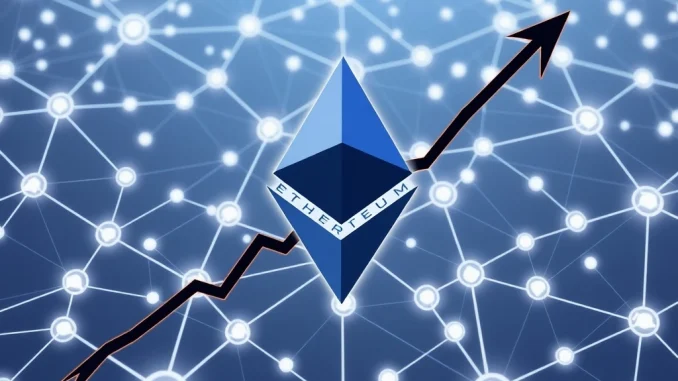
Ethereum’s recent price movement to the $1,890 level represents a critical test of a key psychological and technical resistance zone. Market analyst Tom Lee has drawn attention to a compelling historical pattern for the asset. According to his research, Ethereum has demonstrated a V-shaped recovery—a sharp decline followed by an equally sharp and swift rebound to previous highs—following all eight instances where it experienced a decline of 50% or more since 2018. This pattern suggests a resilient network effect where sell-offs are rapidly met with aggressive buying pressure from long-term believers and new entrants. The current rally appears to be testing this historical precedent, offering a data-driven narrative for the recent bullish momentum beyond mere speculation.
Record-Breaking Demand in Ethereum’s Staking Ecosystem
While price action garners headlines, the most profound story for Ethereum may be unfolding on-chain. The transition to a Proof-of-Stake consensus mechanism via “The Merge” has created a new fundamental metric: staking participation. Data reveals that approximately 30.3% of Ethereum’s total supply, equating to 36.7 million ETH, is now locked in staking contracts. This represents a massive, long-term commitment of capital to the network’s security. The demand to become a validator is so high that a queue has formed. Currently, a record 4 million ETH—worth over $7.5 billion at current prices—is waiting to be activated. With the protocol limiting how many new validators can join per day, this queue has ballooned to an estimated wait time of 71 days. This backlog is a clear, quantitative signal of overwhelming confidence in Ethereum’s long-term viability from its participants.
The Mechanics and Implications of the Validator Queue
The validator queue is a direct function of Ethereum’s protocol design, which limits the number of new validators that can enter the active set in each epoch (approximately every 6.4 minutes) to ensure network stability. The current 71-day wait time is a historical high, indicating that the rate of new ETH being committed to staking far outpaces the protocol’s ability to onboard it. This creates several immediate implications. First, it acts as a constant, underlying buy-and-lock pressure on ETH supply. Second, it suggests that staking, which offers annual percentage yields (APY), is being viewed as a core investment strategy rather than a short-term trade. Finally, the queue itself can influence market psychology, as participants may front-run the anticipated locking of millions more ETH, potentially adding upward pressure on the price.
Historical Context and Network Resilience
To understand the significance of Tom Lee’s V-shaped recovery observation, one must consider Ethereum’s volatile history. Since its launch, Ethereum has weathered multiple crypto winters, scaling debates, and significant protocol upgrades. Each 50%+ drawdown was triggered by different macro or crypto-specific events, such as the 2018 ICO bust, the 2020 March COVID crash, or the 2022 bear market induced by macroeconomic tightening. The consistent pattern of a V-shaped recovery speaks to the network’s foundational utility. Developers continue to build decentralized applications (dApps) on Ethereum, and its position as the primary settlement layer for decentralized finance (DeFi) and non-fungible tokens (NFTs) creates inherent demand that resurfaces after periods of panic. The current staking metrics provide a new, fundamental pillar supporting this resilience that did not exist in previous cycles.
Comparing Market Drivers: Then and Now
The drivers behind Ethereum’s price and network activity have evolved substantially. Earlier cycles were predominantly fueled by speculative trading and the ICO boom. Today, while speculation remains, it is underpinned by tangible, yield-generating activity like staking and DeFi. The table below contrasts key metrics from a previous recovery period with the current environment:
| Metric | 2020-2021 Recovery Phase | 2024-2025 Current Phase |
|---|---|---|
| Primary Catalyst | DeFi Summer, Institutional Entry | Post-Merge Staking, ETF Anticipation |
| % of Supply Locked | ~10% in DeFi (variable) | ~30.3% in Staking Contracts (non-circulating) |
| Network Revenue Source | Gas Fees (Proof-of-Work) | Gas Fees + Staking Economics (Proof-of-Stake) |
| Key Narrative | “Digital Oil” / Settlement Layer | “Internet Bond” / Yield-Generating Asset |
This shift highlights a maturation in Ethereum’s value proposition, moving from pure utility to a combination of utility and structured crypto-economic security.
Conclusion: A Convergence of Technical and Fundamental Factors
The Ethereum price reaching $1,890 is not an isolated event. It represents a convergence of a historically observed technical pattern—the V-shaped recovery highlighted by Tom Lee—with a powerful and measurable fundamental shift: the unprecedented locking of supply through staking. The 71-day validator queue for 4 million ETH demonstrates a level of committed, long-term demand that provides a solid floor for the asset. While past performance is never a guarantee of future results, the current market structure for Ethereum is arguably stronger than during any previous recovery attempt. The network has successfully navigated its most significant technological upgrade and is now seeing its security model validated by billions of dollars in patient capital. As the staking queue gradually clears and more ETH becomes illiquid, the fundamental supply-demand dynamics will continue to be a critical factor for the Ethereum price alongside broader market trends.
FAQs
Q1: What is a “V-shaped recovery” in financial markets?
A V-shaped recovery describes a scenario where an asset’s price experiences a steep and rapid decline, followed by an equally sharp and swift rise back to its previous level, forming a “V” pattern on a chart. It indicates a strong, rapid resurgence in demand after a sell-off.
Q2: Why is there a queue to stake Ethereum?
Ethereum’s protocol is designed to add new validators to the network at a controlled rate for security and stability reasons. When the number of people wanting to stake ETH exceeds this rate, a queue forms. The current 71-day wait shows demand is significantly higher than the protocol’s current onboarding capacity.
Q3: What does it mean that 30.3% of ETH is locked in staking?
It means over 36 million ETH tokens are actively being used to secure the Ethereum blockchain in its Proof-of-Stake system and are not available to be sold or traded on the open market. This reduces the circulating supply, which can impact price economics.
Q4: Who is Tom Lee and why is his analysis significant?
Tom Lee is a managing partner and the head of research at Fundstrat Global Advisors, a well-known financial research firm. He is a prominent figure in mainstream financial analysis of cryptocurrencies, and his observations often carry weight with both crypto-native and traditional finance audiences.
Q5: Does staking Ethereum guarantee a profit if the price rises?
No. Staking provides rewards in the form of additional ETH, similar to interest. Your overall profit or loss depends on the price of ETH when you sell your staked assets versus when you bought them. Staking rewards add to your holdings, but the value of those holdings still fluctuates with the market price.
Related News
- Bitcoin Price Might Never Dip Below $70,000 Again After The US Elections, Here's Why
- Silencio Network Officially Launches, Revolutionizing Noise Data Collection Globally
- Crypto Futures Liquidated: A Staggering $531 Million Hour Sparks Market Tremors
Related: KuCoin Web3 Wallet and Aztec Network Launch Revolutionary $AZTEC Mario Challenge Airdrop
Related: Tokenization Breakthrough: TitanRWA Joins RubberVerseX to Digitize Global Rubber Supply Chains
Related: Bitcoin P2MR Upgrade: Quantum-Resistant Protocol Merged to Secure Network Future