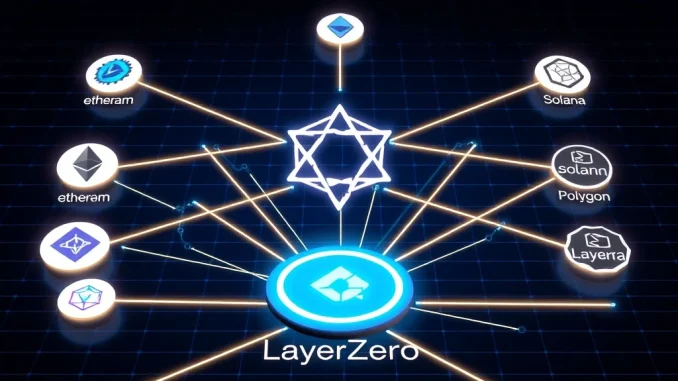
Cardano LayerZero Integration Unleashes Monumental Cross-Chain Expansion
Global, May 2025: The Cardano blockchain has approved a foundational integration with the omnichain interoperability protocol LayerZero, marking its most significant cross-chain expansion to date. This strategic move connects the proof-of-stake network to over 150 blockchains and more than 400 digital assets, fundamentally reshaping its role in the decentralized finance (DeFi) ecosystem. The integration, finalized through Cardano’s on-chain governance process, provides direct access to an estimated $80 billion in omnichain liquidity and will utilize the Stargate bridge to facilitate native asset transfers, eliminating the need for wrapped tokens.
Cardano LayerZero Integration: A Technical Breakdown
The core of this upgrade lies in implementing LayerZero’s lightweight messaging protocol. Unlike traditional bridges that often rely on centralized custodians or complex multi-signature schemes, LayerZero enables smart contracts on Cardano to communicate directly and securely with contracts on any other connected chain. This is achieved through a decentralized network of oracles and relayers that independently verify and transmit transaction proofs. For Cardano developers, this means they can now build decentralized applications (dApps) that natively interact with assets and logic on Ethereum, Solana, Avalanche, and the dozens of other networks in LayerZero’s ecosystem. The technical proposal, which underwent extensive peer review by the Cardano developer community, emphasizes security and minimal trust assumptions, aligning with the network’s rigorous academic philosophy.
The Impact on DeFi and Omnichain Liquidity
This integration directly addresses one of Cardano’s historical challenges: fragmented liquidity. By tapping into LayerZero’s Stargate bridge, Cardano instantly gains access to a shared liquidity pool spanning the vast majority of the DeFi landscape. The implications are profound. Users can move assets like USDC or ETH natively onto Cardano to leverage its lower transaction fees and growing dApp suite, then move them back just as easily. This fluid movement of capital is expected to accelerate development on Cardano, as projects no longer need to bootstrap liquidity in isolation. Furthermore, it enables novel financial primitives, such as omnichain lending markets where collateral posted on one chain can secure a loan on another, all settled on Cardano’s secure settlement layer.
Historical Context and the Evolution of Interoperability
Cardano’s journey toward interoperability has been methodical. Initial efforts focused on sidechains and partner chains using shared security models. The LayerZero integration represents a strategic pivot toward a more generalized, protocol-agnostic standard. This mirrors a broader industry trend away from isolated “walled garden” blockchains and toward interconnected networks, often called the “Internet of Blockchains.” The decision follows similar integrations by other major Layer 1 networks and underscores a competitive necessity in the current market. For context, prior to this, Cardano users relied on a handful of project-specific bridges, which often involved wrapped assets and presented security and liquidity risks. This upgrade consolidates and secures that cross-chain functionality under a single, widely-audited standard.
Stargate Bridge and the End of Wrapped Token Reliance
A key component of this expansion is the deployment of LayerZero’s Stargate bridge. Stargate’s primary innovation is enabling the transfer of native assets, as opposed to wrapped or synthetic versions. When a user sends native USDC from Ethereum to Cardano via Stargate, the protocol locks the tokens on Ethereum and mints an equivalent amount of native USDC on Cardano through a canonical representation. This process eliminates the counterparty risk and redeemability issues associated with wrapped tokens issued by individual bridge operators. The table below outlines the key differences between the old and new cross-chain models for Cardano.
| Feature | Previous Model (Wrapped Assets) | New Model (LayerZero/Stargate) |
|---|---|---|
| Asset Type | Bridged, wrapped tokens (e.g., wETH, wBTC) | Canonical, native representations |
| Security Model | Varies per bridge; often centralized or multi-sig | Decentralized oracle/relayer network |
| Liquidity Source | Isolated to each bridge’s pool | Shared across 150+ chains via unified pools |
| Developer Experience | Custom integrations for each bridge | Unified SDK and messaging layer |
| User Experience | Multiple steps, different interfaces | Streamlined, unified flow via Stargate |
Real-World Consequences for Developers and Users
The practical effects of this integration will manifest in several ways. For developers, the barrier to building cross-chain applications on Cardano has dropped significantly. They can now compose functions from multiple ecosystems, potentially creating more powerful and feature-rich dApps. For end-users, the experience of using Cardano’s DeFi will become seamless. A user could, for example:
- Provide liquidity on an Ethereum-based Automated Market Maker (AMM).
- Use that liquidity position as collateral to borrow ADA on a Cardano lending protocol.
- Use the borrowed ADA to participate in a Cardano-based governance vote.
This complex, cross-chain financial activity, executed without ever manually bridging assets or managing multiple wallets, represents the promised future of omnichain finance.
Conclusion
The Cardano LayerZero integration is a transformative infrastructure upgrade that moves the network from a standalone ecosystem to a central hub in the omnichain universe. By enabling secure, native cross-chain transfers and accessing over $80 billion in shared liquidity, Cardano positions itself to capture the next wave of DeFi innovation and user adoption. This expansion is not merely a technical feature addition; it is a strategic necessity that enhances Cardano’s utility, security, and long-term viability in an increasingly interconnected blockchain landscape. The successful implementation will be closely watched as a benchmark for how proof-of-stake networks can achieve scalable, secure interoperability.
FAQs
Q1: What is the LayerZero protocol?
LayerZero is an omnichain interoperability protocol that allows blockchains to exchange messages and value directly. It uses a decentralized network of oracles and relayers to verify transactions, enabling smart contracts on different chains to communicate without relying on a central intermediary.
Q2: How does this integration benefit Cardano (ADA) holders?
ADA holders benefit from increased utility and demand for the Cardano network. As more developers build cross-chain applications and more users bring external assets onto Cardano, network activity and the value of the ecosystem should rise. It also allows ADA to be used more easily in applications on other chains.
Q3: What is the Stargate bridge and why is it important?
Stargate is LayerZero’s native asset bridge. It allows users to transfer tokens like USDC or ETH in their original, canonical form instead of as wrapped versions. This reduces complexity and eliminates the counterparty risk associated with wrapped tokens from smaller bridge operators.
Q4: Does this integration compromise Cardano’s security?
The integration is designed with security as a priority. LayerZero’s model does not require Cardano to modify its core consensus mechanism. The security of cross-chain messages depends on the decentralized oracle and relayer network, which has undergone significant audits. The implementation on Cardano was subject to its standard peer-review process.
Q5: When will users be able to use the LayerZero bridge on Cardano?
Following the governance approval, the integration enters a deployment and testing phase. Core infrastructure, including the Stargate bridge deployment, must be configured and audited. Wallet and front-end interfaces need to be updated. A public launch date will be announced by the Cardano development teams and the LayerZero foundation, typically within a few months of the governance vote.
Related News
- Ethereum Merge Scheduled to Launch in September
- Crypto Futures Liquidation Crisis: $350 Million Vanishes in One Hour Amid Market Turmoil
- Revolutionary Crypto.com Institutional Custody: Unlocking Secure SUI Token Custody for Global Investors
Related: Transak MegaETH Integration: The Revolutionary Fiat Gateway Bringing Instant ETH to 10 Million Users
Related: Playnance Revolutionizes Web3 Social Gaming with Groundbreaking 50/50 Revshare and Daily Payouts
Related: Financial Literacy in Dating: The Surprising New Priority Beating Love