Groundbreaking: $2.6 Trillion Citigroup Tokenizes Trade Finance Deal on Solana
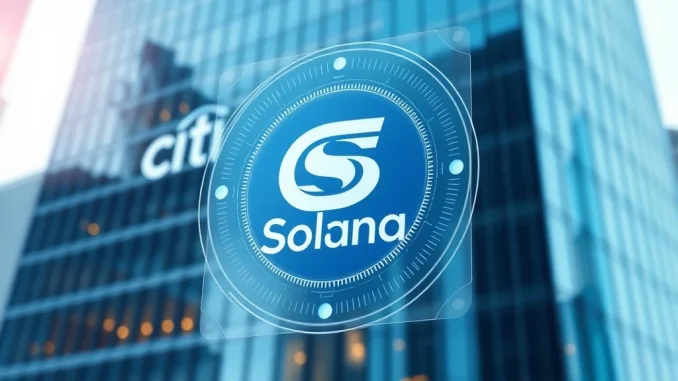
New York, April 2025: In a landmark move for institutional blockchain adoption, financial behemoth Citigroup has successfully executed a full-scale trade finance transaction by tokenizing a bill of exchange on the Solana blockchain. This Citigroup tokenizes trade finance initiative represents one of the most significant real-world deployments of blockchain technology by a global systemically important bank, moving a traditional financial instrument from issuance to final settlement entirely on-chain. With over $2.6 trillion in assets and operations spanning more than 160 countries, Citi’s pilot signals a profound shift in how the world’s largest financial institutions view public blockchain infrastructure for core business functions.
Citigroup’s Pioneering Tokenization on Solana
Citigroup conducted this proof-of-concept using its proprietary Citi Digital Assets Platform (CIDAP). The platform facilitated the creation, issuance, and settlement of a digital representation of a bill of exchange—a centuries-old instrument used to guarantee payment in international trade. The critical differentiator in this test was the use of a public, permissionless blockchain, Solana, rather than a private, permissioned ledger. This choice underscores a growing institutional confidence in the scalability and finality of certain public networks for high-value transactions. The deal was not a simulation; it involved real assets and tested the complete lifecycle of a trade finance instrument, demonstrating practical utility beyond theoretical exploration.
The Mechanics and Significance of On-Chain Settlement
The completion of issuance to settlement fully onchain eliminates multiple intermediaries typically involved in trade finance, such as correspondent banks and clearinghouses. This process traditionally takes days and involves significant manual paperwork and reconciliation. On the Solana blockchain, settlement becomes near-instantaneous and programmatically verifiable. The implications for efficiency, cost reduction, and risk mitigation are substantial. For global trade, which moves over $32 trillion in goods annually, even marginal improvements in settlement times and transparency can unlock billions in working capital and reduce fraud.
- Transparency: All parties to the transaction can view the same immutable record of ownership and payment obligations.
- Speed: Settlement occurs in seconds, compared to the standard 5-10 day window for documentary trade.
- Automation: Smart contracts can automatically execute payments upon fulfillment of digitally-verified conditions, reducing operational overhead.
Context: The Institutional March Toward Digital Assets
Citigroup’s test did not occur in a vacuum. It follows a clear trajectory of cautious but accelerating institutional adoption. Major banks like JPMorgan with its Onyx network and HSBC with its Orion platform have been exploring tokenization, often on private blockchains. Citi’s choice of Solana, known for its high throughput and low transaction costs, suggests a strategic evaluation of public chains for specific use cases where network effects and interoperability are valuable. Furthermore, Citi’s announced plan to launch a digital asset custody service for institutional clients in 2026 provides crucial context. This trade finance pilot serves as foundational R&D, building internal expertise and proving technological viability ahead of offering broader crypto services to clients.
Why Solana? Analyzing the Blockchain Selection
For a transaction requiring security, speed, and finality, Citigroup’s selection of Solana over other blockchains is analytically significant. While Ethereum dominates in decentralized finance (DeFi) and smart contract value, its transaction fees and speeds can be variable. Solana’s architecture is designed for high throughput, currently processing thousands of transactions per second at a fraction of a cent per transaction. For a high-volume, low-margin business like trade finance, this economic and performance profile is highly attractive. The table below contrasts key attributes relevant to institutional tokenization:
| Attribute | Relevance to Trade Finance Tokenization |
|---|---|
| Transaction Finality | Swift, predictable finality is non-negotiable for legal and financial certainty in trade settlements. |
| Transaction Cost | Low, predictable fees make micro-transactions and high-frequency settlements economically feasible. |
| Network Uptime & Stability | Institutions require carrier-grade reliability; any downtime directly translates to financial risk. |
| Developer Ecosystem | A robust ecosystem provides tools, auditing services, and talent to build and secure enterprise applications. |
Future Implications and the Road to 2026
The successful test paves a direct path toward Citi’s planned 2026 crypto custody launch. Custody—the secure storage of cryptographic keys—is the foundational service required for any broader institutional activity in digital assets. By first proving it can manage the lifecycle of a tokenized asset on-chain, Citi builds the operational and compliance muscle needed for custody. This move also pressures competitors and encourages standardization across the banking industry. Regulatory bodies, particularly in the United States, the European Union, and Singapore, are closely watching these developments as they craft rules for tokenized traditional assets. Citi’s real-world data will inform both internal policy and external regulation.
Conclusion
Citigroup’s decision to tokenize a trade finance deal on Solana is a definitive milestone, moving blockchain application in finance from pilot purgatory to production-grade testing. It validates the use of public blockchains for complex, real-world institutional finance and signals a strategic commitment from one of the world’s largest banks. As Citi and its peers continue to bridge traditional finance with digital asset infrastructure, the efficiency gains for global trade could be transformative. This Citigroup tokenizes trade finance event is not just a technical test; it is a clear indicator that the future architecture of global finance is being built on-chain.
FAQs
Q1: What exactly did Citigroup tokenize on Solana?
Citigroup tokenized a bill of exchange, which is a legally binding financial instrument used in international trade to guarantee that an importer will pay an exporter a specific sum by a certain date. They created a digital representation of this instrument on the Solana blockchain.
Q2: Why is using a public blockchain like Solana significant for a bank?
Most previous bank-led tokenization projects used private, permissioned blockchains. Using a public chain like Solana demonstrates a willingness to engage with open, interoperable infrastructure, which can enhance liquidity, enable broader network participation, and leverage the security of a larger decentralized validator set.
Q3: What is the Citi Digital Assets Platform (CIDAP)?
CIDAP is Citigroup’s internal platform for exploring, developing, and deploying digital asset and blockchain-based solutions. It serves as the bank’s sandbox and gateway for experimenting with tokenization, smart contracts, and crypto-related services before offering them to clients.
Q4: How does tokenization benefit traditional trade finance?
Tokenization can drastically reduce processing times from days to minutes, lower costs by cutting intermediaries, minimize fraud through transparent tracking, and unlock capital by allowing tokenized invoices or obligations to be used as collateral in new, digitally-native financial markets.
Q5: What does Citi’s planned 2026 crypto custody service have to do with this test?
The trade finance tokenization pilot is a foundational step. It allows Citi to develop secure, compliant processes for handling digital asset lifecycles on-chain. This operational experience is directly applicable and essential for launching a regulated, institutional-grade custody service for client assets in 2026.
Related News
- SUI Cryptocurrency Launches on HashKey Exchange: A Strategic Leap for Regulated Spot and OTC Trading
- What is Crypto Arena & Where its been located?
- Urgent Warning: Bithumb Designates LEVER as Closely Monitored Asset
Related: Transak MegaETH Integration: The Revolutionary Fiat Gateway Bringing Instant ETH to 10 Million Users
Related: Playnance Revolutionizes Web3 Social Gaming with Groundbreaking 50/50 Revshare and Daily Payouts
Related: Financial Literacy in Dating: The Surprising New Priority Beating Love