OKX Wallet and Ledger Forge Powerful Alliance – DEX API Integration Unlocks Unprecedented On-Chain Liquidity
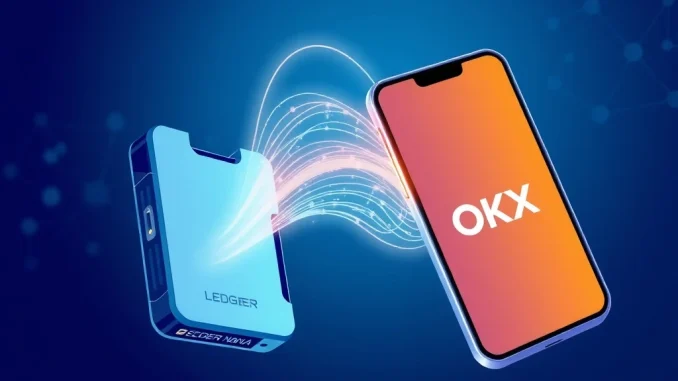
Global, April 2025: In a significant move for the decentralized finance (DeFi) ecosystem, OKX Wallet and Ledger have announced a strategic integration. This collaboration connects OKX Wallet’s sophisticated Decentralized Exchange (DEX) API directly with Ledger’s renowned hardware wallet infrastructure. The partnership fundamentally reshapes how users interact with on-chain assets, providing a seamless bridge between top-tier security and expansive, deep liquidity across thousands of Ethereum Virtual Machine (EVM) compatible tokens.
OKX Wallet and Ledger Integration Redefines Secure DeFi Access
The core of this announcement is the technical integration of OKX Wallet’s DEX aggregation API into the Ledger Live application and compatible wallet interfaces. For users, this means they can now initiate trades, swap tokens, and interact with decentralized applications (dApps) directly from an interface connected to their Ledger device, without ever compromising the private keys stored offline on the hardware wallet. The API aggregates liquidity from hundreds of DEXs across multiple EVM-compatible blockchains, including Ethereum, Polygon, Arbitrum, and Avalanche. Consequently, it sources optimal prices by scanning order books and liquidity pools in real-time, a process that mitigates price slippage and maximizes value for the trader. This integration represents a maturation in the industry, moving beyond simple wallet connectivity to a unified experience that prioritizes both security and execution quality.
The Mechanics of Enhanced On-Chain Liquidity
On-chain liquidity refers to the depth and availability of assets within decentralized liquidity pools on blockchains. Prior to aggregators, users often had to manually check multiple DEXs to find the best rate, a time-consuming and inefficient process. The OKX DEX API solves this by functioning as a sophisticated router. When a user requests a swap, the API performs a complex series of operations behind the scenes:
- Liquidity Source Scanning: It queries all integrated DEXs and liquidity pools for the desired trading pair.
- Optimal Route Calculation: Using algorithms, it determines the most cost-effective path, which may involve a single trade or a multi-hop route through several intermediate tokens to achieve a better final price.
- Price Impact Analysis: It calculates the potential slippage for the trade size and recommends the pool with the deepest liquidity to minimize it.
- Secure Transaction Signing: The final transaction is passed to the user’s Ledger device for secure, offline signing before being broadcast to the blockchain.
This technical synergy means Ledger users no longer need to choose between the gold-standard security of cold storage and the dynamic, competitive world of DeFi trading. They can now access the latter from the safety of the former.
A Historical Context: The Evolution of Wallet Security and Utility
The partnership between OKX and Ledger is a landmark in a longer narrative of cryptocurrency wallet development. In the early years, users faced a binary choice: convenient, web-connected “hot” wallets susceptible to hacking, or ultra-secure but functionally isolated “cold” wallets like Ledger. The rise of DeFi after 2020 created a tension, as engaging with new financial protocols required connectivity that seemed at odds with cold storage principles. Initial solutions involved “connecting” a hardware wallet to a web browser, but the user experience was often fragmented. The current integration represents a next-generation solution. It embeds powerful DeFi functionality directly into the secure ecosystem, reflecting an industry-wide push towards creating seamless, secure, and comprehensive user experiences that do not force compromises on safety or access.
Implications for the Broader Cryptocurrency Ecosystem
This collaboration has several immediate and long-term implications for various market participants. For the average user, it dramatically lowers the technical barrier to secure DeFi participation. Retail investors can engage with a vast array of tokens with confidence, knowing their assets remain in cold storage. For institutional players, the integration provides a compliant and secure on-ramp to decentralized liquidity, a growing requirement for treasury management and investment strategies. Furthermore, the move validates the aggregator model as critical infrastructure. By choosing to integrate OKX’s API, Ledger signals that liquidity aggregation is now a baseline expectation for a premium wallet service, not an optional add-on. This could pressure other wallet and security providers to form similar alliances, accelerating innovation and consolidation in the wallet service sector.
| Feature | Traditional Hardware Wallet Use | With OKX DEX API Integration |
|---|---|---|
| Token Access | Limited to assets supported natively or via manual dApp connection. | Access to thousands of EVM tokens across aggregated DEXs. |
| Price Optimization | Manual checking across platforms; often suboptimal pricing. | Automatic scanning for deepest liquidity and best price execution. |
| Security Posture | Keys remain offline; high security. | Keys remain offline; high security with enhanced utility. |
| User Workflow | Fragmented between wallet, explorer, and multiple DEX interfaces. | Unified, seamless experience within the Ledger ecosystem. |
The Critical Role of EVM Compatibility
The focus on EVM-compatible tokens is a strategic and logical one. The Ethereum Virtual Machine has become the de facto standard for smart contract execution, with a vast majority of DeFi activity, Total Value Locked (TVL), and developer mindshare residing within its ecosystem and its layer-2 scaling solutions. By targeting EVM chains, the OKX-Ledger integration immediately serves the largest and most active segment of the DeFi market. This broad compatibility ensures users are not locked into a single blockchain but can explore opportunities across a multi-chain landscape from a single, secure entry point. It future-proofs the service, as new EVM-compatible chains can be integrated into the API’s backend with relative ease, continuously expanding the available liquidity universe for Ledger users.
Conclusion
The integration of OKX Wallet’s DEX API with Ledger hardware wallets marks a pivotal step towards a more secure, liquid, and user-friendly decentralized financial future. It successfully bridges two critical pillars of the cryptocurrency experience: uncompromising asset security and efficient access to global on-chain liquidity. This partnership not only enhances the practical utility of Ledger devices but also strengthens the overall DeFi infrastructure by bringing more secured assets into the liquidity ecosystem. For users, the message is clear: they no longer must sacrifice yield or opportunity for safety. This development underscores the ongoing maturation of the crypto industry, where strategic alliances are solving complex user experience challenges, ultimately driving broader adoption and a more robust on-chain economy.
FAQs
Q1: What exactly does the OKX and Ledger integration do?
A1: It integrates OKX Wallet’s DEX aggregation API into Ledger’s services. This allows Ledger hardware wallet users to search for, compare, and execute token swaps across hundreds of decentralized exchanges directly from a Ledger-connected interface, while their private keys remain securely offline on the hardware device.
Q2: Do I need to move my crypto to OKX Wallet to use this feature?
A2: No. Your assets remain in self-custody on your Ledger device. The integration provides a software interface (via Ledger Live or other supported apps) that uses the OKX API to find the best trading routes. The transaction is always signed securely on your Ledger, meaning your keys never leave the hardware wallet.
Q3: Which cryptocurrencies and blockchains are supported?
A3: The integration focuses on EVM-compatible tokens. This includes assets on Ethereum mainnet and major Layer 2 networks like Polygon, Arbitrum, Optimism, and Avalanche, among others. It aggregates liquidity from DEXs operating on these chains, providing access to thousands of tokens.
Q4: How does this integration provide “optimal prices” and “deep liquidity”?
A4: The OKX DEX API scans multiple decentralized exchanges and liquidity pools simultaneously for the requested trade. It uses algorithms to find the route that offers the most tokens for your swap (best price), prioritizing pools with the largest amount of assets (deep liquidity) to minimize the price impact of your trade.
Q5: Is there any additional cost or fee for using this service?
A5: You will always pay the standard blockchain network (gas) fees for the transaction and any fees charged by the underlying DEXs or liquidity pools where the trade is executed. The OKX API itself may apply a small, transparent service fee for the aggregation and routing service, which would be disclosed clearly before you confirm any transaction.
Related News
- World Liberty Financial's Stunning $83.1M WLFI Transfer to Jump Trading Signals Major DeFi Strategy
- Coinbase Listing: Revolutionary WLFI Token Joins the Cryptocurrency Exchange
- MVL's TADA Targets $100M for Ambitious U.S. Ride-Hailing Expansion
Related: Strategic Stability: Strategy Inc. Unveils 'Stretch' Preferred Shares with 11.25% Dividend
Related: AI-Driven Crypto Trading Unveiled as Fraction AI Partners with Grvt to Launch 'Gravvy'
Related: Revealed: Ripple Lawyer Stuart Alderoty Details White House Stablecoin Talks Breakthrough