Danske Bank Reverses Crypto Policy: A Strategic Pivot Fueled by Regulatory Clarity
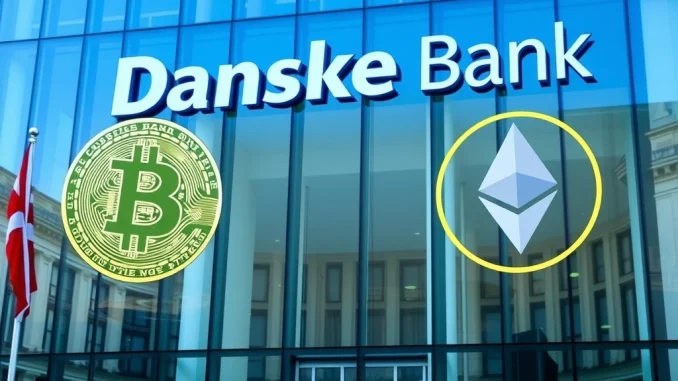
Copenhagen, Denmark – May 2025: In a significant strategic shift, Danske Bank, Denmark’s largest financial institution, has officially reversed its longstanding restrictive policy on cryptocurrency investments. The bank now provides its private banking and institutional clients with access to regulated Exchange-Traded Products (ETPs) tracking Bitcoin and Ethereum. This pivotal move, directly attributed to substantial progress in global and European cryptocurrency regulation, signals a new chapter for traditional finance’s engagement with digital assets in the Nordic region.
Danske Bank’s Crypto Policy Reversal: From Caution to Cautious Access
For nearly a decade, Danske Bank maintained a notably cautious public stance towards cryptocurrencies. Following the 2017 bull market, the bank, like many of its European peers, issued warnings to customers about the volatility and perceived regulatory uncertainties surrounding digital assets. It restricted direct purchases and discouraged exposure. The decision to now offer Bitcoin and Ethereum ETPs represents a complete reversal of that position. Importantly, the bank is not offering direct cryptocurrency trading or custody. Instead, it is leveraging a regulated, familiar financial instrument—the ETP—as a conduit. This approach allows the bank to manage risk while meeting demonstrable client demand. A Danske Bank spokesperson confirmed the change stems from a comprehensive internal review, concluding that the regulatory landscape has matured sufficiently to support such products within a controlled framework.
The Catalytic Role of Evolving Cryptocurrency Regulation
The bank’s statement explicitly cites “regulation progress” as the core rationale for its policy shift. This refers to several key developments that have fundamentally altered the risk calculus for major financial institutions. The most impactful is the full implementation of the European Union’s Markets in Crypto-Assets (MiCA) regulation. MiCA provides a comprehensive, harmonized rulebook for crypto-asset service providers across the EU, covering issuance, transparency, disclosure, and authorization. For a bank like Danske, MiCA reduces legal ambiguity and establishes clear operational standards. Concurrently, jurisdictions like Germany and Switzerland have established robust frameworks for crypto-backed securities and ETPs, creating proven blueprints. Furthermore, guidance from global standard-setters like the Financial Stability Board (FSB) and the Basel Committee on Banking Supervision on prudential treatment of crypto exposures has provided banks with the clarity needed to develop internal risk models.
Understanding the ETP Vehicle: A Bridge for Traditional Finance
Danske Bank’s choice of ETPs is a deliberate and strategic one. An Exchange-Traded Product is a regulated security that trades on traditional stock exchanges, like Nasdaq Copenhagen. The ETPs in question are physically backed, meaning a regulated custodian holds the underlying Bitcoin or Ethereum. For the client, it functions like buying a share of a company. This structure offers several advantages that align with a traditional bank’s priorities:
- Regulatory Familiarity: ETPs fall under existing EU securities laws (MiFID II), a domain where banks have deep expertise.
- Reduced Operational Risk: The bank avoids the complexities of private key custody, wallet management, and blockchain settlement.
- Accessibility: Clients can use their existing brokerage accounts, simplifying the investment process.
- Transparency: ETPs provide daily disclosure of net asset value and holdings, meeting high standards of investor protection.
This model mirrors the path taken by other European banks, allowing them to participate in asset class growth while mitigating direct technological and custody risks.
Implications for the Nordic Banking Landscape and Broader Market
Danske Bank’s move is not occurring in a vacuum. It reflects and will likely accelerate a regional trend. Swedish banks, for instance, have shown varying degrees of openness. The action by Denmark’s largest lender creates competitive pressure and serves as a powerful signal of institutional validation. Analysts anticipate other Nordic financial institutions may follow suit with similar product offerings in the coming quarters. For the broader cryptocurrency market, this development represents continued institutionalization. It provides a new, significant channel for capital inflow from a demographic—high-net-worth individuals and institutions in Northern Europe—that values stability and regulatory compliance. It further legitimizes Bitcoin and Ethereum as reference assets within a diversified portfolio, moving beyond the niche of “tech speculation” and into the realm of “alternative investment.”
A Timeline of Danske Bank’s Evolving Stance
The policy reversal is the result of a multi-year evolution. The table below outlines key milestones.
| Period | Danske Bank Stance & Action | External Catalysts |
|---|---|---|
| 2017-2018 | Issued customer warnings, restricted direct crypto purchases. | Initial Coin Offering (ICO) boom, high volatility, minimal regulation. |
| 2019-2021 | Maintained cautious public commentary, monitored market development. | Growth of institutional custody solutions, Bitcoin futures ETFs in US. |
| 2022-2023 | Began internal reviews and risk assessments on digital assets. | EU finalizes MiCA text, major asset managers launch ETPs in Europe. |
| 2024-2025 | Announced and implemented access to Bitcoin & Ethereum ETPs for clients. | MiCA implementation begins, clear banking guidance published, sustained client inquiries. |
Conclusion: A Measured Step in Finance’s Digital Transformation
Danske Bank’s reversal of its crypto policy is a landmark event, emblematic of a broader maturation within both the cryptocurrency industry and the traditional financial sector. It is not a move driven by hype, but by a calculated response to concrete regulatory progress and evolving client needs. By offering access through regulated ETPs, the bank has found a middle ground that respects its fiduciary duties while acknowledging the growing importance of digital assets. This decision strengthens the bridge between legacy finance and the crypto economy, suggesting that future integration will be characterized by structured products, clear regulation, and a persistent focus on risk management. The Danske Bank crypto policy shift will likely be studied as a case study in how major financial institutions adapt to technological innovation within the bounds of a strengthening regulatory framework.
FAQs
Q1: What exactly is Danske Bank offering?
Danske Bank is now allowing its eligible clients to buy and sell regulated Exchange-Traded Products (ETPs) that track the price of Bitcoin and Ethereum. These are securities that trade on traditional stock exchanges.
Q2: Can I buy Bitcoin directly from Danske Bank now?
No. The bank is not offering direct cryptocurrency purchases, custody, or trading. Access is exclusively through the secondary market for these specific, regulated ETP securities.
Q3: Why did Danske Bank change its policy?
The bank cites major progress in cryptocurrency regulation, specifically the EU’s MiCA framework, as the primary reason. This regulatory clarity has reduced legal and operational risks to a level the bank deems manageable for a controlled product offering.
Q4: Is this service available to all Danske Bank customers?
Initially, the service is targeted at the bank’s private banking and institutional clients. It may not be immediately available to all retail banking customers, as it involves complex financial instruments subject to suitability assessments.
Q5: What does this mean for other banks in Scandinavia?
Danske Bank’s move as the region’s largest lender sets a significant precedent. It increases competitive pressure and may encourage other Nordic banks to explore similar regulated crypto investment products for their clients in the near future.
Related News
- Altcoin Rally Momentum Weakens as Liquidity Shifts to Bitcoin and Ethereum, Revealing Critical Market Shift
- Strategic Partnership: Lunar Strategy Joins Incrypted to Propel Ukrainian Web3 Projects Globally
- Shocking Crypto Scam: Five Plead Guilty in $36.9M Fraud Against US Victims
Related: Bitcoin Volatility Surges: Binance Data Shows Highest Level Since 2022 as BTC Holds $70K