BlockDAG Mainnet Launch: The 500x Faster Ethereum Alternative Emerges as BNB and Solana Consolidate
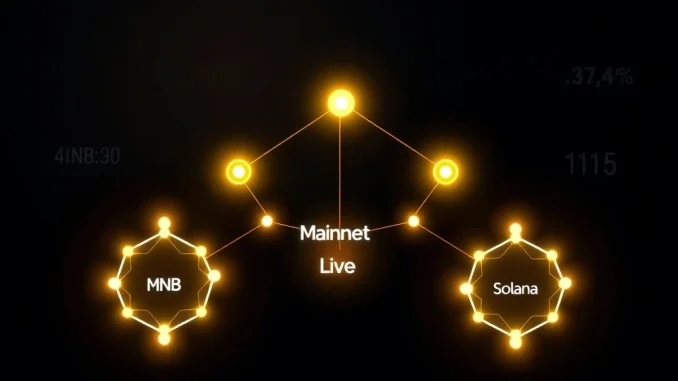
Global, February 16, 2025: The blockchain landscape witnesses a significant shift today as BlockDAG officially launches its mainnet, positioning itself as a potential 500x faster alternative to Ethereum. This development arrives during a period of consolidation for established players like BNB and Solana, creating a compelling moment for comparative analysis of blockchain architectures and market positions.
BlockDAG Mainnet Launch: Technical Architecture and Performance Claims
The activation of the BlockDAG mainnet represents the culmination of years of research and development in directed acyclic graph (DAG) technology. Unlike traditional blockchain structures that organize transactions in sequential blocks, BlockDAG employs a parallel processing model. This architecture allows multiple transactions to be confirmed simultaneously across different branches of the network graph.
Technical documentation released alongside the mainnet launch details how this parallel validation system theoretically enables significantly higher throughput. The network’s developers claim transaction finality in under two seconds, with the capacity to process tens of thousands of transactions per second (TPS). These metrics, if sustained under real-world conditions, would represent a substantial leap from Ethereum’s current base layer performance, though direct comparisons require careful contextualization of different consensus mechanisms and security models.
Comparative Analysis: BlockDAG Versus Established Blockchain Networks
Understanding BlockDAG’s position requires examining it alongside the current state of major blockchain ecosystems. The performance claims primarily contrast with Ethereum’s architecture, which, despite numerous scaling improvements through layer-2 solutions, maintains different fundamental design priorities centered around decentralization and security.
Meanwhile, the BNB Chain and Solana networks present their own distinct approaches to scalability. BNB Chain has evolved through multiple iterations focusing on high throughput for decentralized applications, while Solana employs a unique proof-of-history consensus combined with parallel execution. Both networks have experienced periods of network congestion and are currently in what market analysts describe as a consolidation phase, focusing on stability and developer adoption rather than radical architectural changes.
The Technical Distinction: DAG Versus Linear Blockchain
The core innovation behind BlockDAG lies in its departure from linear blockchain sequencing. In a traditional blockchain, validators must agree on a single chain of blocks, creating inherent bottlenecks. BlockDAG’s structure resembles a web where transactions reference multiple previous transactions, enabling validators to work on different parts of the network simultaneously.
This technical approach carries both potential advantages and challenges:
- Advantages: Parallel processing capacity, reduced confirmation times, and theoretically infinite scalability as more participants join the network
- Challenges: More complex consensus mechanisms, potential security trade-offs, and unproven resilience under extreme network conditions
Market Context: BNB and Solana Enter Consolidation Phase
As BlockDAG enters the market with its performance-focused narrative, established networks face different developmental priorities. BNB Chain has recently shifted emphasis toward enhancing its decentralized governance model and expanding its layer-2 ecosystem, following a period of rapid growth that necessitated network stability improvements.
Solana continues to recover from well-documented network outages that highlighted the challenges of maintaining both high throughput and consistent uptime. The network’s development teams have implemented multiple protocol upgrades focused on reliability, with recent quarters showing improved stability metrics. This focus on consolidation rather than radical performance claims represents a maturation phase for these established networks.
Implementation Timeline and Exchange Listings
The BlockDAG mainnet transition follows a structured rollout plan beginning February 16, 2025. This process includes the migration of tokens from the previous testnet environment, activation of network validators, and the commencement of exchange listings. The phased approach aims to ensure network stability during the initial adoption period.
Exchange support will develop gradually, with initial listings on decentralized exchanges followed by centralized platform integrations. This listing strategy mirrors patterns observed with previous blockchain launches, balancing accessibility with network stability considerations during the critical early mainnet period.
Real-World Applications and Developer Adoption Prospects
The ultimate test for any blockchain network lies in its practical utility and developer adoption. BlockDAG’s architecture theoretically supports applications requiring high-frequency microtransactions, including:
- Real-time payment systems and financial settlements
- High-throughput decentralized exchanges
- Gaming and entertainment platforms with frequent in-app transactions
- Internet of Things (IoT) device networks requiring rapid data validation
However, the network faces the classic adoption challenge confronting all new blockchain platforms: attracting developers away from established ecosystems with mature tooling, documentation, and user bases. The coming months will reveal whether BlockDAG’s performance advantages translate into tangible developer migration and innovative application deployment.
Industry Implications and Future Trajectory
The emergence of BlockDAG represents another iteration in the ongoing evolution of distributed ledger technology. Each architectural approach—from Bitcoin’s proof-of-work to Ethereum’s smart contract platform to various high-throughput alternatives—addresses different aspects of the blockchain trilemma: balancing decentralization, security, and scalability.
Industry observers note that the blockchain space increasingly resembles traditional technology markets, with different platforms specializing for particular use cases rather than pursuing universal dominance. In this context, BlockDAG’s performance-focused positioning may carve out specific niches rather than directly replacing established networks, contributing to a more diversified and application-specific blockchain ecosystem.
Conclusion
The BlockDAG mainnet launch introduces a new architectural approach to blockchain scalability during a period of consolidation for established networks like BNB and Solana. While the 500x performance claims relative to Ethereum represent ambitious technical objectives, the network’s real-world adoption will depend on multiple factors beyond raw transaction speed, including security, decentralization, developer experience, and ecosystem growth. As the blockchain industry continues maturing, such architectural diversity ultimately benefits the entire space by pushing technological boundaries and expanding possible applications for decentralized systems.
FAQs
Q1: What is BlockDAG and how does it differ from traditional blockchains?
BlockDAG is a distributed ledger technology that uses a directed acyclic graph structure instead of linear blocks. This allows parallel transaction processing, potentially enabling higher throughput and faster confirmations compared to sequential blockchain architectures.
Q2: How does BlockDAG claim to be 500x faster than Ethereum?
The performance claim is based on theoretical maximum throughput enabled by BlockDAG’s parallel processing architecture. While laboratory tests show significant speed advantages, real-world performance depends on network adoption, validator distribution, and application patterns that differ from controlled test environments.
Q3: What does “consolidation phase” mean for BNB and Solana?
Consolidation refers to a period where blockchain networks focus on stability, security improvements, developer tooling, and ecosystem growth rather than radical architectural changes or maximum throughput claims. This phase often follows periods of rapid expansion or technical challenges.
Q4: When will BlockDAG be available on major cryptocurrency exchanges?
Exchange listings began February 16, 2025, starting with decentralized platforms. Major centralized exchange listings typically follow a phased approach as networks demonstrate stability and sufficient trading volume, a process that may unfold over several weeks or months.
Q5: What are the main technical challenges facing new blockchain architectures like BlockDAG?
Primary challenges include achieving sufficient decentralization while maintaining high throughput, ensuring network security under various attack scenarios, attracting developer communities from established platforms, and building robust tooling and documentation for application development.
Related News
- Coinfest Asia 2025 Unveils Crypto’s Biggest Names and Builds a Web3 Experience Like No Other
- Cardone Capital Bitcoin Purchase: Strategic $10M Investment Signals Institutional Confidence
- Bitcoin Long-Term Holders Unleash Intensified Selling Pressure, Market Data Confirms
Related: Staggering $27.5M Loss: Crypto Trader Machi Big Brother Liquidated on Hyperliquid
Related: Online Sportsbook Evolution: Why Rookie Bettors Are Exploring New Platforms Beyond Traditional Names