Crypto Market Losses Deepen as Bitcoin and Ethereum Slide Amid Extreme Fear Gauge
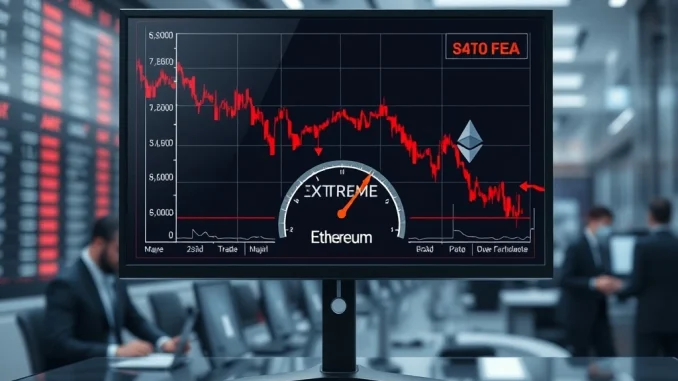
Global, May 2025: The cryptocurrency market extended its losses this week, with leading assets Bitcoin (BTC) and Ethereum (ETH) posting significant declines. This downward movement coincides with a stark reading from a key market sentiment indicator, which has plunged into “Extreme Fear” territory. The sell-off presents a complex picture, applying pressure across decentralized finance (DeFi) protocols while some segments of the non-fungible token (NFT) market demonstrate unexpected resilience.
Crypto Market Losses Intensify for Major Assets
The digital asset market entered a pronounced corrective phase over the past several trading sessions. Bitcoin, the flagship cryptocurrency, broke below several key technical support levels that analysts had been monitoring. Similarly, Ethereum, which serves as the foundational blockchain for a vast ecosystem of applications, mirrored this downward trajectory. Market data from major exchanges confirms a broad-based retreat in valuation, erasing gains accumulated during the previous quarter. This movement is not isolated to spot markets; derivatives markets also show increased volatility, with funding rates turning negative across major perpetual swap platforms. The decline has triggered a wave of liquidations in leveraged positions, exacerbating the downward price pressure as automated systems close out overextended trades.
Understanding the Extreme Fear Signal
The prevailing market mood is quantitatively captured by the Crypto Fear & Greed Index, a popular sentiment tool that aggregates data from volatility, market momentum, social media, surveys, and dominance metrics. This week, the index registered a value deep within the “Extreme Fear” zone, a level historically associated with market capitulation and heightened investor anxiety. The index operates on a scale from 0 to 100.
- 0-24: Extreme Fear
- 25-49: Fear
- 50: Neutral
- 51-74: Greed
- 75-100: Extreme Greed
Historically, prolonged periods of extreme fear have sometimes preceded market bottoms, as weak hands exit and selling pressure exhausts itself. However, analysts caution that the index is a measure of sentiment, not a timing tool or a direct price predictor. The current reading reflects a confluence of factors, including macroeconomic uncertainty, regulatory headlines, and technical breakdowns on price charts.
Historical Context of Market Sentiment Shifts
Market veterans often reference previous cycles where sentiment reached similar extremes. For instance, during the market downturn of 2022, the Fear & Greed Index spent extended periods in the Extreme Fear zone. These phases were characterized by low trading volumes, negative media coverage, and a general exodus of retail interest. Conversely, the bull market of 2021 saw the index frequently in Extreme Greed territory, often coinciding with parabolic price moves that later corrected. Understanding this pendulum swing between fear and greed is a fundamental aspect of behavioral finance within the crypto asset class. The current environment suggests a risk-off mentality has taken hold, with investors prioritizing capital preservation over speculative growth.
Diverging Trends: DeFi Dips While NFTs Find Footing
The market downturn has had a uneven impact across different cryptocurrency sectors. The decentralized finance (DeFi) ecosystem, which is closely tied to the value and utility of Ethereum and other smart contract platforms, has felt immediate pressure. Key metrics tell a clear story.
| DeFi Metric | Trend | Implied Impact |
|---|---|---|
| Total Value Locked (TVL) | Sharp Decline | Reduced capital in lending, trading, and yield protocols |
| Governance Token Prices | Underperforming ETH/BTC | Compressed valuations for protocol ownership |
| Stablecoin Yields | Contracting | Lower demand for leverage and borrowing |
In contrast, certain segments of the NFT market have displayed notable resilience. While floor prices for many profile-picture (PFP) collections have softened, trading volume for high-end digital art and collectibles on platforms like Sotheby’s Metaverse has remained stable. Furthermore, utility-focused NFTs tied to gaming, membership, and intellectual property have not experienced the same magnitude of decline as purely speculative assets. This divergence suggests a maturation within the NFT space, where value is increasingly derived from tangible utility and cultural significance rather than pure financial speculation. Some analysts interpret this as a healthy sign of market segmentation, even during a broad downturn.
The Macroeconomic Backdrop and Regulatory Landscape
The crypto market does not operate in a vacuum. Its current weakness aligns with a challenging global macroeconomic environment. Central banks continue to grapple with inflation, influencing interest rate policies that affect the attractiveness of non-yielding, high-risk assets like cryptocurrencies. Additionally, the regulatory landscape for digital assets remains in flux across major jurisdictions like the United States and the European Union. While the Markets in Crypto-Assets (MiCA) framework provides clarity in Europe, ongoing legislative debates in the U.S. create uncertainty. Institutional investors, who have become a more significant force in the market since 2020, are particularly sensitive to this regulatory uncertainty. Their cautious positioning can amplify market moves, contributing to the current risk-averse sentiment.
Conclusion
The cryptocurrency market is navigating a period of significant stress, marked by deepening crypto market losses for core assets Bitcoin and Ethereum. The plunge of the Fear & Greed Index into Extreme Fear territory objectively quantifies the prevailing negative sentiment. This environment creates distinct pressures, notably on the DeFi sector, while also revealing pockets of stability in utility-driven NFT applications. For market participants, these conditions underscore the inherent volatility of the asset class and the critical importance of fundamental analysis, risk management, and a long-term perspective that looks beyond short-term sentiment gauges. The current extreme fear reading, while daunting, represents a single data point in the ongoing evolution of the digital economy.
FAQs
Q1: What is the Crypto Fear & Greed Index?
The Crypto Fear & Greed Index is a sentiment analysis tool that compiles data from volatility, trading volume, social media, surveys, and market trends to produce a single number between 0 and 100. This number indicates whether investors are broadly fearful (low scores) or greedy (high scores), helping to gauge overall market emotion.
Q2: Why does DeFi typically dip when Bitcoin and Ethereum fall?
Many DeFi protocols are built on Ethereum and use ETH or wrapped versions of BTC as collateral. When the value of this collateral falls, it can trigger liquidations and reduce the Total Value Locked (TVL) in the system. Additionally, declining prices often lead to reduced trading activity and borrowing demand across DeFi platforms.
Q3: Has “Extreme Fear” signaled a market bottom in the past?
While not a perfect indicator, prolonged periods of Extreme Fear have historically coincided with or preceded major market lows, such as those seen in late 2018 and mid-2022. It suggests that panic selling may be exhausting itself, but it does not guarantee an immediate price reversal.
Q4: How are some NFTs rising during a general market decline?
Not all NFTs are purely financial assets. Some derive value from strong communities, gaming utility, intellectual property rights, or artistic prestige. During downturns, these “utility-based” or “blue-chip” NFTs can see more stable demand compared to speculative profile-picture collections, leading to divergent performance.
Q5: What should investors consider during periods of Extreme Fear?
Investors should review their risk tolerance, ensure their portfolio allocation aligns with their long-term strategy, and avoid making emotional decisions based on short-term price action. It is also a time to conduct fundamental research on projects, as weaker ones may falter while stronger ones endure the downturn.
Related News
- Won-Pegged Stablecoin Sparks Urgent Warning from Bank of Korea Governor
- Bitcoin Whales Defiantly Accumulate $3.2 Billion as Retail Investors Retreat
- Binance Alpha Unveils CORL: A Pivotal Leap for Early-Stage On-Chain Trading
Related: Aurora Labs Intents Widget: The Revolutionary Tool Making NEAR Intents Effortless to Embed
Related: SUI Price Analysis: Why the $0.75 Level Emerges as a Pivotal Technical Support Zone
Related: Bitcoin Ransom: FBI Confirms $6M Cryptocurrency Demand in Nancy Guthrie Kidnapping Case