STON.fi’s Revolutionary Integration Opens TON DeFi to Bitcoin and Ethereum
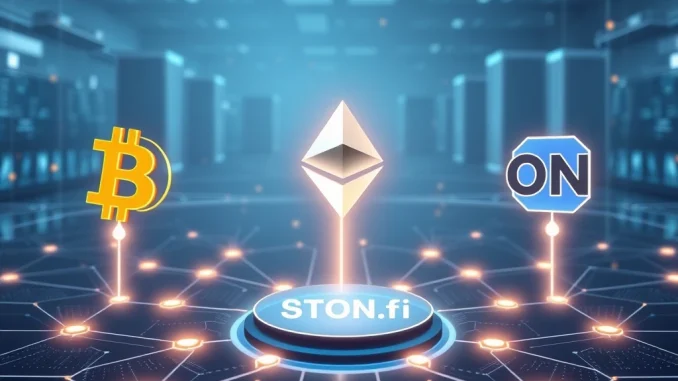
Road Town, British Virgin Islands, 11th February 2026: In a landmark development for decentralized finance, the automated market maker STON.fi has announced a comprehensive technical integration that effectively bridges The Open Network’s (TON) DeFi ecosystem with the two largest cryptocurrency networks by market capitalization: Bitcoin and Ethereum. This strategic move, confirmed in an official statement from the project’s development team, represents one of the most significant interoperability plays of the year, potentially unlocking billions in dormant liquidity and reshaping user access across blockchain frontiers.
STON.fi’s Strategic Bridge: Connecting Crypto’s Largest Economies
The core of STON.fi’s announcement centers on the deployment of secure, non-custodial cross-chain bridges and wrapped asset standards. These technological components allow Bitcoin (BTC) and Ethereum (ETH), along with major tokens from their respective ecosystems like ERC-20 standards, to be represented as native assets on the TON blockchain. Once transferred, these assets become immediately usable within STON.fi’s liquidity pools and the broader TON DeFi landscape, which includes lending protocols, yield aggregators, and NFT marketplaces. This integration directly addresses a long-standing critique of blockchain technology: isolated liquidity and fragmented user experiences. By creating a seamless conduit, STON.fi enables capital and users to flow between networks without relying on centralized exchanges as intermediaries.
Historically, DeFi activity has been concentrated on Ethereum and its Layer-2 networks, with Bitcoin largely sidelined as a non-programmable store of value. The TON blockchain, originally conceived by Telegram, has seen rapid growth in user adoption and developer activity since its community-led revival, but its DeFi total value locked (TVL) remained a fraction of Ethereum’s. This integration is a deliberate attempt to alter that dynamic. It leverages TON’s high throughput and low transaction fees as a competitive advantage, positioning it as a cost-effective settlement layer for assets originating from more congested and expensive networks.
Technical Architecture and Security Implications
The engineering challenge of connecting such disparate networks is substantial. Bitcoin uses a simple, proof-of-work based scripting language, while Ethereum and TON utilize more complex, Turing-complete virtual machines (EVM and TVM, respectively). STON.fi’s solution reportedly involves a multi-signature federation of reputable, audited node operators for the Bitcoin bridge, ensuring the BTC backing the wrapped tokens on TON remains securely locked in a transparent manner. For Ethereum, the bridge likely employs a combination of smart contracts on the origin chain and verifiable proofs on the destination chain.
Security remains the paramount concern in cross-chain operations, as evidenced by several high-profile bridge exploits in recent years. STON.fi’s documentation emphasizes a security-first approach, with audits conducted by multiple independent firms and a bug bounty program to incentivize white-hat hackers. The architecture is designed to minimize trust assumptions where possible, moving toward a more decentralized validator set over time. This technical rigor is critical for gaining user trust, as the bridge will be a prime target for malicious actors seeking to exploit any vulnerability.
- Bitcoin Integration: Uses a federated peg-in system to lock BTC, minting wrapped tokens (wBTC) on TON.
- Ethereum Integration: Leverages smart contract locks on Ethereum and message verification on TON to mint wrapped assets (wETH, wUSDC, etc.).
- User Flow: Users deposit native BTC/ETH into a bridge interface, receive wrapped tokens on TON, and can then supply them to STON.fi pools for trading or yield.
The Evolving Landscape of Blockchain Interoperability
STON.fi’s move occurs within a broader industry trend toward interconnected blockchains. Projects like Polkadot, Cosmos, and LayerZero have pioneered various models for cross-chain communication. However, STON.fi’s approach is notably application-specific, focusing on providing deep liquidity for DeFi rather than building a generalized messaging layer. This focused utility could lead to faster adoption among DeFi users who prioritize simplicity and immediate functionality over architectural generality. The timing is also strategic, coinciding with increased institutional interest in Bitcoin DeFi (often called “DeFi 2.0” or “BitFi”) and growing user frustration with Ethereum mainnet gas fees during periods of congestion.
Market Impact and Future Trajectory for TON DeFi
The immediate consequence of this integration is a substantial influx of new capital options into the TON ecosystem. Bitcoin holders, who collectively guard over $1 trillion in value, now have a direct, decentralized pathway to put their assets to work generating yield without selling them. Similarly, Ethereum users can escape high fees by moving assets to TON to trade or provide liquidity, while maintaining the ability to bridge back. Analysts predict this could catalyze a surge in TON’s DeFi TVL, attracting new developers to build applications that can now tap into the deep liquidity of Bitcoin and Ethereum.
Furthermore, this development strengthens TON’s unique positioning as a user-friendly blockchain, originally designed for mass adoption via Telegram. The integration simplifies the user journey immensely; a Telegram user could, in theory, acquire Bitcoin, bridge it to TON with a few clicks, and then swap it for a TON-based asset or stake it in a liquidity pool—all within a familiar messaging interface. This seamless experience is a key differentiator in the competitive DeFi landscape.
Conclusion
STON.fi’s integration of Bitcoin and Ethereum into the TON DeFi ecosystem marks a pivotal moment in the maturation of decentralized finance. It moves beyond theoretical interoperability to deliver a practical, secure, and user-focused bridge between the world’s largest cryptocurrency networks and a high-potential, scalable blockchain. By solving for liquidity fragmentation and high transaction costs, this cross-chain development not only boosts the utility of STON.fi and TON but also advances the entire industry toward a more connected and efficient multi-chain future. The success of this integration will be closely watched, as it could set a new standard for how value moves across the decentralized web.
FAQs
Q1: What exactly did STON.fi announce?
STON.fi announced the launch of secure cross-chain bridges that allow users to bring their Bitcoin (BTC) and Ethereum (ETH) assets onto The Open Network (TON) blockchain. Once on TON, these assets can be used within the STON.fi decentralized exchange and the wider TON DeFi ecosystem.
Q2: Is my Bitcoin safe when using this bridge?
The security model relies on a federated group of audited, reputable node operators who custody the locked Bitcoin. While not fully trustless, this is a common and established model for Bitcoin bridges (like Wrapped Bitcoin). STON.fi emphasizes multiple audits and a security-first design to mitigate risks.
Q3: Why would a Bitcoin holder use this?
It allows Bitcoin holders to participate in decentralized finance (DeFi) activities like lending, yield farming, and trading on TON without having to sell their Bitcoin. This unlocks yield-generating potential for an asset traditionally used solely for holding.
Q4: How does this benefit the TON ecosystem?
It brings massive new sources of liquidity (Bitcoin and Ethereum’s combined value) into TON’s DeFi space. This attracts users, increases trading volume, makes the ecosystem more robust, and incentivizes more developers to build on TON.
Q5: What are the potential risks involved?
The primary risks are smart contract bugs or exploits in the bridge technology, which could lead to loss of funds. There is also a degree of trust placed in the bridge operators. Users should only bridge funds they are willing to risk and ensure they understand the technology.
Related News
- Ethereum Price Collapse: Bank of Italy's Dire Warning on Financial Stability Threat
- Binance Alpha Unveils Exciting Lnfi Network (LN) Listing on July 25
- HTX Innovation Zone Listing Sets FUNToken on Path to Mass Adoption
Related: Sybil Attacks: The Hidden Threat Undermining Blockchain Security and Decentralization
Related: Bitcoin Drawdown Analysis: Pompliano Identifies Strongest Pullback Amidst Institutional Growth