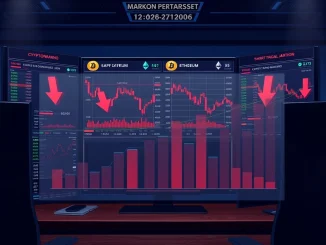
Bitcoin Selloff Deepens as Institutional ETF Flows Turn Negative, Erasing Post-Election Gains
New York, March 21, 2025: The bitcoin selloff accelerated this week, plunging below critical support levels as a key pillar of the 2024 bull market—sustained institutional buying—showed significant cracks. Data reveals net outflows from U.S. spot Bitcoin Exchange-Traded Funds (ETFs), marking a pivotal shift in market dynamics. This institutional retreat has erased all gains made since the U.S. presidential election in November 2024, pushing prices to their lowest point in months and signaling pressure that extends far beyond typical leverage-driven liquidations.
Bitcoin Selloff Accelerates on Sustained ETF Outflows
For the first time since their landmark launch in January 2024, U.S. spot Bitcoin ETFs have recorded consecutive days of net negative flows. This reversal follows months of consistent, multi-billion dollar inflows that helped propel Bitcoin to new all-time highs. Analysts point to this shift as the primary catalyst for the current bitcoin selloff, which saw the digital asset drop over 18% in a seven-day period. The selling pressure is not isolated to derivatives markets, where long positions were liquidated, but appears rooted in a reassessment by major traditional finance players.
“The narrative has flipped,” explained Marcus Chen, a veteran crypto market analyst at Arca Insights. “For most of 2024, ETF inflows were a reliable tailwind, absorbing sell-side pressure. Now, they have become a source of pressure themselves. This changes the fundamental supply-demand equation in the spot market.” Data from Farside Investors confirms the trend, showing aggregate outflows exceeding $850 million over a critical three-day window, with established funds like Grayscale’s GBTC and newer entrants like BlackRock’s IBIT both experiencing redemptions.
Institutional Flows Turn Negative: Analyzing the Catalysts
Several interconnected factors are driving the sudden negativity in institutional flows. Market participants cite a confluence of macroeconomic recalibration and crypto-specific headwinds.
- Macroeconomic Pressure: Renewed hawkish signals from the Federal Reserve regarding interest rates have strengthened the U.S. dollar and dampened appetite for risk assets globally. Bitcoin, often still correlated with tech equities in periods of stress, has been caught in this broader sell-off.
- Profit-Taking and Rebalancing: After a historic rally, institutional portfolios that allocated to Bitcoin earlier in the year are engaging in quarterly rebalancing, locking in substantial profits. This mechanical selling contributes directly to ETF outflows.
- Regulatory Uncertainty: While the ETF approval was a major victory, lingering regulatory questions around crypto staking, custody rules for banks, and tax treatment have created a cautious environment for some large allocators.
- Technical Breakdown: The breach of key technical support levels, such as the 100-day moving average and the $68,000 price zone, triggered automated selling algorithms and forced the exit of momentum-driven institutional strategies.
The table below illustrates the flow shift for major ETFs during the selloff’s peak:
| ETF Ticker | Provider | Net Flow (3-Day Period) | Impact |
|---|---|---|---|
| GBTC | Grayscale | -$420M | Continued conversion outflows |
| IBIT | BlackRock | -$185M | First sustained outflows since launch |
| FBTC | Fidelity | -$155M | Significant reversal from inflows |
| ARKB | ARK Invest | -$90M | Reflecting risk-off sentiment |
The Post-Election Rally: A Gain Fully Erased
The speed of the decline has been particularly striking because it completely unwound the “Trump rally” that followed the November 2024 election. In the weeks after the vote, Bitcoin surged approximately 22%, fueled by expectations of a more favorable regulatory landscape for digital assets. The current bitcoin price has not only given back those gains but has fallen to levels last seen in late October 2024. This demonstrates that short-term political catalysts are being overwhelmed by stronger fundamental and macroeconomic forces. The market is now grappling with the reality that ETF approval was a milestone, not a perpetual motion machine for prices.
Beyond Leverage: A Deeper Market Sentiment Shift
Initial reports framed the selloff as a routine flush of over-leveraged long positions in the perpetual futures market. While billions in leveraged positions were indeed liquidated, analysts now emphasize this was a symptom, not the cause. The root cause is the change in spot market demand from the largest and most stable cohort of buyers: institutions via ETFs.
“Leverage liquidations amplify moves, but they don’t initiate sustained downtrends from key levels,” noted Sarah Jennings, Head of Research at BlockTower Capital. “The initiation here was spot selling. The negative institutional flows confirm a genuine reevaluation of near-term risk and reward among professional managers. Sentiment has turned from ‘buy the dip’ to ‘reduce exposure.'” On-chain data supports this, showing increased movement of older Bitcoin holdings (held 3-6 months) to exchanges, typically a precursor to selling by longer-term investors.
Historical Context and Potential Paths Forward
This is not the first time Bitcoin has faced a severe test following a major adoption milestone. The period after the launch of Bitcoin futures on the CME in 2017 and the Coinbase direct listing in 2021 also saw significant corrections as markets digested new institutional involvement. The critical question is whether the current outflow trend is a short-term rotation or the beginning of a longer de-risking cycle.
Market structure has evolved, however. The existence of spot ETFs creates a transparent, daily barometer of institutional appetite that was previously opaque. This transparency can exacerbate volatility but also provides clearer signals. Some strategists argue that a period of consolidation or further downside is necessary to establish a new, sustainable foundation for the next leg of institutional adoption, potentially bringing in cost-sensitive buyers who missed the initial ETF rally.
Conclusion
The deepening bitcoin selloff marks a significant inflection point, transitioning from a market driven by enthusiastic institutional adoption to one contending with the realities of profit-taking, macroeconomic headwinds, and recalibrated risk models. The turn to negative institutional flows in spot Bitcoin ETFs is the central story, demonstrating that the current pressure is more fundamental than a mere leverage washout. While the long-term thesis for digital asset adoption remains intact for many institutions, the short-term market sentiment has clearly soured. The market’s ability to find a new equilibrium, and whether ETF flows can stabilize or return to positive territory, will be the key determinant of Bitcoin’s price trajectory in the coming quarter. The era of easy institutional inflows has paused, demanding a fresh assessment of the digital asset’s immediate value proposition.
FAQs
Q1: What does it mean that institutional ETF flows have turned negative?
A1: It means that more money is being withdrawn from U.S. spot Bitcoin ETFs than is being deposited. This indicates net selling pressure from institutional and large-scale investors, reversing a long trend of net buying that supported the market.
Q2: Is this bitcoin selloff only due to leveraged traders being liquidated?
A2: No. While leveraged liquidations amplified the price drop, the primary cause appears to be a shift in the spot market, specifically institutional selling through ETFs. This represents a deeper change in fundamental demand.
Q3: How much has Bitcoin fallen since the post-election rally?
A3: Bitcoin’s price has fallen to levels last seen in late October 2024, completely erasing the approximate 22% gain it experienced in the weeks following the U.S. presidential election in November.
Q4: Could this be the start of a prolonged bear market for Bitcoin?
A4: It is too early to declare a prolonged bear market. This is a significant correction driven by specific factors (ETF outflows, macro conditions). Historical precedent shows sharp corrections can follow major adoption milestones before markets find a new base.
Q5: What should investors watch to gauge a potential recovery?
A5: The key metric to watch is the daily net flow data for U.S. spot Bitcoin ETFs. A stabilization and return to consistent positive flows would signal renewed institutional confidence. Additionally, holding above major long-term support levels (e.g., the 200-day moving average) would be a positive technical signal.
Related News
- Ethereum Quantum Computing Defense: Foundation Launches Urgent Post-Quantum Security Initiative
- Pudgy Penguins Forges Revolutionary Partnership with Manchester City in Groundbreaking Web3 Sports Deal
- Apple AI: Shocking Report Reveals Ex-Siri Head’s Gemini Preference Over ChatGPT
Related: Revolutionary Attention-Based Markets: How Polymarket and Kaito AI Are Redefining Prediction Trading
Related: Strategic Partnership: Lunar Strategy Joins Incrypted to Propel Ukrainian Web3 Projects Globally
Related: Bitcoin Outflow: CryptoQuant's Critical Warning on a $2.6B Liquidity Squeeze