Asseto Finance Pioneers Integration of Chainlink CCIP and Price Feeds for Revolutionary Tokenized RWA Fund
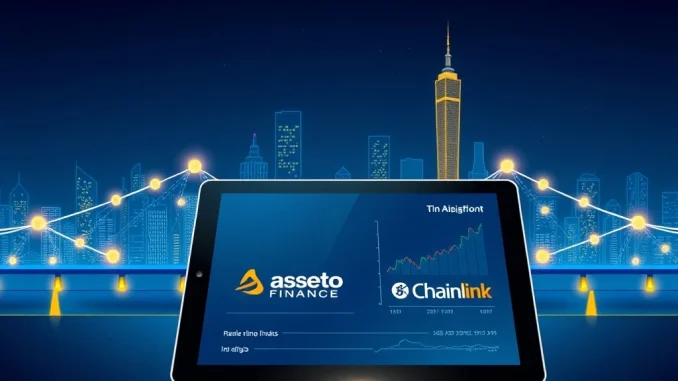
Zug, Switzerland, April 2025: In a significant development for the digital asset sector, Asseto Finance has announced the integration of Chainlink’s Cross-Chain Interoperability Protocol (CCIP) and its decentralized oracle network’s Price Feeds. This technical integration directly connects to the real-time Net Asset Value (NAV) calculation and facilitates cross-chain transfers for its CASH+ tokenized real-world asset (RWA) fund. The move represents a concrete step toward solving long-standing challenges of transparency, liquidity, and interoperability within the burgeoning RWA tokenization market.
Asseto Finance Integrates Chainlink for Enhanced RWA Infrastructure
The integration centers on two core Chainlink services. First, Chainlink Price Feeds will supply high-fidelity, tamper-resistant market data to power the real-time NAV calculation for the CASH+ fund. This is a critical function, as the NAV represents the per-share value of the fund’s underlying assets, which include short-duration corporate debt and other fixed-income instruments. Accurate, real-time NAV is foundational for investor trust and efficient secondary market trading of the tokenized shares. Second, Chainlink CCIP will serve as the secure messaging layer to enable the transfer of CASH+ tokens across different blockchain networks. This cross-chain capability is designed to unlock liquidity by allowing investors on various chains to access the fund, moving beyond the limitations of a single blockchain ecosystem.
The Technical Architecture Behind Tokenized Real-World Assets
Tokenizing real-world assets involves representing ownership of physical or traditional financial instruments—like bonds, real estate, or commodities—as digital tokens on a blockchain. The primary technical hurdles for RWAs have historically been:
- Data Oraclization: Reliably and securely bringing off-chain asset data (like price, interest payments, or maturity dates) onto the blockchain.
- Cross-Chain Liquidity: Avoiding market fragmentation by allowing the tokenized asset to move seamlessly between different blockchain environments.
- Regulatory Compliance: Ensuring the digital representation faithfully and transparently reflects the legal and financial reality of the underlying asset.
Asseto Finance’s architecture uses the CASH+ token as a digital share of the fund. The integration with Chainlink addresses the first two hurdles directly. The Price Feeds provide the necessary external data for valuation, while CCIP acts as a standardized protocol for communicating asset ownership and transfer instructions across chains, reducing bridge-related risks.
Historical Context and Industry Evolution
The concept of asset tokenization is not new, with early experiments dating back to the 2017-2018 period. However, initial efforts often struggled with centralized points of failure, especially in data feeds and bridge mechanisms. The 2022 cross-chain bridge exploits, which resulted in billions in losses, underscored the security imperative. The current industry trend, evident in this announcement, involves leveraging battle-tested, decentralized infrastructure like Chainlink’s oracle networks to mitigate these systemic risks. This shift marks a maturation from speculative prototypes to infrastructure designed for institutional-grade reliability and security.
Implications for Real-Time NAV and Investor Transparency
The promise of real-time NAV for a tokenized RWA fund is a substantial departure from traditional finance, where most funds calculate and publish NAV only once per trading day. By utilizing Chainlink’s decentralized oracle network, Asseto Finance aims to provide a continuously updated valuation. This has several potential implications:
- Reduced Arbitrage Windows: Minimizes the gap between the token’s market price and its intrinsic value, leading to more efficient markets.
- Enhanced Risk Management: Investors and portfolio managers can monitor exposure with greater precision.
- Auditability: The data sources and update mechanisms are verifiable on-chain, creating a transparent audit trail for the fund’s valuation.
- Crypto Futures Liquidated: $1.14 Billion Wiped Out in One Hour as Market Plunges
- Binance Alpha Unveils Crucial TCOM Global Listing on August 15
- Web3 Revenue Crisis: Shocking Tiger Research Report Reveals 99% of Crypto Projects Generate Zero Dollars
This model could set a new standard for transparency in asset management, applying blockchain’s inherent auditability to a core financial metric.
The Role of Chainlink CCIP in Unlocking Cross-Chain Finance
Chainlink CCIP is positioned as a generalized messaging protocol that allows smart contracts to send and receive data and tokens across any blockchain. For the CASH+ fund, its integration means the token is not siloed on its native chain. An investor on Ethereum could seamlessly acquire tokens that are ultimately settled on another supported chain like Avalanche or Polygon, based on liquidity and cost considerations. This interoperability is crucial for scaling RWAs, as it aggregates liquidity from the entire multi-chain landscape rather than competing for it within isolated networks. It reduces friction and expands the potential investor base significantly.
Conclusion: A Step Toward a Mature Tokenized Asset Ecosystem
The integration of Chainlink CCIP and Price Feeds by Asseto Finance represents a pragmatic and infrastructure-focused approach to scaling tokenized real-world assets. By tackling the dual challenges of reliable data and secure cross-chain movement with established decentralized services, the project addresses key barriers to institutional adoption and market efficiency. This development points toward a future where the liquidity and programmability of digital assets are successfully merged with the stability and yield of traditional finance, creating a more transparent, accessible, and interconnected global financial system. The success of implementations like the CASH+ fund will be closely watched as a benchmark for the viability of large-scale RWA tokenization.
FAQs
Q1: What is the CASH+ fund from Asseto Finance?
The CASH+ fund is a tokenized real-world asset (RWA) fund that invests primarily in short-duration corporate debt. Its shares are represented as digital tokens (CASH+) on a blockchain, allowing for fractional ownership and potential trading on digital asset markets.
Q2: How does Chainlink improve the CASH+ fund?
Chainlink improves the fund in two main ways. Its Price Feeds supply secure, real-world financial data to calculate the fund’s real-time Net Asset Value (NAV). Its Cross-Chain Interoperability Protocol (CCIP) enables the CASH+ token to be securely transferred across different blockchains, increasing its accessibility and liquidity.
Q3: Why is real-time NAV important for a tokenized fund?
Real-time NAV provides continuous transparency into the fund’s underlying value. This reduces information asymmetry between investors and fund managers, minimizes arbitrage opportunities, and allows for more precise pricing when the token is traded on secondary markets, leading to a fairer and more efficient market.
Q4: What are the main benefits of using CCIP for cross-chain transfers?
CCIP offers a standardized and audited security framework for moving tokens and data across chains. It aims to reduce the risks associated with custom-built bridges, which have been frequent targets for exploits. This security is critical for handling valuable real-world assets.
Q5: Does this integration make the CASH+ fund a decentralized finance (DeFi) product?
While it utilizes decentralized blockchain infrastructure for transparency and transfer, the fund itself is a regulated financial product managed by Asseto Finance. It blends traditional fund management with decentralized technological components, often referred to as “TradFi” meeting “DeFi.”
Q6: What risks remain for investors in tokenized RWA funds like CASH+?
Key risks include the regulatory environment, which is still evolving; the performance and security of the underlying traditional assets (e.g., corporate debt); the smart contract risk of the tokenization platform; and, despite improvements, the inherent complexities and potential vulnerabilities in any cross-chain communication system.
Related News
Related: Bitcoin Outflow: CryptoQuant's Critical Warning on a $2.6B Liquidity Squeeze
Related: Bitcoin Selloff Deepens as Institutional ETF Flows Turn Negative, Erasing Post-Election Gains
Related: OneKey and Turbos Finance Forge Strategic Alliance to Elevate On-Chain Trading on Sui