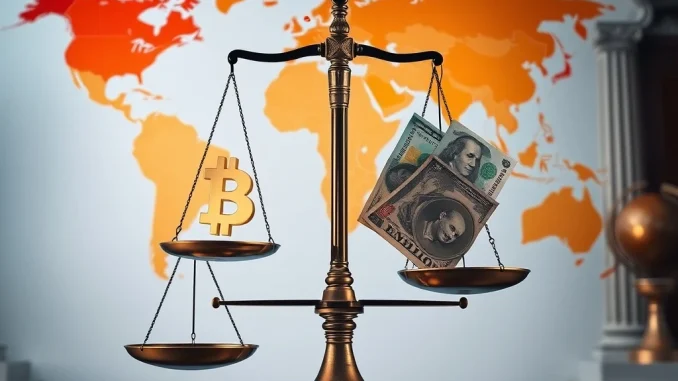
IMF Stablecoins Warning: The Alarming Threat to Emerging Market Economies
Washington D.C., April 2025: A stark warning from the International Monetary Fund (IMF) has sent ripples through global financial circles. The fund’s latest research presents a dual-edged analysis of stablecoins, highlighting their potential to revolutionize payments while simultaneously posing a severe threat of currency substitution in emerging markets. This development places fragile economies squarely in the crosshairs of a new financial era, forcing regulators worldwide to confront a complex challenge that blends technological promise with systemic peril.
IMF Stablecoins Analysis: A Tale of Promise and Peril
The IMF’s comprehensive report, derived from cross-country data and economic modeling, does not dismiss stablecoins outright. It acknowledges their core utility: providing a fast, low-cost, and accessible medium for cross-border payments and remittances. For citizens in developing nations with underdeveloped banking infrastructure or high transfer fees, dollar-pegged digital assets can offer a tangible financial lifeline. This efficiency gain represents the “promise” side of the equation—a technological solution to a long-standing problem of financial inclusion and cost.
However, the IMF swiftly pivots to the “peril.” The very features that make stablecoins attractive—their stability relative to volatile cryptocurrencies and their ease of use—accelerate the risk of currency substitution, or “cryptoization.” This occurs when residents of a country lose faith in their domestic currency and begin adopting a foreign currency, or a digital proxy for it, for everyday savings and transactions. Historically, this phenomenon, known as dollarization, occurred with physical US dollars. Stablecoins now digitize and supercharge this process, allowing it to happen at internet speed and scale, bypassing traditional capital controls.
The Currency Substitution Mechanism in Fragile Economies
To understand the IMF’s concern, one must examine the economic conditions that make emerging markets uniquely vulnerable. The mechanism follows a clear, destabilizing chain reaction.
- Loss of Monetary Sovereignty: When a significant portion of a population holds savings and conducts business in US dollar stablecoins, the domestic central bank loses its ability to effectively implement monetary policy. Tools like interest rate adjustments become less impactful if citizens operate outside the traditional banking system.
- Erosion of the Tax Base: Economic activity conducted via opaque, pseudonymous blockchain networks can become difficult for tax authorities to trace, potentially reducing government revenue critical for public services and stability.
- Capital Flight Amplification: Stablecoins provide a frictionless channel for capital to exit an economy during periods of doubt or crisis, potentially exacerbating currency devaluation and draining foreign exchange reserves.
- Financial Fragmentation: A parallel, crypto-based financial system can develop, fragmenting liquidity and weakening traditional banks, which are essential for credit provision and economic growth.
The IMF notes that countries with a history of high inflation, volatile exchange rates, and weak institutions are at the greatest risk. Citizens in these nations, seeking to preserve their purchasing power, are the most likely to adopt stablecoins as a pragmatic hedge, inadvertently undermining their own country’s monetary framework.
Historical Context: From Dollarization to Digitalization
This is not the first time the IMF has grappled with currency substitution. The Latin American debt crises of the 1980s and 1990s, and hyperinflation episodes in countries like Zimbabwe and Venezuela, led to widespread unofficial dollarization. Regaining monetary control was a painful, decades-long process requiring restored confidence and stringent reforms. The digital nature of stablecoins presents a more insidious challenge. Unlike physical dollar bills, which require physical smuggling, digital assets flow across borders instantaneously via the internet, making containment through traditional regulatory measures nearly impossible.
Regulatory Responses and the Path Forward
The IMF’s report is a clarion call for proactive, coordinated regulation rather than reactive bans, which often prove ineffective. The fund outlines a multi-pronged approach for national authorities, particularly in emerging markets.
First, and most critically, is the imperative to address the root causes of cryptoization. This means strengthening domestic macroeconomic policies to ensure low and stable inflation, building credible institutions, and fostering deep, efficient domestic financial markets. If the local currency is trustworthy, the incentive to seek alternatives diminishes.
Second, the IMF advocates for the development of robust legal and regulatory frameworks for crypto assets. This includes:
- Clear licensing requirements for stablecoin issuers and service providers.
- Strict governance, reserve backing, and disclosure rules to ensure stablecoins are truly stable and transparent.
- Strong anti-money laundering and counter-terrorist financing (AML/CFT) standards applied uniformly across the crypto ecosystem.
Finally, the report emphasizes the potential role of Central Bank Digital Currencies (CBDCs). A well-designed digital version of a national currency could offer the digital efficiency benefits citizens seek, but within the regulated, sovereign monetary system. It could provide a public digital alternative to compete with private stablecoins, helping to preserve monetary sovereignty.
Conclusion: A Defining Challenge for Global Finance
The IMF’s warning on stablecoins and emerging markets is a defining document for the next phase of digital finance. It moves the conversation beyond speculative investment and technological novelty to the core issues of economic stability and sovereignty. The promise of efficient, inclusive payments is real, but the peril of rapid, unmanaged currency substitution poses a direct threat to the economic health of the world’s most vulnerable nations. The path forward requires a delicate balance: fostering innovation while safeguarding stability, and ensuring that the digital future of money strengthens, rather than fractures, the global financial system. The response from policymakers in the coming months will be critical in determining whether stablecoins become a tool for development or a vector for disruption.
FAQs
Q1: What exactly is currency substitution or “cryptoization”?
Currency substitution, often called cryptoization in this context, is the process where residents of a country significantly reduce their use of the national currency in favor of a foreign currency or a digital asset pegged to one (like a US dollar stablecoin). This undermines the local central bank’s control over the economy.
Q2: Why are emerging markets specifically at risk from stablecoins?
Emerging markets often have histories of high inflation, currency volatility, and less trusted financial institutions. Citizens naturally seek stable stores of value. Stablecoins offer a digital, accessible alternative to shaky local currencies, making rapid, large-scale adoption—and thus loss of monetary control—more likely.
Q3: What are the main benefits of stablecoins that the IMF acknowledges?
The IMF recognizes that stablecoins can drastically reduce the cost and increase the speed of cross-border payments and remittances. This can improve financial inclusion for people in regions with poor banking infrastructure, providing a practical tool for everyday finance.
Q4: How can countries prevent the risks associated with stablecoin adoption?
Key strategies include strengthening their own economies to build trust in the local currency, implementing clear regulations for crypto asset service providers, enforcing transparency on stablecoin reserves, and exploring the issuance of their own Central Bank Digital Currencies (CBDCs) as a public digital alternative.
Q5: What is the difference between dollarization and stablecoin-driven cryptoization?
Traditional dollarization involved the physical use of US banknotes. Stablecoin-driven cryptoization is digital, global, and instantaneous. It can happen at a much larger scale and speed, is harder to track, and bypasses physical border controls, making it a more potent and difficult-to-manage challenge for authorities.
Related News
- US Job Market Sees Growth in June as Crypto Market Slumps
- Pump.fun Pump Fund: The Strategic Pivot Transforming Crypto Platform Economics
- BlockDAG Unleashes Revolutionary 10x Miner Demo, Eclipsing XRP News and AVAX Amidst $350M Presale and Anticipated 2025 Crypto Shift
Related: Crucial Debate: OKX CEO Star Xu Counters Claims That DEXs and CEXs Are Identical
Related: Binance Cross Margin Trading Expands with Crucial PAXG, ASTER, SUI, and XRP Pairs