Bitcoin Price Faces Critical Test as BTC Shorts Gain Momentum After $72K Rejection
Global, May 2025: Bitcoin’s recent attempt to breach the $72,000 threshold has ended in a sharp pullback, presenting traders with a classic and challenging market scenario. The flagship cryptocurrency faced multiple rejections at the $71,500 level, triggering a wave of profit-taking and short-position accumulation. This price action underscores what many seasoned market participants describe as the hardest part of trading: maintaining discipline when market sentiment shifts abruptly. The current volatility tests both technical strategies and psychological resilience.
Bitcoin Price Rejection at $72K Signals Market Hesitation
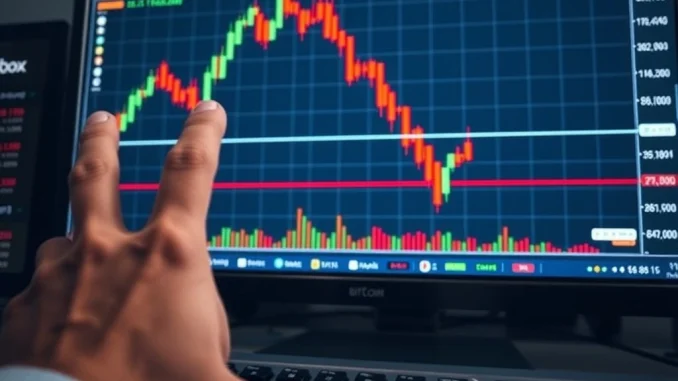
The rally that pushed Bitcoin toward $72,000 last week encountered significant selling pressure, creating a distinct resistance zone. Market data from major exchanges shows a cluster of sell orders concentrated just above the $71,000 mark, which acted as a ceiling for upward momentum. This rejection is not an isolated event but part of a broader pattern observed in Bitcoin’s price discovery phases. Historically, after major rallies, the asset often experiences consolidation or correction as it digests gains and establishes new support levels. The current pullback reflects a natural market mechanism where profit-taking by long-term holders meets renewed skepticism from short-term traders.
Analyzing the order book depth reveals that the path to $72,000 was littered with substantial sell walls. These are large limit sell orders placed by institutional players and whales aiming to exit positions at a perceived peak. The repeated failure to break through this supply zone has shifted the short-term momentum. On-chain metrics, such as the Net Unrealized Profit/Loss (NUPL) indicator, suggested the market was entering a state of extreme greed prior to the rejection, often a precursor to a correction. This technical setup created a fertile environment for short sellers to initiate positions, betting on a further decline.
The Rise of BTC Short Positions and Market Sentiment Shift
Following the rejection, derivatives markets witnessed a notable increase in short interest. Data from futures exchanges indicates funding rates turned neutral to slightly negative, signaling that leveraged traders are paying to hold short positions. This is a marked shift from the persistently positive funding rates seen during the rally. The buildup of shorts represents a tactical bet that the rejection will lead to a deeper correction, potentially toward the $68,000 support level that held strong in previous weeks.
However, a high level of short interest can itself become a market catalyst. A phenomenon known as a “short squeeze” occurs when a sudden price rise forces those short sellers to buy back Bitcoin to cover their positions, accelerating the upward move. This creates a tense standoff. The current market structure presents a clear narrative:
- Bearish Perspective: The failure at a key psychological level ($72K) confirms exhaustion, and the path of least resistance is down toward lower support.
- Bullish Perspective: This is a healthy pullback within a larger uptrend, shaking out weak hands and liquidating overleveraged shorts before the next leg up.
Traders are now closely monitoring liquidation levels. A cluster of leveraged long positions sits just below the current price, meaning a swift drop could trigger cascading liquidations, fueling a steeper decline. Conversely, a swift rebound could inflict significant pain on the newly established short positions.
The Psychological Hurdle: Discipline in Volatile Markets
Beyond the charts and order flows, the current situation highlights the profound psychological component of trading. The period after a clear rejection is fraught with emotional decision-making. Traders who bought near the top face the dilemma of holding through potential further loss or cutting their position. Those in profit must decide whether to secure gains or let their winners run. This is the “hardest part” referenced by trading veterans—the execution of a plan amidst fear, greed, and uncertainty.
Behavioral finance studies show that investors feel the pain of loss approximately twice as intensely as the pleasure of an equivalent gain. This loss aversion can lead to premature selling during pullbacks or, conversely, holding onto losing positions for too long in hope of a rebound. The disciplined trader relies on predefined risk parameters, such as stop-loss orders and position sizing, to remove emotion from the equation. In volatile crypto markets, this discipline is the primary differentiator between long-term success and failure.
Historical Context and Macroeconomic Backdrop
To understand the significance of the $72,000 level, one must look back. Bitcoin’s all-time high, set in the previous cycle, sits just above this price point. Re-testing this historic resistance was always likely to be a volatile event, as it represents a zone where previous buyers turned into sellers. Furthermore, the current macroeconomic environment adds layers of complexity. Shifting expectations around central bank interest rates and global liquidity conditions directly impact risk assets like Bitcoin.
The cryptocurrency market no longer operates in a vacuum. Its correlations with traditional equity indices, particularly tech stocks, have increased. Therefore, Bitcoin’s price action must be analyzed alongside broader financial market trends. A risk-off sentiment in global markets can quickly spill over into crypto, exacerbating sell-offs. Conversely, positive liquidity injections can provide a tailwind. This interconnectedness means traders must now monitor a wider array of data points, from Federal Reserve meeting minutes to bond yield movements.
Conclusion: Navigating Uncertainty with a Clear Strategy
Bitcoin’s rejection at the $72,000 mark serves as a potent reminder of the market’s inherent volatility. The subsequent rise in BTC shorts illustrates a tactical response to a clear technical signal. For traders, the critical takeaway is the importance of strategy over speculation. Successful navigation of these phases depends less on predicting the exact next move and more on managing risk and emotional responses. Whether the pullback deepens or reverses into a squeeze, the market will ultimately reveal its direction. The hardest part of trading remains the psychological fortitude to stick to a rational plan when prices move against expectations, a test that every participant now faces once again.
FAQs
Q1: What does a “rejection” at a price level like $71,500 mean?
A rejection occurs when the price of an asset approaches a specific level but fails to break through, instead reversing direction. It often indicates strong selling pressure (resistance) at that level, where market participants are willing to sell en masse.
Q2: Why do short positions increase after a price rejection?
Traders interpret a failure to break resistance as a sign of weakness and a potential start of a downtrend. They borrow and sell the asset (shorting) to profit from an expected decline, betting the rejection will lead to a larger correction.
Q3: What is a short squeeze and how could it affect Bitcoin now?
A short squeeze happens when a rising price forces traders who bet on a decline (shorts) to buy back the asset to limit their losses. This buying pressure can fuel a rapid price increase. If Bitcoin rebounds sharply, it could trigger a squeeze on the recently added short positions.
Q4: How does trading psychology impact decisions during volatility?
Emotions like fear and greed can lead to impulsive actions—selling at a loss out of panic or holding a losing position hoping for a miracle. Discipline involves following a pre-set trading plan with defined entry, exit, and risk management rules to counteract these biases.
Q5: What key levels are traders watching after this pullback?
Traders are monitoring immediate support near $68,000, which held prior to the rally. A break below could target $65,000. On the upside, reclaiming $71,500 is crucial for bulls to regain control and make another attempt at $72,000 and beyond.
Related News
- Bitcoin Tests Critical April Lows – Analysts Project Potential Rally to $82,000 After Consolidation
- JCB Stablecoin Payments Launch Revolutionary Offline Test in Japanese Retail Stores
- Alchemy Acquisition Boosts Smart Wallets and Web3 Onboarding via HeyMint Deal
Related: Spartans Revolutionizes Digital Sports Wagering with 33% CashRake and Exclusive Incentives
Related: ZKP Presale Stuns Market with 190M Daily Allocation, Diverting Focus from ADA and SUI Prices
Related: IMF Stablecoins Warning: The Alarming Threat to Emerging Market Economies