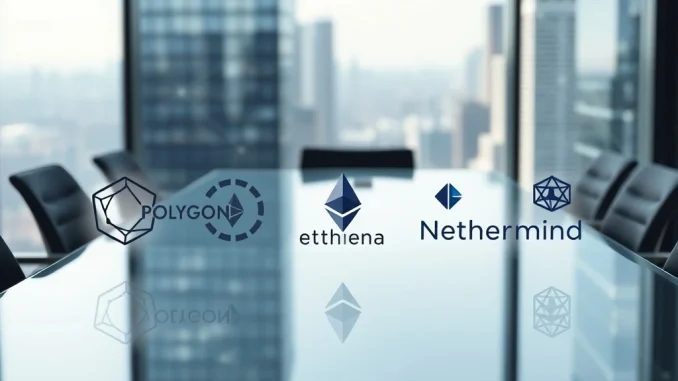
Institutional Ethereum Takes Shape as Polygon, Ethena, and Nethermind Join the Enterprise Ethereum Alliance
New York, United States, 10th February 2026: The Enterprise Ethereum Alliance (EEA), the world’s largest open-source blockchain initiative, has significantly expanded its membership with the addition of three major players: Polygon, a leading Ethereum scaling network; Ethena, a prominent synthetic dollar protocol; and Nethermind, a premier Ethereum research and engineering firm. This coordinated move signals a decisive step toward the maturation of institutional Ethereum, as diverse yet complementary technologies converge under a unified standards body to address enterprise needs.
Enterprise Ethereum Alliance Gains Critical Mass with New Members
The Enterprise Ethereum Alliance serves as a cornerstone for corporate blockchain adoption. Its primary mission involves developing open, standards-based specifications to enhance the privacy, security, and scalability of Ethereum for business applications. Membership has historically included a mix of Fortune 500 companies, technology vendors, and blockchain startups. The inclusion of Polygon, Ethena, and Nethermind represents a strategic infusion of deep technical expertise from different layers of the Ethereum ecosystem. This is not merely an addition of names to a roster. It reflects a deliberate consolidation of forces aimed at solving the practical challenges that have, until now, limited large-scale enterprise deployment. The alliance now possesses direct access to scaling solutions, novel financial primitives, and core protocol engineering talent under one collaborative umbrella.
Analyzing the Strategic Roles of Polygon, Ethena, and Nethermind
Each new member brings a distinct and critical capability to the EEA’s institutional Ethereum vision. Their combined expertise covers the full stack, from base-layer infrastructure to advanced financial applications.
- Polygon: As a foundational Layer 2 scaling suite, Polygon provides the throughput and low-cost transaction environment essential for enterprise operations. Its contribution will center on interoperability standards and scaling specifications that allow corporate systems to interact seamlessly with high-performance Ethereum-compatible chains.
- Ethena: This protocol introduces the concept of a “synthetic dollar,” or ‘Internet Bond,’ built on Ethereum. For institutions, Ethena’s expertise in creating scalable, dollar-denominated savings instruments on-chain addresses a core need for treasury management and stable digital asset exposure within a regulated framework.
- Nethermind: As a team of elite Ethereum core developers and researchers, Nethermind’s role is foundational. They contribute direct knowledge of the Ethereum protocol’s evolution, including the upcoming Verkle trees and stateless clients. Their work ensures EEA specifications remain future-proof and aligned with Ethereum’s core roadmap.
The Historical Context: From Enterprise Experiment to Institutional Reality
The journey toward institutional Ethereum has been incremental. Early enterprise efforts, often private permissioned chains, struggled with liquidity isolation and developer scarcity. The narrative shifted with the rise of public blockchain utility and the emergence of robust Layer 2 networks. The 2023-2025 period saw a surge in real-world asset (RWA) tokenization and treasury management experiments by major financial institutions. These pilots highlighted remaining friction points: finality costs, regulatory clarity for novel assets like synthetic dollars, and the need for standardized client software. The EEA, by bringing Nethermind (client software), Polygon (scaling), and Ethena (financial primitive) together, is directly assembling the toolkit to resolve these specific, identified pain points. This move follows a logical industry progression from isolated testing to integrated solution-building.
Implications for Corporate Blockchain Adoption and Standards
The immediate consequence of this membership expansion is the acceleration of tangible, production-ready standards. Corporations looking to leverage Ethereum no longer need to navigate a fragmented landscape. They can engage with the EEA and access guided pathways for implementation. Key areas likely to see rapid development include:
- Standardized APIs for Layer 2 Interactions: Creating uniform interfaces for businesses to broadcast transactions across multiple scaling networks.
- Compliance Frameworks for Synthetic Assets: Developing best-practice models for auditing, reporting, and risk-managing protocols like Ethena within corporate balance sheets.
- Enhanced Client Performance for Enterprises: Leveraging Nethermind’s work to optimize Ethereum execution and consensus clients for high-availability, data-center environments.
This collaborative effort reduces the technical risk and internal research cost for any corporation entering the space, effectively lowering the barrier to adoption.
Expert Insight on the Convergence of Technology and Governance
Industry analysts view this as a natural maturation phase. “The initial wave of enterprise blockchain was about exploration and proof-of-concept,” notes Dr. Anya Petrova, a fintech researcher at a leading university. “The current phase is about industrialization. You see this pattern in any disruptive technology: first comes innovation at the edges, then a consolidation phase where the most viable technologies coalesce around standards bodies to achieve mainstream scale. The EEA is playing that consolidating role for Ethereum. Adding these three members isn’t about hype; it’s about filling specific, technical gaps in the enterprise stack.” This perspective underscores the move’s operational, rather than speculative, nature.
Conclusion: A Defining Moment for Ethereum’s Enterprise Future
The simultaneous entry of Polygon, Ethena, and Nethermind into the Enterprise Ethereum Alliance marks a pivotal inflection point. It represents a conscious alignment of scaling infrastructure, innovative DeFi primitives, and core protocol development toward a common goal: making Ethereum robust, predictable, and accessible for global institutions. This collaboration moves beyond theoretical potential, focusing instead on the practical engineering and standardization required for widespread institutional Ethereum adoption. The collective effort within the EEA framework is now poised to translate Ethereum’s technical promise into the operational reality of corporate finance, supply chain, and digital identity systems worldwide.
FAQs
Q1: What is the Enterprise Ethereum Alliance (EEA)?
The Enterprise Ethereum Alliance is the world’s largest open-source blockchain initiative for businesses. It develops industry standards and specifications to enhance the privacy, security, and scalability of the Ethereum network for enterprise use cases.
Q2: Why is Polygon’s membership significant for the EEA?
Polygon provides critical Ethereum scaling technology. Its membership ensures that the EEA’s standards for institutional Ethereum will be designed with high-throughput, low-cost Layer 2 solutions as a foundational component, which is essential for business applications.
Q3: What does Ethena contribute to an enterprise-focused group?
Ethena develops a synthetic dollar protocol, a key financial primitive. Its expertise helps the EEA create frameworks for how institutions can safely interact with and leverage stable, yield-generating digital assets native to the Ethereum ecosystem.
Q4: How does Nethermind’s role differ from Polygon and Ethena?
Nethermind is a core Ethereum engineering and research team. They contribute deep, low-level knowledge of the Ethereum protocol itself, ensuring that EEA standards are compatible with the network’s long-term technical roadmap and performance upgrades.
Q5: What does this mean for traditional companies interested in blockchain?
For corporations, this consolidation simplifies the adoption process. Instead of evaluating dozens of disparate technologies, they can engage with the EEA to access integrated, standardized solutions for scaling, digital assets, and infrastructure that are being co-developed by leading experts in each field.
Related News
- Ethereum Whale Withdraws $39.98M from Binance: A Strategic Signal for 2025
- Bitcoin Bear Market: Analyst Reveals Critical Technical Breakdown and Future Price Targets
- Ethereum Co-Founder Transfers $72M to Kraken Exchange
Related: IMF Stablecoins Warning: The Alarming Threat to Emerging Market Economies
Related: Revealed: XRP Price Prediction Tests Key Levels as HBAR Gains Traction and APEMARS Emerges for 2026