BlockDAG $0.00025 Final Private Sale Opens: A New Liquidity Model Emerges Amid Broader Crypto Market Weakness
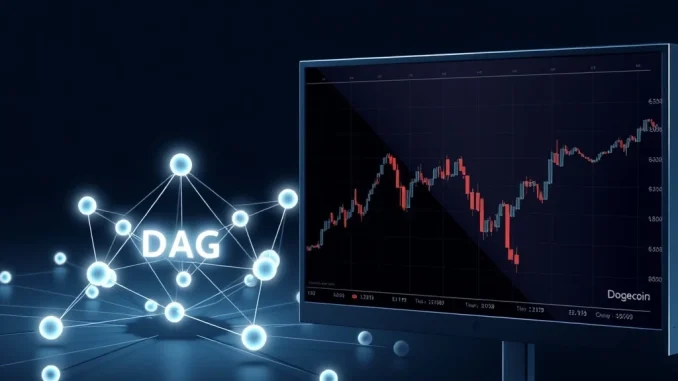
Global, April 2025: The cryptocurrency market presents a complex landscape of shifting valuations and emerging opportunities. A notable development this week is the opening of BlockDAG’s final private sale round, priced at $0.00025 per token and structured to provide immediate liquidity upon exchange listing. This launch coincides with observable price pressure on established assets like Aave, which has retreated to the $105 region, and Dogecoin, trading near $0.09. This confluence of events prompts a closer examination of market dynamics, project fundamentals, and the evolving structures of early-stage crypto fundraising.
Analyzing the BlockDAG Private Sale and Its Liquidity Promise
BlockDAG’s current funding round represents what the project terms its “final private sale” phase. The core technical proposition of BlockDAG involves utilizing a Directed Acyclic Graph (DAG) structure instead of a traditional linear blockchain. Proponents of DAG-based systems argue they can offer higher transaction throughput and scalability by allowing multiple chains of transactions to coexist and be validated concurrently.
The $0.00025 entry point and the advertised “zero-vesting” period with “day-one liquidity” are significant features in the current climate. In cryptocurrency project fundraising, a vesting schedule typically locks up early investor or team tokens for a predetermined period to prevent immediate market dumping post-listing. A zero-vesting model removes this lock, meaning tokens purchased in the sale could, in theory, be traded immediately on supporting exchanges. This structure shifts risk and reward dynamics, offering early participants quicker exit potential but also introducing different supply-side considerations at launch.
It is critical for observers to distinguish between technical architecture and financial mechanics. While the DAG model presents an interesting technical alternative, the liquidity promise is a separate financial and operational undertaking dependent on the project securing exchange listings with sufficient market depth.
Contextualizing Aave and Dogecoin’s Market Performance
To understand the broader market environment into which BlockDAG launches, analyzing the recent performance of two major but disparate assets is instructive. Their movements reflect wider trends affecting both decentralized finance (DeFi) and major cryptocurrencies.
Aave (AAVE): As a leading decentralized lending protocol, Aave’s token price is often influenced by metrics within its ecosystem and broader DeFi sentiment. A drop to the $105 level, from higher valuations earlier in the year, may correlate with several factors:
- Total Value Locked (TVL) Fluctuations: Changes in the total capital deposited into the Aave protocol can impact fee revenue and perceived utility.
- Competitive Landscape: The DeFi lending space remains highly competitive, with multiple protocols vying for market share.
- General Crypto Market Sentiment: Broader market corrections often disproportionately affect DeFi tokens, which are considered higher-beta assets.
Dogecoin (DOGE): Originally created as a meme, Dogecoin has evolved into a major cryptocurrency with a large community. Its price decline to approximately $0.09 highlights its sensitivity to different market drivers:
- Social Media and Celebrity Influence: DOGE price action has historically shown correlation with mentions by high-profile individuals and social media trends.
- Broader Altcoin Market Health: As a leading altcoin, Dogecoin often moves in tandem with general market sentiment toward cryptocurrencies outside of Bitcoin and Ethereum.
- Lack of Fundamental Development News: Periods without significant protocol upgrades or major adoption news can lead to price consolidation or decline.
The simultaneous weakness in these two distinct assets suggests a market that is either risk-off, consolidating, or reallocating capital, which forms the backdrop for any new project entry.
The Evolution of Crypto Fundraising: From ICOs to Structured Sales
The structure of BlockDAG’s sale is part of a long evolution in crypto project financing. The Initial Coin Offering (ICO) boom of 2017-2018 was often characterized by minimal vesting and immediate liquidity, leading to notorious pump-and-dump scenarios. In response, the industry shifted toward stricter models, including:
- SAFTs (Simple Agreements for Future Tokens): Legal investment contracts for accredited investors.
- Lengthy Vesting Schedules: Multi-year cliffs and gradual release schedules for team and investor tokens.
- Community Airdrops: Distributing tokens to users of a protocol to decentralize ownership.
A move back toward a “zero-vesting” model, if executed with transparency and proper exchange partnerships, could be seen as an attempt to balance immediate market fairness with project sustainability. However, it requires robust initial liquidity provision to function without severe price volatility.
Technical Deep Dive: What is a BlockDAG?
For investors and observers to make informed assessments, understanding the proposed technology is paramount. A Directed Acyclic Graph (DAG) is a data structure that differs fundamentally from a linear blockchain.
| Feature | Traditional Blockchain (e.g., Bitcoin) | DAG-Based Structure (e.g., BlockDAG Proposal) |
|---|---|---|
| Structure | Linear chain of blocks | Web or graph of interconnected transactions/blocks |
| Consensus | Proof-of-Work or Proof-of-Stake on one chain | Often uses consensus mechanisms validating multiple branches simultaneously |
| Scalability Thesis | Limited by block size and time; layer-2 solutions often needed | Theoretically higher throughput as more participants add transactions |
| Examples | Bitcoin, Ethereum (pre-merge) | IOTA, Hedera Hashgraph (though not pure DAG), Nano |
It is important to note that while DAGs offer theoretical advantages, they face their own challenges, including potential security trade-offs and the complexity of achieving decentralized consensus without a single chain. The success of any DAG project hinges on solving these practical implementation hurdles.
Market Implications and Investor Considerations
The emergence of a new project during a period of weakness for established names is a recurring pattern in crypto markets. It can indicate a search for new narratives or value propositions. For individuals assessing such opportunities, several key considerations emerge:
- Liquidity vs. Stability: Day-one liquidity provides flexibility but can also lead to high initial volatility. Projects must ensure sufficient market-making support.
- Technical Viability: Beyond the sale structure, the long-term value proposition rests on the real-world utility and security of the BlockDAG protocol.
- Regulatory Landscape: The regulatory treatment of token sales continues to evolve globally, impacting project operations and investor eligibility.
- Market Timing: Launching in a period of broader market weakness can mean less competitive noise but also a potentially smaller pool of available capital.
The current situation with Aave and Dogecoin may reflect sector-specific rotations or macro-level pressures on risk assets, unrelated to the fundamentals of any single new project launch.
Conclusion
The opening of BlockDAG’s final private sale at $0.00025, with its emphasis on immediate liquidity, presents a distinct model within the contemporary crypto fundraising landscape. Its launch occurs against a backdrop where major assets like Aave and Dogecoin are experiencing price declines, highlighting a moment of potential market recalibration. Ultimately, the long-term significance of any project will be determined not by its initial sale structure alone, but by the subsequent execution of its technology, the growth of its ecosystem, and its ability to deliver tangible utility. Market participants are advised to prioritize fundamental research, an understanding of the underlying technology like DAG, and a clear assessment of risk in any dynamic cryptocurrency environment.
FAQs
Q1: What does “day-one liquidity” mean for a crypto token sale?
A1: It means that tokens purchased in the sale are not subject to a lock-up or vesting period and are expected to be tradable on one or more cryptocurrency exchanges immediately upon the token’s listing. This depends on the project successfully securing those listings.
Q2: How does a BlockDAG differ technically from a blockchain?
A2: A traditional blockchain orders transactions in a single, linear chain of blocks. A Directed Acyclic Graph (DAG) structures data like a web or graph, where multiple chains of transactions can be validated in parallel, aiming for higher scalability and speed.
Q3: Why are Aave and Dogecoin prices mentioned in relation to a new project launch?
A3: Their recent price movements provide context for the broader market environment. Weakness in established, large-cap assets like these can indicate shifting investor sentiment, risk appetite, or capital flows, which forms the backdrop for any new entry into the market.
Q4: What are the risks associated with a “zero-vesting” token sale model?
A4: The primary risk is increased initial selling pressure (“dumping”) if a large number of early investors decide to exit immediately upon listing. This can lead to high volatility and price declines unless there is strong, coordinated buying demand or market-making support to provide liquidity.
Q5: Is a lower token price (e.g., $0.00025) an indicator of future value or potential?
A5: Not inherently. The absolute token price is less important than the total market capitalization (price x circulating supply). A low per-token price with a very high supply can represent the same market cap as a high per-token price with a low supply. Evaluation should focus on the project’s fundamentals, technology, team, and total valuation.
Related News
- Bitcoin Price: Understanding the Explosive BTC Rally and Future Cryptocurrency Trends
- Movemaker: Aptos Growing Chinese-Speaking Region with Multi-Million-Dollar Support via its Official Community
- Europe's $10.4 Trillion Leverage: How Transatlantic Financial Tensions Could Reshape Global Markets
Related: Layer-2 Social Dominance: How Linea and Starknet's Surging Engagement Signals a New Growth Paradigm
Related: ZKP Project: The Revolutionary Privacy Ecosystem Transforming Digital Finance in 2026
Related: MiCA License Deadline: France's Urgent Warning to Crypto Firms Before July 2026 Crackdown