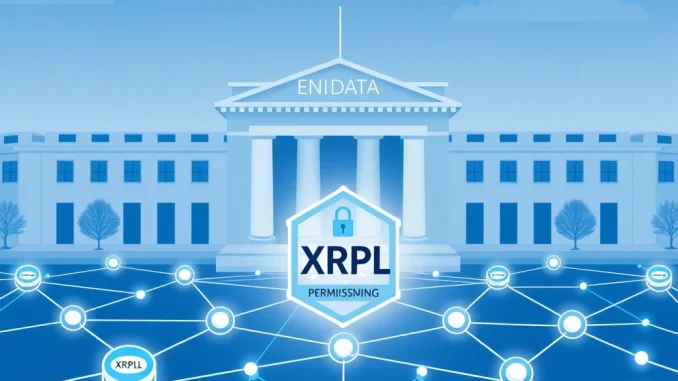
XRPL Permissioned Domains: The Revolutionary Upgrade That Just Went Live
Global, April 2025: The XRP Ledger (XRPL) has activated one of its most significant infrastructure upgrades to date. Permissioned Domains are now operational on the XRPL mainnet, marking a pivotal evolution in the blockchain’s capability to serve regulated financial institutions. This development, confirmed by RippleX, represents a strategic move to bridge the gap between decentralized finance (DeFi) principles and the stringent compliance requirements of traditional finance.
XRPL Permissioned Domains: A Technical Breakdown
The core innovation of this upgrade is the implementation of Permissioned Domains. This feature allows entities to create controlled, private sub-networks within the public XRP Ledger. Within these domains, operators can enforce specific rules for participation, transaction validation, and asset issuance. Crucially, these domains remain interoperable with the broader, permissionless XRPL mainnet. This architecture enables institutions to leverage the speed and efficiency of XRPL—which settles transactions in 3-5 seconds—while maintaining the governance and compliance controls mandated by their operational frameworks. The upgrade does not alter the fundamental XRP token or the public ledger’s operations; instead, it layers a new, permissioned functionality on top of the existing infrastructure.
The Drive for Institutional DeFi and Compliance
This launch directly addresses a major barrier to institutional adoption of blockchain technology: the conflict between transparency and privacy. Traditional DeFi operates on fully transparent ledgers, which can expose sensitive business logic and counterparty relationships. Permissioned Domains provide a middle path. Financial institutions, asset managers, and corporations can now execute complex financial operations, such as private securities trading or cross-border settlements between known parties, with transaction details visible only to pre-approved participants. This model supports regulatory requirements like Know Your Customer (KYC) and Anti-Money Laundering (AML) checks at the domain level, a critical factor for banks and licensed financial service providers exploring digital asset ecosystems.
From Concept to Mainnet: The Development Timeline
The journey to this mainnet launch followed a meticulous development and testing protocol. RippleX, the development arm behind XRPL, first introduced the concept through extensive research papers and developer discussions. Following community feedback and several amendment proposals, the feature underwent rigorous testing on the XRPL devnet and testnet. This phased approach allowed developers to simulate enterprise use cases and stress-test the interoperability between permissioned and permissionless environments. The official activation occurred via the XRPL’s decentralized amendment process, where validator nodes vote on protocol changes, ensuring the upgrade reflected network consensus.
Implications for the Permissioned DEX and Beyond
A direct application enabled by this upgrade is the Permissioned Decentralized Exchange (DEX). The native DEX on XRPL has always been a core feature, but it was fully public. Now, institutions can operate a DEX within a Permissioned Domain, facilitating the trading of digital assets—including tokenized real-world assets like bonds, carbon credits, or private equity—among vetted participants. This creates a new paradigm for capital markets infrastructure. The potential extends to central bank digital currency (CBDC) issuance, where a central bank could operate a domain for interbank settlements, or to supply chain finance, where a consortium of companies can track and finance goods with shared, private data.
The table below outlines key differences between the public XRPL and a Permissioned Domain:
| Feature | Public XRPL | Permissioned Domain |
|---|---|---|
| Access | Permissionless, open to all | Restricted to approved participants |
| Transaction Visibility | Fully public on the ledger | Private within the domain |
| Governance | Decentralized validator consensus | Defined by domain operator |
| Use Case Focus | General payments, public DeFi | Institutional finance, private asset trading |
| Interoperability | N/A (base layer) | Can interact with public XRPL via bridges |
Conclusion
The activation of Permissioned Domains on the XRP Ledger mainnet is a transformative event that repositions the network for a new class of enterprise adoption. By providing a compliance-oriented infrastructure layer, XRPL is no longer competing solely in the realm of public cryptocurrencies but is actively building the rails for the future of institutional digital finance. This upgrade demonstrates a clear trajectory for blockchain evolution: not as a replacement for existing financial systems, but as a versatile, interoperable foundation upon which both open and regulated ecosystems can be securely built. The success of this XRPL Permissioned Domains launch will be measured by the real-world financial products and private market solutions it enables in the coming months.
FAQs
Q1: What exactly are XRPL Permissioned Domains?
Permissioned Domains are private, controlled sub-networks on the XRP Ledger where operators can set rules for participation and transaction visibility, designed for institutional use while maintaining connectivity to the public mainnet.
Q2: Does this upgrade change how the public XRP Ledger or XRP token works?
No. The public XRP Ledger and the XRP cryptocurrency continue to operate unchanged. Permissioned Domains are an additional, optional layer of functionality built on top of the existing infrastructure.
Q3: Who is the target user for this new feature?
The primary target users are regulated financial institutions, corporations, and consortiums that require private, compliant blockchain solutions for activities like asset tokenization, private securities trading, and regulated settlements.
Q4: How does this relate to the concept of “institutional DeFi”?
It provides the missing compliance layer. Institutional DeFi aims to bring DeFi’s efficiency and automation to traditional finance, but needs privacy and control. Permissioned Domains offer precisely that on a proven, scalable ledger.
Q5: What is a Permissioned DEX?
A Permissioned DEX is a decentralized exchange that operates within a Permissioned Domain. It allows vetted participants to trade digital assets (like tokenized real-world assets) with each other in a private, compliant environment, leveraging the XRPL’s built-in DEX functionality.
Related News
- Urgent: Coinbase Faces Lawsuit Over Data Breach and FCA Allegations
- Best Crypto Tax Software In India: For Hassle-Free Tax Filing
- Bitcoin Price Prediction: Twenty One Capital CEO's Bold $200K Forecast Amid Economic Turmoil
Related: ZK Cryptocurrency Triggers Urgent South Korean Scrutiny After Stunning 1,000% Upbit Surge
Related: Tether Mints $1B USDT: Unprecedented $3B Liquidity Surge Hits Crypto Markets