Sui Gasless Payments: How Mysten Labs’ Tidehunter Database Paves the Revolutionary Path
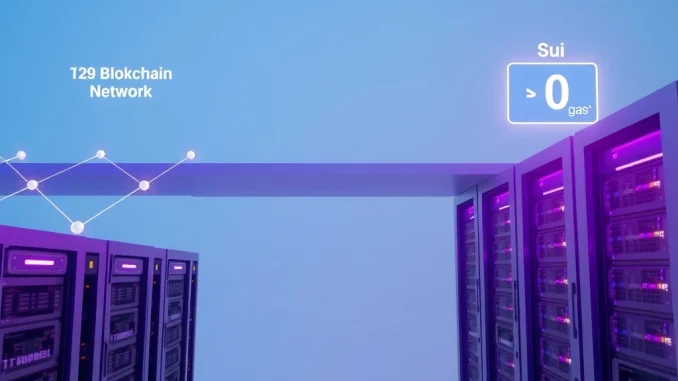
San Francisco, April 2025: The Sui network, a prominent Layer 1 blockchain, has taken a foundational step toward eliminating one of the most persistent user friction points in Web3: transaction fees. Mysten Labs, the core research and development entity behind Sui, has officially launched Tidehunter, a novel database architecture specifically engineered to enhance SSD performance and reliability. This technical upgrade is not merely an incremental improvement; it represents the critical infrastructure required to support a future of stable, predictable, and ultimately gasless transfers on the Sui blockchain, marking a pivotal moment in its development roadmap.
Sui Gasless Payments: The Vision and The Technical Hurdle
For years, the concept of gasless transactions has been a holy grail for blockchain developers. Gas fees—the payments users make to compensate network validators for computing energy—create volatility, complexity, and a significant barrier to mass adoption, especially for micro-transactions and new users. While some networks offer “sponsored transactions” where a third party pays the fee, true, native gaslessness requires a fundamental rethinking of network economics and underlying data structures. The Sui network, built with the Move programming language and an object-centric data model, was architecturally designed for high throughput and low latency. However, achieving consistent, predictable, and eventually zero-cost transactions demands extreme efficiency at the data layer, where transaction history and state are stored and retrieved. This is the precise problem Tidehunter aims to solve.
Decoding Tidehunter: A Database Built for Blockchain Scale
Tidehunter is not a consumer-facing application but a core infrastructural component. Its primary function is to manage the state of the Sui blockchain—the record of all assets, ownership, and smart contract data—with unprecedented efficiency. Traditional blockchain databases can become bottlenecks, especially under high load, leading to slower sync times for validators and increased operational costs that ultimately translate to user fees. Tidehunter introduces a re-architected database system optimized for Solid State Drives (SSDs), which are standard in modern data centers. Key innovations include:
- Enhanced Write Amplification Reduction: It minimizes the number of times data is rewritten on the SSD, drastically extending hardware lifespan and improving write speeds.
- Optimized State Pruning: The system can more efficiently archive old transactional data while keeping the active “hot” state readily accessible, reducing storage bloat.
- Predictable Performance: By smoothing out I/O (input/output) operations, Tidehunter provides more consistent performance under variable loads, a prerequisite for stable transaction pricing.
This engineering work directly lowers the operational overhead for network validators. When validators can operate more efficiently and at lower cost, the economic model of the network can evolve to subsidize or eliminate fees for end-users without compromising security or decentralization.
The Historical Context: From Bitcoin’s Volatile Fees to Modern Solutions
The quest to mitigate gas fees has driven innovation across the crypto industry. Ethereum’s shift to a Proof-of-Stake consensus mechanism and subsequent proto-danksharding roadmap aim to increase capacity and lower costs. Other chains employ mechanisms like delegated staking or burn models to manage fee markets. Sui’s approach with Tidehunter is distinct because it attacks the problem at the foundational data layer. It follows a logical progression in blockchain scaling: first, optimize consensus for speed (which Sui did with its Narwhal & Bullshark consensus); second, optimize execution parallelization (Sui’s object-centric model); and third, optimize data storage and retrieval for long-term sustainability and cost reduction. Tidehunter represents this crucial third pillar, an evolution that acknowledges that for true mass adoption, the user experience must become indistinguishable from, or superior to, traditional digital payments.
Implications for Developers and the Sui Ecosystem
The rollout of Tidehunter has immediate and long-term consequences for projects building on Sui. In the short term, developers benefit from a more reliable and performant network backend, which can reduce infrastructure headaches and improve the responsiveness of their decentralized applications (dApps). In the medium to long term, the path toward gasless transactions opens new design spaces:
- Microtransaction-Based Models: Games and content platforms can implement true pay-per-action or fractional ownership models without fees consuming the transaction value.
- Enterprise Adoption: Businesses requiring predictable operational costs can model blockchain integration more accurately without fearing gas price spikes.
- User Onboarding: The complexity of acquiring native tokens solely to pay fees—a major hurdle for newcomers—is removed, enabling seamless first-time interactions.
This transition will likely be phased. Mysten Labs has indicated that stable, predictable transfers are the immediate goal post-Tidehunter, creating a fee market less susceptible to wild fluctuations. A fully gasless model may involve community governance, tokenomics adjustments, or sponsored transaction frameworks built atop this new, efficient foundation.
Conclusion: A Foundational Step Toward Invisible Infrastructure
The launch of Tidehunter on the Sui network is a seminal development that transcends a simple technical upgrade. It represents a calculated, infrastructure-first approach to solving the gas fee dilemma. By re-engineering the database layer for maximum SSD performance and reliability, Mysten Labs is laying the physical groundwork for an economic shift. While Sui gasless payments are not a present-day reality, Tidehunter provides the essential technical credibility for that future. It signals that the next frontier of blockchain competition is not just about transactions per second, but about creating a user experience so smooth that the underlying technology becomes invisible—a necessary condition for Web3 to reach its next billion users.
FAQs
Q1: What is Tidehunter on the Sui network?
Tidehunter is a new database system launched by Mysten Labs for the Sui blockchain. It is optimized for SSD storage to significantly improve network performance, reliability, and data handling efficiency, which is foundational for enabling future gasless transaction capabilities.
Q2: Does Tidehunter mean Sui transactions are gasless right now?
No. Tidehunter is an infrastructure upgrade that paves the way for gasless transactions. It lowers operational costs and improves stability, which are necessary prerequisites. The actual implementation of a gasless model will involve further economic and governance decisions by the Sui community.
Q3: How does a better database lead to gasless payments?
Gas fees compensate validators for computational and storage costs. By making data storage and retrieval vastly more efficient with Tidehunter, the operational cost for validators decreases. This creates the economic headroom to subsidize or eliminate fees for end-users without compromising network security or validator incentives.
Q4: What are the immediate benefits of the Tidehunter upgrade?
Immediate benefits include improved network performance and consistency for all Sui users, more reliable infrastructure for developers building dApps, and extended hardware lifespan for network validators due to reduced SSD wear. This leads to a more stable and predictable user experience.
Q5: How does Sui’s approach to gaslessness differ from other blockchains?
While some chains focus on layer-2 solutions or alternative fee markets, Sui’s approach with Tidehunter is to solve the cost problem at the base layer’s data storage architecture. It combines this with Sui’s inherently high-throughput design, aiming to make the core network itself so efficient that fees become negligible or unnecessary.
Related: Bitcoin Neo-Bank Breakthrough: Core's SatPay Aims to Redefine BTC Financial Infrastructure
Related: UK FCA Stablecoins: Regulator Reveals Four Firms for Critical Sandbox Testing Before 2027 Rules
Related: $SHOLA Token Launch: Shola's Strategic Collaboration with Pump.fun on Solana