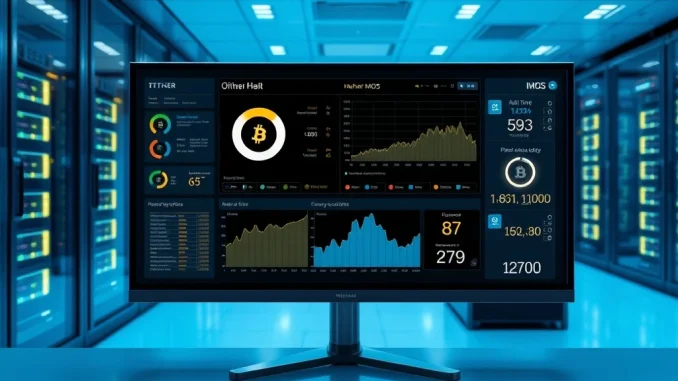
Tether MOS: The Revolutionary Open-Source OS Transforming Bitcoin Mining Forever
San Salvador, February 2, 2026: In a move poised to reshape the foundational infrastructure of the world’s largest cryptocurrency, Tether Operations Limited unveiled its Mining OS (MOS), a comprehensive open-source operating system designed for Bitcoin mining. Announced at the Plan 9 Forum, this platform aims to introduce unprecedented levels of centralized control, operational scalability, and data integration to an industry historically characterized by fragmentation. By providing a unified system to manage hardware, energy consumption, and infrastructure data in bulk, Tether MOS represents a significant evolution in how mining enterprises and pools can optimize their operations.
Tether MOS: A Deep Dive into the Open-Source Mining Platform
The core innovation of Tether MOS lies in its holistic approach. Unlike proprietary management software bundled with specific hardware or developed in-house by large mining farms, MOS is offered as a free, open-source solution. This strategic decision allows for widespread adoption and community-driven development. The system is engineered to aggregate and analyze data from three critical pillars of mining: the application-specific integrated circuit (ASIC) hardware itself, the energy sources powering them, and the physical infrastructure housing the operations. By creating a single pane of glass for this information, operators gain real-time insights into efficiency, predict maintenance needs, and dynamically adjust operations based on energy price fluctuations. This level of integrated control was previously accessible only to the largest and most well-capitalized entities in the space.
The Technical Architecture and Scalability Advantages
From a technical standpoint, MOS functions as a layer between the physical mining rigs and the Bitcoin network. Its architecture is built for scale, capable of managing thousands of individual ASIC units as a single, cohesive fleet. Key features likely include remote reboot and firmware update capabilities, detailed performance benchmarking per unit, and automated failover protocols. The open-source nature means the codebase is publicly auditable, which can enhance security and foster trust within the mining community. Furthermore, it allows third-party developers to build plugins and extensions, potentially creating an ecosystem of tools for predictive analytics, carbon credit tracking, or integration with demand-response energy grids. This approach directly addresses the industry’s pressing need for better tools to manage the immense complexity and capital intensity of modern Bitcoin mining.
Historical Context and Industry Implications
The release of MOS marks a notable pivot for Tether, a company primarily known for issuing the USDT stablecoin. This move signals a strategic expansion into the underlying infrastructure of the cryptocurrency ecosystem it helps facilitate. Historically, Bitcoin mining software has evolved from simple command-line clients like CGMiner and BFGMiner to more graphical, pool-specific interfaces. However, a standardized, enterprise-grade operating system has remained elusive. Tether’s entry into this space, backed by its substantial resources, could accelerate the professionalization and institutionalization of mining. It also raises important discussions about the balance between decentralization—a core tenet of Bitcoin—and the efficiency gains offered by centralized management software. The industry will closely watch whether MOS becomes a neutral tool for all or creates a new form of ecosystem dependency.
Potential Impact on Mining Profitability and Sustainability
The most immediate consequence of widespread MOS adoption could be a narrowing of profit margins for less efficient operators. By providing top-tier management tools for free, Tether effectively raises the baseline for operational competence. Miners using MOS may achieve higher hash rates per watt, reduce downtime, and optimize energy procurement, squeezing out competitors reliant on outdated methods. Concurrently, the sophisticated energy and infrastructure monitoring could become a powerful tool for miners seeking to prove sustainable or green energy usage, a growing concern for regulators and institutional investors. The ability to precisely document energy source and consumption patterns may open doors to new financing or partnership opportunities focused on Environmental, Social, and Governance (ESG) criteria.
Conclusion
Tether’s launch of the open-source Mining OS (MOS) is a landmark development for the Bitcoin mining sector. By offering a robust, scalable, and free operating system that centralizes control over hardware, energy, and infrastructure, Tether is providing the industry with a powerful tool to enhance efficiency, profitability, and potentially, its environmental narrative. While the long-term effects on mining decentralization and market dynamics remain to be seen, the introduction of MOS undeniably represents a significant step toward the maturation and professionalization of global Bitcoin mining operations. The coming months will reveal how quickly the mining community embraces this new platform and what innovations its open-source foundation will inspire.
FAQs
Q1: What is Tether MOS?
Tether MOS (Mining OS) is an open-source operating system released by Tether Operations Limited in February 2026. It is designed to provide centralized management, monitoring, and optimization for large-scale Bitcoin mining operations by integrating data from hardware, energy sources, and physical infrastructure.
Q2: Is Tether MOS free to use?
Yes, Tether has released MOS as a free and open-source software platform. This means anyone can download, use, audit, and modify the code for their own mining operations without licensing fees.
Q3: How does MOS affect Bitcoin mining decentralization?
The impact is a topic of debate. While MOS itself is a neutral tool that any miner can use, its efficiency could favor larger, more organized mining farms. Some argue it promotes centralization of operational best practices, while others contend that making such tools freely available actually decentralizes access to advanced management capabilities.
Q4: What are the main benefits of using the MOS platform?
The primary benefits include bulk management of mining hardware, detailed energy consumption analytics, infrastructure monitoring, potential for increased operational efficiency (hash rate per watt), reduced downtime through predictive maintenance, and tools for better energy procurement strategies.
Q5: Why would Tether, a stablecoin company, develop a Bitcoin mining OS?
Tether’s move is viewed as a strategic expansion into cryptocurrency infrastructure. By supporting and professionalizing the Bitcoin mining industry, Tether strengthens the underlying network of the ecosystem in which its USDT stablecoin operates. It also positions the company in a new, adjacent sector within the blockchain economy.
Related News
- CrytocoinMiner: Helping you unlock $5,000 in daily profits (for everyone)
- Stock Market’s $1.05 Trillion Wipeout Puts To Test Bitcoin Stability
- Won-Pegged Stablecoin Sparks Urgent Warning from Bank of Korea Governor
Related: Explosive Lawsuit: Terraform Estate Accuses Jane Street of Insider Trading During UST Collapse
Related: Launch a Crypto Company in Dubai: The Essential 2026 Founder's Guide
Related: Crypto Market Downturn: Bitcoin and Ethereum Plunge as Investor Fear Hits Extreme Levels