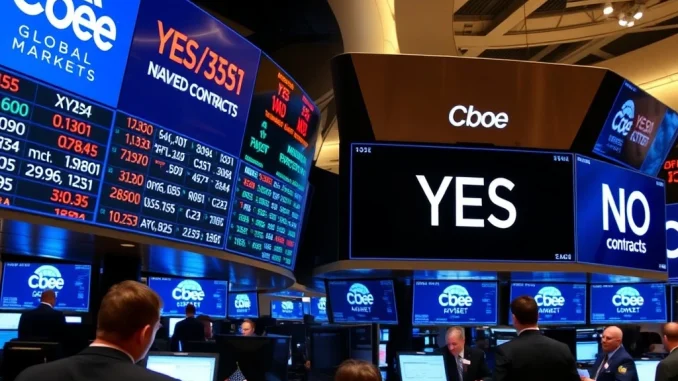
Chicago, April 2025: In a move that signals a significant shift in the landscape of event-based trading, Cboe Global Markets, one of the world’s largest options exchanges, is preparing to reintroduce all-or-nothing options contracts. This strategic initiative, first reported by The Wall Street Journal, directly targets the burgeoning retail interest in binary, yes-no style contracts and positions the regulated exchange as a formidable competitor to decentralized prediction markets like Kalshi and Polymarket. The relaunch represents a pivotal moment, aiming to bring the speculative appeal of prediction markets under a established, transparent regulatory framework long associated with traditional finance.
Cboe’s Calculated Return to Binary Options
Cboe’s plan to relaunch all-or-nothing contracts is not its first foray into binary outcomes. The exchange previously listed similar products but delisted them years ago due to low trading volumes and a nascent retail derivatives market. The current environment, however, is fundamentally different. A confluence of factors has created fertile ground for this reintroduction. The dramatic growth in retail trading participation since 2020, fueled by zero-commission brokers and social media, has created a vast pool of investors comfortable with derivatives. Simultaneously, prediction markets operating in regulatory gray areas have demonstrated substantial demand for contracts based on political elections, economic indicators, and current events.
This time, Cboe is leveraging its core strengths: deep liquidity, established clearinghouse infrastructure (Options Clearing Corporation), and stringent regulatory oversight by the SEC and CFTC. The new contracts will be standardized, exchange-listed, and centrally cleared, mitigating the counterparty risk that can plague over-the-counter or crypto-based prediction markets. This framework directly addresses historical concerns associated with binary options, which were often marketed through unregulated offshore platforms and linked to widespread fraud and investor losses in the past.
The Direct Challenge to Prediction Market Platforms
The relaunch sets the stage for a direct clash between traditional, regulated finance and the agile, often crypto-native, prediction market sector. Platforms like Kalshi, which is registered with the CFTC as a designated contract market, and Polymarket, which operates on blockchain technology, have carved out a niche by offering contracts on non-financial events—from Oscar winners to geopolitical outcomes. Cboe’s entry threatens to fragment this growing market by offering a trusted, familiar venue for a similar product type.
The competition will likely hinge on several key factors:
- Regulatory Clarity vs. Innovation Speed: Cboe offers a clear regulatory path, appealing to institutional players and cautious retail investors. Prediction markets may retain an edge in quickly listing contracts on niche or timely events.
- Market Access and Integration: Cboe contracts will be accessible through existing brokerage accounts used by millions, lowering the barrier to entry compared to setting up a crypto wallet for platforms like Polymarket.
- Contract Design and Settlement: The specific terms of Cboe’s contracts—such as event selection, tick sizes, and settlement mechanisms—will be crucial in determining their appeal relative to the often more flexible structures on prediction platforms.
This competition could lead to a bifurcation: regulated exchanges capturing high-volume, financially-oriented event contracts (e.g., “Will the Fed raise rates by 25bps?” or “Will Company X’s earnings exceed estimates?”), while crypto-native markets focus on cultural, political, and long-tail events.
Addressing the Legacy of High-Risk Binary Trading
Cboe’s initiative is acutely aware of the checkered history of binary options. In the 2010s, the term became synonymous with predatory, offshore platforms that used aggressive marketing and often manipulated pricing to guarantee client losses. Regulatory bodies worldwide issued stern warnings and crackdowns. By bringing these instruments onto a regulated exchange, Cboe aims to rehabilitate the product’s image. The exchange-listed model ensures price transparency, fair execution, and segregation of customer funds. Furthermore, the involvement of the OCC as the central counterparty eliminates the risk that the contract writer will default on a payout, a critical layer of protection absent in many previous binary options schemes.
This move can be seen as part of a broader trend of traditional finance co-opting and formalizing innovations from the fintech and crypto spaces. Just as Bitcoin futures brought cryptocurrency volatility into regulated markets, Cboe’s all-or-nothing contracts aim to domesticate the speculative energy of prediction markets.
Implications for Traders and the Broader Market
The successful relaunch of these contracts could have wide-ranging effects. For retail traders, it provides a new, potentially simpler tool for expressing a directional view on an event’s outcome with defined risk (the premium paid) and defined reward. For the market structure, it represents an expansion of the listed derivatives universe, potentially attracting new capital and trading strategies. Market makers and proprietary trading firms will need to develop models to price and hedge these event-based options, which behave differently from traditional equity or index options.
From a regulatory perspective, the development will be closely watched. A successful, transparent, and fair market for these contracts could provide a template for how event-based trading can be integrated into the mainstream financial system. It also raises questions about the future regulatory path for standalone prediction markets, potentially increasing pressure for them to seek formal designation or face continued competition from deeply capitalized incumbents.
Conclusion
Cboe Global Markets’ decision to relaunch all-or-nothing contracts is a strategic and timely maneuver. It seeks to capitalize on proven retail demand, channel it into a regulated environment, and directly challenge the growing prediction market sector. This move is more than just a new product listing; it is a boundary push, testing how far the traditional listed derivatives model can expand to encompass non-financial speculation. The success of these Cboe all-or-nothing contracts will depend on their design, liquidity, and ability to offer a compelling alternative to both the shadow of past binary options scandals and the innovative appeal of decentralized prediction platforms. The coming months will reveal whether the authority of a legacy exchange can successfully tame and monetize the volatile world of event-based betting.
FAQs
Q1: What are all-or-nothing options contracts?
All-or-nothing options, also known as binary options, are a type of derivative where the payoff is either a fixed monetary amount if a specific condition is met (e.g., an index closes above a certain level) or nothing at all. They offer a simple yes/no proposition on the outcome of an event.
Q2: How will Cboe’s new contracts differ from past binary options?
Cboe’s contracts will be exchange-listed and centrally cleared through the Options Clearing Corporation (OCC). This provides price transparency, regulatory oversight, and eliminates counterparty risk, addressing the fraud and opacity that plagued many unregulated, offshore binary options platforms in the past.
Q3: Who are the main competitors to Cboe in this space?
The primary competitors are regulated prediction markets like Kalshi (CFTC-regulated) and decentralized, crypto-based platforms like Polymarket. These platforms already offer contracts on a wide range of events, from finance to politics and pop culture.
Q4: Why is Cboe relaunching these contracts now?
Cboe is likely motivated by the surge in retail trading, demonstrated demand for event-based contracts on prediction markets, and an opportunity to bring this activity into a regulated, familiar ecosystem where it can leverage its existing infrastructure and liquidity.
Q5: What are the potential risks for retail traders with these new contracts?
While the regulated structure mitigates fraud risk, the contracts are inherently high-risk, speculative instruments. The entire premium paid for the option can be lost if the predicted outcome does not occur. Traders must fully understand the all-or-nothing payoff structure before participating.