Best Crypto to Buy Analysis: SOL and SHIB Stall as ZKP’s 190M Daily Token Release Reshapes Market
Global, March 2025: The cryptocurrency market presents a complex picture as established assets like Solana (SOL) and Shiba Inu (SHIB) encounter significant resistance at key technical levels. Concurrently, a substantial shift in tokenomics from projects utilizing Zero-Knowledge Proof (ZKP) technology, marked by a daily release of 190 million tokens and a $5 million incentive pool, is introducing new variables for traders evaluating the best crypto to buy. This divergence highlights evolving market mechanics beyond simple price action.
Analyzing the Resistance for SOL and SHIB
Market data from major exchanges indicates that Solana’s price has struggled to maintain momentum above the $180 threshold, a level that has acted as both support and resistance multiple times throughout 2024. This stagnation occurs despite continued growth in its network activity, including daily active addresses and decentralized exchange volume. Analysts point to a combination of macroeconomic headwinds affecting the broader technology sector and profit-taking from earlier investors as primary contributors to the current consolidation phase.
Shiba Inu faces a similar narrative, with its price action hovering around the $0.00003 mark. The memecoin’s trajectory has become increasingly tied to broader sentiment shifts rather than isolated developments within its ecosystem. The SHIB community continues to advocate for the token’s utility through its Shibarium layer-2 network, but market movements suggest traders are awaiting a stronger catalyst to push beyond established resistance zones. This period of stability, following previous volatility, is not uncommon for assets of this market cap and reflects a market searching for clear directional signals.
The Mechanics of ZKP’s Substantial Daily Token Release
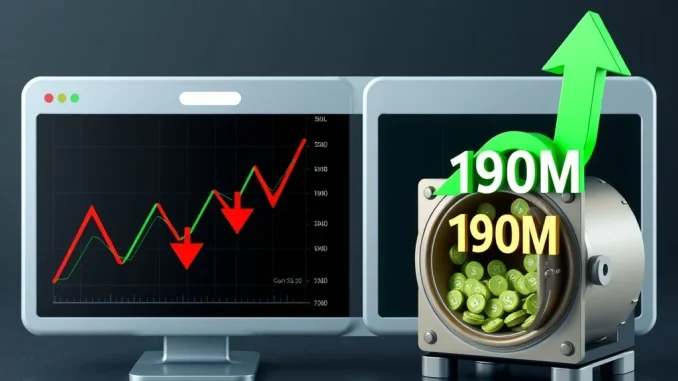
A distinct dynamic is emerging from a segment of the market focused on privacy and scalability. Several projects built with Zero-Knowledge Proof technology have initiated token generation events featuring aggressive emission schedules. One prominent protocol has structured its economics to release approximately 190 million tokens into circulation daily. This design is not an airdrop but a programmed, linear vesting schedule tied to network participation and staking rewards.
The framework typically involves a presale auction model that determines initial distribution, followed by a multi-year emission curve. Proponents argue this model promotes decentralization and long-term alignment by preventing large, concentrated token dumps from early backers. However, the immediate effect is a constant, predictable increase in circulating supply, which requires sustained demand growth to maintain price equilibrium. This presents a clear, quantifiable variable for any trader assessing the project’s viability.
- Vesting Schedule: Tokens are unlocked daily over several years from team, investor, and foundation treasuries.
- Staking Rewards: A significant portion of the daily release is allocated as incentives for users who stake tokens to secure the network.
- Ecosystem Fund: Another segment is directed towards grants and liquidity provisions to bootstrap application development.
Contextualizing the $5 Million Prize Pool Initiative
Parallel to the token release, a $5 million prize pool has been announced by the project’s governing foundation. This capital is not a marketing giveaway but is structured as a developer incentive program. The funds are allocated through a transparent governance process to reward the building of specific, high-value applications on the ZKP network, such as private decentralized finance (DeFi) tools or scalable gaming infrastructures.
This initiative mirrors successful ecosystem development strategies seen in earlier blockchain cycles, where targeted funding accelerated developer adoption. The prize pool creates a tangible use-case demand driver for the native token, as developers often need to acquire and hold it for gas fees, governance, or integration within their awarded projects. This creates a potential counterbalance to the sell pressure from the daily token release by fostering utility-driven demand.
Evaluating New Tokenomics in Crypto Investment Decisions
The confluence of these factors—resistance in large-cap assets and novel emission models in newer protocols—requires traders to expand their analytical frameworks. The question of the best crypto to buy now involves more than chart patterns. It necessitates a deep understanding of token supply mechanics, vesting schedules, and real utility triggers.
For assets like SOL and SHIB, analysis focuses on network fundamentals, adoption metrics, and their ability to break key technical levels that could trigger new market cycles. For projects with high emission rates like the ZKP example, the critical metric becomes the “demand capture rate”—whether new utility, users, and locked value can grow faster than the expanding supply. The $5 million developer pool is a direct attempt to engineer this demand.
| Factor | SOL/SHIB Scenario | High-Emission ZKP Scenario |
|---|---|---|
| Primary Challenge | Overcoming technical & psychological price resistance | Managing predictable, large daily sell-side pressure |
| Demand Driver | Broader market sentiment, ecosystem growth | Programmed utility incentives (e.g., developer prizes) |
| Trader Focus | On-chain activity, breakout volume | Emission schedule, staking yield, utility adoption rate |
| Risk Profile | Market-correlated volatility | Inflationary dilution if demand lags |
Conclusion
The current cryptocurrency landscape demonstrates a maturation in market dynamics. Identifying the best crypto to buy opportunities now requires dissecting both technical price action for established tokens and the fundamental economic design of emerging protocols. While SOL and SHIB work through consolidation phases at familiar resistance levels, the ambitious token release and incentivized development model of certain ZKP projects present a different type of proposition—one where success is measured by the network’s ability to productively absorb new supply. For informed participants, this divergence creates distinct analytical pathways, emphasizing that comprehensive research into both charts and tokenomics remains the cornerstone of effective crypto market navigation.
FAQs
Q1: Why are SOL and SHIB prices stalling?
Both assets are encountering established technical resistance levels (around $180 for SOL and $0.00003 for SHIB). This is often a zone where selling pressure increases from earlier investors taking profits, combined with a lack of immediate, strong bullish catalysts to push the price higher, leading to consolidation.
Q2: What does a 190M daily token release mean for a cryptocurrency?
It means the circulating supply of the token increases by that amount every day, typically through programmed vesting or staking rewards. This creates constant sell-side pressure. The project’s long-term success depends on generating enough new demand (through utility, users, and locked value) to outpace this inflation.
Q3: How does a presale auction framework work?
Instead of a fixed-price sale, participants bid for tokens during a set period. The final token price is determined by the auction’s clearing price, aiming for a more market-driven and fair initial distribution. Tokens are often subject to a vesting schedule after the auction.
Q4: What is the purpose of a $5M developer prize pool?
It is an ecosystem growth tool. The funds are awarded to developers who build specific, valuable applications on the blockchain. This incentivizes development, increases network utility, and can create sustained demand for the native token from developers and users of the new applications.
Q5: What should I research when looking for the best crypto to buy?
Look beyond price charts. Research the project’s tokenomics (total supply, emission rate, vesting schedules), its core technology and utility, on-chain activity metrics (active addresses, transaction volume), development activity, and the competitive landscape. Understand both the potential for price appreciation and the risks, such as dilution or lack of adoption.
Related News
- No mining machine is needed, you can earn coins while lying down! KGNcloud mining allows ordinary people to easily obtain passive income from Bitcoin and Dogecoin!
- HTX USDT on Aptos: A Strategic Move as Network Hits $1B Stablecoin Milestone
- HODL 2025 Announces Its Biggest Web3 Gathering in Dubai
Related: Strategic Shift: Public Miner Sells Entire Bitcoin Stockpile as Self-Managed Hashrate Climbs to Top
Related: XRP Ledger Transactions Surge 40%: A Revealing 2.5M Daily Activity Divergence
Related: Daily Crypto Gainers: $PIPPIN Surges 18% as $DCR Leads Altcoin Momentum