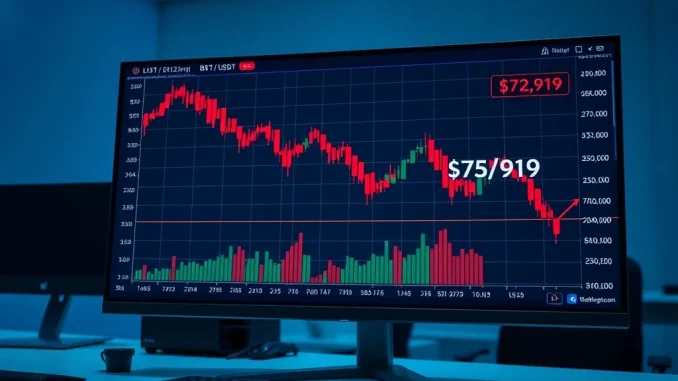
Bitcoin Price Plummets: BTC Falls Below $76,000 in Market Correction
Global, May 2025: The cryptocurrency market experienced a significant correction today as the price of Bitcoin (BTC) fell below the $76,000 threshold. According to real-time data from CoinPulseHQ, Bitcoin is currently trading at $75,919.51 on the Binance USDT perpetual futures market. This move represents a notable pullback from recent highs and has sparked analysis among traders and market observers regarding the underlying drivers and potential trajectory.
Bitcoin Price Dips Below Key Psychological Level
The descent below $76,000 marks a critical juncture for the world’s leading digital asset. Market monitoring services recorded the drop during early trading hours, with selling pressure accelerating across major exchanges. This price action follows a period of consolidation and tests the resolve of the bullish sentiment that has characterized much of the recent market cycle. Analysts point to several immediate factors that may have contributed to the downward movement.
Firstly, broader macroeconomic indicators often influence cryptocurrency valuations. Shifts in traditional equity markets, changes in monetary policy expectations from central banks, and fluctuations in the strength of the US dollar can create headwinds for risk assets like Bitcoin. Secondly, on-chain data reveals patterns of profit-taking by long-term holders, a common phenomenon after sustained price appreciation. Large transfers to exchange wallets, often a precursor to selling, were noted in the hours preceding the decline.
Analyzing the Cryptocurrency Market Context
To understand the significance of Bitcoin trading at $75,919, one must consider the historical and technical context. Bitcoin’s price is inherently volatile, and movements of this magnitude, while attention-grabbing, are not uncommon within its market structure. The asset recently challenged all-time highs, and a retracement is a typical feature of its price discovery process.
- Support and Resistance: Technical analysts are closely watching key support levels. The $75,000 zone has acted as both support and resistance in recent months, making its defense crucial for the near-term bullish thesis.
- Market Dominance: Bitcoin’s market dominance—its share of the total cryptocurrency market capitalization—often shifts during corrections. A stable or increasing dominance can signal that the sell-off is contained within Bitcoin, while a drop might indicate a broader flight from crypto assets into stablecoins or fiat.
- Liquidations: Derivatives markets play a large role. The price drop likely triggered the liquidation of leveraged long positions on futures exchanges, which can exacerbate downward momentum in a cascade effect.
Historical Precedents and Volatility Cycles
Bitcoin’s history is defined by cycles of rapid appreciation followed by significant drawdowns. For instance, the 2021 bull market saw multiple corrections exceeding 20% before the asset reached its peak. These periods serve as a reminder of the asset’s high-risk, high-reward profile. Current volatility, as measured by metrics like the Bitcoin Volatility Index, remains elevated but within the expected range for this phase of its adoption curve. Long-term investors often view such pullbacks as potential accumulation opportunities, though this strategy carries inherent risk.
The Mechanics of the Trade: Binance USDT Perpetual Market
The reported price of $75,919.51 comes specifically from the Binance USDT perpetual swap market. This is a critical venue for price discovery. Perpetual contracts, or “perps,” are derivative instruments that allow traders to speculate on Bitcoin’s price without an expiry date. The price on this market is kept in line with the spot price through a funding rate mechanism. Discrepancies between major perpetual markets (like Binance, Bybit, and OKX) and spot exchanges (like Coinbase) are usually arbitraged away quickly, ensuring global price cohesion.
The prevalence of USDT (Tether) as the quote currency highlights its role as the primary stablecoin pairing in crypto. Most global trading volume occurs against USDT, making its price the de facto benchmark for many traders. Monitoring the order book depth on this pair provides insight into where buy and sell orders are clustered, indicating potential future support or resistance levels.
Institutional and Regulatory Landscape
The current price movement occurs against a backdrop of evolving institutional involvement. The approval and launch of spot Bitcoin Exchange-Traded Funds (ETFs) in several jurisdictions have created new channels for traditional capital to enter the market. Daily net flows into or out of these ETFs are now a key metric watched by analysts. Simultaneously, regulatory developments worldwide continue to shape market sentiment. Clarity in some regions contrasts with uncertainty in others, creating a complex environment for global asset pricing.
Potential Implications for the Broader Digital Asset Ecosystem
Bitcoin’s price action often sets the tone for the entire digital asset sector, a phenomenon known as “market beta.” When Bitcoin corrects sharply, altcoins (alternative cryptocurrencies) frequently experience even more pronounced declines. This correlation underscores Bitcoin’s role as the reserve asset of the crypto economy. However, the degree of correlation can vary. In some market phases, capital rotates from Bitcoin into altcoins, or vice versa, based on narratives around technological innovation, protocol upgrades, or specific sector trends like Decentralized Finance (DeFi) or Non-Fungible Tokens (NFTs).
For retail and institutional portfolios, such volatility necessitates robust risk management frameworks. Strategies like dollar-cost averaging (DCA), position sizing, and the use of stop-loss orders are commonly discussed in response to market moves. Furthermore, the health of the underlying Bitcoin network—measured by hash rate, active addresses, and transaction fees—remains strong, suggesting a divergence between short-term price action and long-term network fundamentals.
Conclusion
Bitcoin’s fall below $76,000 to a price of $75,919.51 is a significant event that reflects the dynamic and often unpredictable nature of the cryptocurrency market. While the immediate cause may be a combination of profit-taking and macroeconomic sensitivity, the move fits within the historical pattern of Bitcoin’s volatile growth. Market participants will now watch for whether key support levels hold, the behavior of institutional ETF flows, and the resilience of broader market sentiment. The Bitcoin price remains the foremost indicator for the digital asset industry, and its next steps will be critical in determining the direction for the wider market in the coming weeks.
FAQs
Q1: Why did Bitcoin’s price fall below $76,000?
The decline is likely due to a combination of factors including broader market risk-off sentiment, profit-taking by investors after a period of gains, and liquidations of leveraged long positions in derivatives markets. Macroeconomic conditions often influence all risk assets, including cryptocurrencies.
Q2: Is a drop to $75,919 a major crash for Bitcoin?
While notable, a drop of this magnitude is within the range of normal volatility for Bitcoin. The cryptocurrency has a history of experiencing corrections of 20-30% during bull markets. Context, such as the percentage drop from recent highs and the defense of key support levels, is more important than the absolute dollar figure.
Q3: What does “trading on the Binance USDT market” mean?
It means the price is quoted from the Bitcoin/USDT trading pair on the Binance exchange. USDT (Tether) is a stablecoin pegged to the US dollar. The “perpetual” market refers to a type of futures contract with no expiry date, which is a major venue for price discovery and often closely tracks the spot price.
Q4: How does Bitcoin’s price drop affect other cryptocurrencies?
Bitcoin often leads the market. A sharp drop in BTC typically puts downward pressure on most other cryptocurrencies (altcoins), often with higher volatility. This is due to Bitcoin’s large market dominance and its role as a benchmark for the entire asset class.
Q5: Where can investors find reliable, real-time Bitcoin price data?
Reputable sources include data aggregators like CoinGecko and CoinMarketCap, which compile prices from multiple exchanges. Trading platforms like Binance, Coinbase, and Kraken provide real-time charts and order book data. It’s important to use established platforms to ensure data accuracy.
Related News
- From $100 to $1 Million: These Low-Cap Gems Could Make You a Crypto Millionaire by 2025
- Solana Validator Count Plummets: A 65% Decline from Peak Raises Decentralization Questions
- Layer-2 Social Dominance: How Linea and Starknet's Surging Engagement Signals a New Growth Paradigm
Related: Bitcoin ETF Inflows Surge to $88M as Ethereum ETF Demand Stalls Dramatically
Related: Strategic Accumulation: Bitmine Acquires $217M in ETH During Market Panic Selling