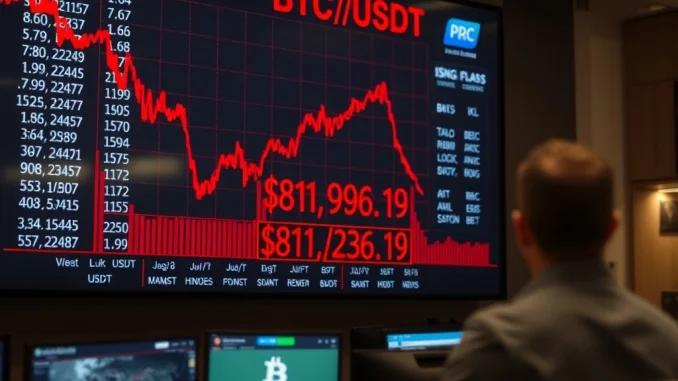
Global, May 2025: The cryptocurrency market witnessed a significant movement as the Bitcoin price fell below the $82,000 mark. According to real-time data from CoinPulseHQ, the premier digital asset is currently trading at $81,957.71 on the Binance USDT perpetual futures market. This decline represents a notable shift in market sentiment and follows a period of relative consolidation at higher levels. The move below this psychological threshold has prompted analysis from traders and observers worldwide, seeking to understand the drivers and potential trajectory.
Bitcoin Price Drops Below Key Level
The descent of Bitcoin below $82,000 marks a clear technical breach. Market data shows a decisive break from the $82,500 to $84,000 range where BTC had traded for several sessions. The Binance USDT pair, a primary liquidity venue for global traders, reflects the immediate selling pressure. This price action is not occurring in isolation. Concurrently, we observe correlated movements in major altcoins and shifts in key market metrics like the Bitcoin Dominance Index and total cryptocurrency market capitalization. The velocity of the drop suggests a combination of liquidations and strategic profit-taking by large holders, often referred to as whales. Historical order book analysis indicates that $82,000 served as a robust support zone, making its breach a focal point for technical analysts.
Analyzing the Cryptocurrency Market Context
To fully grasp the significance of this price movement, one must consider the broader market landscape. Several interconnected factors typically influence such volatility.
- Macroeconomic Signals: Traditional finance indicators, such as U.S. Treasury yield movements, dollar strength (DXY), and equity market performance, often exert pressure on digital asset valuations. Risk-off sentiment in broader markets can trigger capital outflow from cryptocurrencies.
- On-Chain Metrics: Data from blockchain analysts provides deeper insight. Metrics like Exchange Net Flow, which tracks movements of BTC to and from trading platforms, can signal whether holders are accumulating or preparing to sell. The Spent Output Profit Ratio (SOPR) indicates the profitability of coins being moved on-chain.
- Derivatives Market Health: The funding rates on perpetual swap contracts and open interest on derivatives exchanges like Binance and Bybit are critical. Excessively high funding rates can precede corrections as long positions become expensive to hold.
- Regulatory and Geopolitical Newsflow: Announcements from major economies regarding digital asset regulation or monetary policy can create immediate market reactions.
Historical Precedents and Market Cycles
Bitcoin’s history is characterized by periods of explosive growth followed by significant corrections. A drop of this magnitude, while noteworthy, fits within the established pattern of the asset’s volatility. For context, during the 2021 bull market, Bitcoin experienced multiple drawdowns exceeding 20% before resuming its upward trend. The current market structure, post-2024 halving, suggests we are in a phase where volatility is expected as the market seeks a new equilibrium. Analysts often compare present support and resistance levels to those established in previous cycles, although each cycle possesses unique fundamentals.
Implications for Traders and Long-Term Holders
The immediate implications differ vastly between short-term traders and long-term investors. For active traders, the break below $82,000 may trigger predefined risk management protocols. Stop-loss orders clustered around this level can create cascading sell pressure, a phenomenon known as a liquidity sweep. Conversely, value-oriented investors may view this as a potential accumulation zone, especially if on-chain data suggests long-term holders are not distributing their coins. The behavior of large entities, tracked through wallets holding over 1,000 BTC, will be closely monitored for signs of conviction or capitulation.
The table below outlines key price levels and their significance based on recent trading activity:
| Price Level | Significance |
|---|---|
| $85,000 | Previous resistance; psychological barrier |
| $82,000 | Recent support; now breached |
| $80,000 | Major psychological and technical support |
| $78,500 | Next significant support zone (previous consolidation) |
| $75,000 | Long-term trend support (200-day moving average region) |
Expert Perspective on Market Structure
Seasoned market participants emphasize the importance of zooming out. While intraday moves capture headlines, the fundamental thesis for Bitcoin—as a decentralized store of value and hedge against monetary inflation—remains unchanged for its proponents. Network security, measured by hash rate, continues to hit all-time highs, indicating strong miner commitment. Adoption metrics, such as active addresses and settlement volume, provide a more holistic view of network health than price alone. This perspective helps separate short-term noise from long-term signal.
Conclusion
The Bitcoin price falling below $82,000 serves as a reminder of the asset’s inherent volatility and the dynamic nature of the cryptocurrency market. This movement, verified by data from CoinPulseHQ and visible on the Binance USDT market, is a multi-faceted event driven by technical, on-chain, and macroeconomic factors. For the market to regain bullish momentum, it must demonstrate an ability to reclaim lost ground and establish higher support levels. Conversely, a sustained break lower would necessitate a reassessment of near-term bullish scenarios. As always, informed participation in this market requires a focus on verifiable data, robust risk management, and an understanding of the broader financial landscape in which digital assets now operate.
FAQs
Q1: Why did Bitcoin fall below $82,000?
Bitcoin’s price decline is likely due to a combination of factors including leveraged long position liquidations, profit-taking after a rally, potential negative shifts in broader macroeconomic sentiment, and technical selling after breaching a key support level.
Q2: Is this a normal occurrence for Bitcoin?
Yes, significant price corrections are a common feature of Bitcoin’s market cycles. Historical data shows that drawdowns of 20-30% are frequent during bull markets and are often followed by periods of consolidation or recovery.
Q3: What does the price on Binance USDT represent?
The Binance USDT (Tether) pair price represents the value of one Bitcoin quoted in USDT, a stablecoin pegged to the US dollar. It is one of the most liquid trading pairs globally and is a primary benchmark for the spot price of BTC.
Q4: What are the key support levels to watch now?
Following the break below $82,000, traders are watching $80,000 (a major psychological level), followed by $78,500 (a previous consolidation zone), and then the $75,000 region, which aligns with long-term moving averages.
Q5: How does this affect the overall cryptocurrency market?
Bitcoin’s price movement heavily influences the broader crypto market. A sustained drop in BTC often leads to correlated declines in major altcoins (Ethereum, Solana, etc.) and can reduce overall market capitalization and trading volume across all digital assets.