Washington D.C., January 2026: As the United States government entered a partial shutdown this weekend, cryptocurrency prediction markets faced unprecedented scrutiny. Platforms like Polymarket and Kalshi, which allow traders to speculate on real-world events using blockchain technology, revealed significant limitations in their contract formulations and execution mechanisms. The shutdown exposed troubling ambiguities in how these decentralized platforms define, measure, and resolve real-world political events, raising fundamental questions about their reliability and future development.
Crypto Prediction Markets Face Reality Test
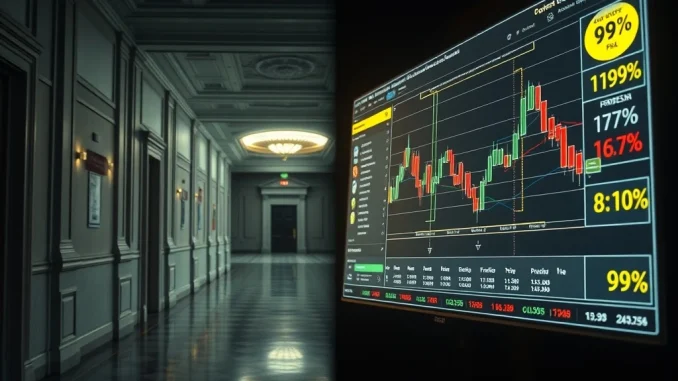
The partial government shutdown began when the House of Representatives, on parliamentary recess, delayed a crucial funding vote until Monday despite Senate approval on Friday night. This created an unprecedented weekend paralysis of federal services. On prediction markets, contracts immediately reflected near-certainty of the event, with Polymarket’s “US Government Shutdown Saturday?” contract showing 99% probability and Kalshi’s similar contract reaching comparable levels. However, examination of contract terms revealed these platforms weren’t actually measuring whether government services ceased operation, but whether specific digital announcements appeared on government websites.
This distinction proved crucial. Polymarket’s contract resolution depended not on whether federal agencies actually stopped functioning, but on whether the Office of Personnel Management (OPM) issued an official announcement. Similarly, Kalshi’s contract required a specific notice to appear on the OPM website at a precise time. This created a paradoxical situation where traders could be betting on digital representations rather than real-world occurrences, fundamentally altering the nature of prediction market utility. The platforms effectively transformed from event predictors to announcement trackers, a subtle but significant shift in their purported function.
The Definition Dilemma in Decentralized Markets
Prediction markets operate on a simple premise: collective wisdom can forecast events more accurately than individual experts. However, the government shutdown exposed how this premise breaks down when contract definitions lack precision. The core problem centers on what exactly constitutes a “government shutdown” for contract resolution purposes. Traditional financial markets and political analysts define shutdowns based on specific criteria:
- Furlough of non-essential federal employees
- Suspension of non-essential government services
- Official designation by the Office of Management and Budget
- Media confirmation through multiple reliable sources
Crypto prediction markets, by contrast, created their own definitions that sometimes diverged from these established standards. This divergence created several problems. First, it introduced information asymmetry between sophisticated traders who understood the fine print and casual participants who assumed they were betting on the commonly understood event. Second, it created potential manipulation opportunities, as parties with knowledge of OPM announcement schedules could gain unfair advantages. Third, it undermined the markets’ credibility as forecasting tools, since their measurements didn’t align with real-world observations.
The Temporal Confusion in Duration Contracts
Further complications emerged in contracts measuring shutdown duration. Polymarket offered contracts allowing bets on whether the shutdown would last 1+, 2+, or 3+ days, all showing probabilities above 99%. However, traders quickly realized the platforms hadn’t clearly defined what constituted a “day” for resolution purposes. Forum discussions revealed intense debate about whether a presidential signature on Monday would invalidate the third day, or whether 72 consecutive hours were required. This ambiguity transformed what should have been straightforward calculations into complex temporal puzzles.
The confusion stemmed from differing interpretations of government operations. Some traders argued that any funding bill signed before midnight Monday would end the shutdown for that day, while others contended that services needed to resume fully to count as a day ending. Kalshi faced similar issues with its “How many days will the federal government be paralyzed before March?” contract, where the “more than two days” option showed over 98% probability despite unclear definition of what constituted paralysis versus partial operation. These definitional problems highlight a broader challenge for prediction markets: translating continuous real-world phenomena into discrete, binary contract outcomes inevitably involves simplification that can distort reality.
Growth Versus Governance in Prediction Markets
The timing of these revelations is particularly significant given prediction markets’ explosive growth. Kalshi recorded $466 million in transactions on January 12 alone, representing 66% of the sector’s total volume. Polymarket has seen similar expansion, with increasing institutional interest in using these platforms for hedging and speculation. This growth creates tension between market expansion and governance refinement. As platforms scale, they face pressure to standardize contracts while maintaining flexibility for diverse events.
Several factors contribute to this governance challenge:
| Challenge | Impact on Markets | Potential Solutions |
|---|---|---|
| Definition ambiguity | Reduced trust, manipulation risk | Clear, publicly verifiable resolution criteria |
| Temporal measurement | Contract resolution disputes | Precise time definitions and measurement standards |
| Information sources | Dependence on specific announcements | Multiple verification sources and oracles |
| Institutional adoption | Need for regulatory compliance | Transparent governance frameworks |
The government shutdown experience suggests prediction markets may need to develop more sophisticated governance mechanisms. These could include independent resolution committees, multi-source verification systems, or standardized definition frameworks for common event types. Without such improvements, platforms risk alienating the institutional traders they’re actively courting, as financial institutions require certainty in contract terms and execution.
The Oracle Problem in Real-World Event Resolution
At its core, the shutdown controversy highlights what blockchain developers call “the oracle problem”—how decentralized systems verify real-world information. Prediction markets rely on oracles (data feeds that provide external information to smart contracts) to resolve contracts. The shutdown revealed weaknesses in current oracle implementations, particularly their dependence on single sources (like specific government websites) rather than consensus across multiple reliable sources.
This single-point dependence creates several vulnerabilities. Government websites can experience technical issues, delays in updates, or even intentional manipulation. More robust systems might incorporate multiple verification methods, including:
- Cross-referencing multiple government agency announcements
- Incorporating reputable media confirmation
- Using decentralized oracle networks with multiple independent reporters
- Implementing time delays to allow for verification and correction
The current approach also raises questions about temporal precision. Government operations don’t switch on and off instantaneously at specific times—they wind down and restart gradually. Prediction markets’ binary, time-specific resolution mechanisms struggle to capture this reality, potentially creating unfair outcomes for traders.
Regulatory Implications and Future Development
The shutdown controversy occurs amid increasing regulatory scrutiny of prediction markets. The Commodity Futures Trading Commission (CFTC) has been examining whether these platforms constitute illegal gambling or legitimate financial markets. Ambiguities in contract definition and resolution complicate this regulatory assessment, as unclear terms could be interpreted as unfair or deceptive practices.
Regulators typically evaluate markets based on several criteria:
- Transparency of terms and conditions
- Fairness in contract design and resolution
- Protection against manipulation and fraud
- Adequate disclosure of risks to participants
The government shutdown experience suggests prediction markets may need to improve performance in all these areas to gain regulatory approval for broader adoption. This could involve developing standardized contract templates for common event types, establishing clearer resolution procedures, or implementing more robust anti-manipulation measures. Platforms that successfully address these issues may gain competitive advantages in attracting institutional participation and regulatory approval.
Conclusion
The US partial government shutdown has served as a revealing stress test for crypto prediction markets, exposing significant flaws in contract design and execution. While these platforms demonstrate impressive growth and technological innovation, their handling of real-world political events highlights fundamental challenges in translating complex occurrences into precise, binary smart contracts. The experience underscores that prediction markets’ reliability depends not just on blockchain technology, but on careful contract design, clear definitions, and robust verification mechanisms. As these markets continue expanding, their success may depend less on technological sophistication and more on governance maturity—particularly their ability to create transparent, fair, and reliable systems for measuring and resolving real-world events. The shutdown controversy ultimately reveals that crypto prediction markets face the same fundamental challenge as traditional markets: building trust through consistency, transparency, and fairness in how they define and measure the events they claim to predict.
FAQs
Q1: What are crypto prediction markets?
Crypto prediction markets are decentralized platforms that allow users to trade contracts based on the outcomes of real-world events using cryptocurrency. They use blockchain technology to create transparent, global markets for event speculation.
Q2: How did the government shutdown reveal problems with these markets?
The shutdown exposed ambiguities in how platforms define events for contract resolution. Contracts depended on specific digital announcements rather than whether government services actually ceased, creating mismatches between market measurements and reality.
Q3: What is the “oracle problem” in prediction markets?
The oracle problem refers to the challenge of reliably bringing real-world information onto blockchain systems. Prediction markets need accurate external data to resolve contracts, but verifying this information in a decentralized, tamper-proof way presents technical and governance challenges.
Q4: How do definition ambiguities affect market participants?
Unclear definitions create information asymmetry, where sophisticated traders who understand fine print gain advantages over casual participants. They also enable potential manipulation and reduce market credibility as forecasting tools.
Q5: What improvements could address these issues?
Potential improvements include clearer contract definitions, multiple verification sources rather than single-point dependencies, standardized templates for common events, independent resolution committees, and more transparent governance frameworks.