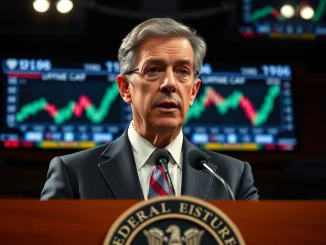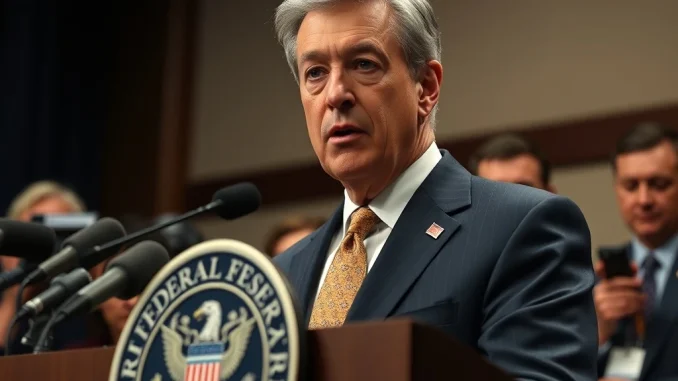
Washington, D.C., May 15, 2025: In a highly anticipated statement, Federal Reserve Chair Jerome Powell affirmed that the central bank’s current monetary policy stance remains appropriate. This declaration signals a period of stability for interest rates as the Fed pursues its dual mandate of price stability and maximum employment. The announcement carries significant weight for financial markets, businesses, and consumers navigating the post-pandemic economic landscape.
Federal Reserve’s Appropriate Policy Stance Explained
Chair Powell’s characterization of the current policy as “appropriate” represents a critical assessment of the economic crossroads. The Federal Open Market Committee (FOMC) has maintained the federal funds rate within a specific target range following an aggressive tightening cycle that began in 2022. This period of stability allows previous rate hikes to fully transmit through the economy while providing policymakers time to assess incoming data. The Fed’s current stance balances the risks of reigniting inflation against the potential for excessive economic cooling. Historical context reveals that such “hold” periods often follow substantial policy adjustments, allowing the complex mechanisms of monetary policy to work through financial systems, credit markets, and ultimately, consumer behavior.
Understanding the Federal Reserve’s Dual Mandate
Chair Powell explicitly referenced the Fed’s two statutory goals established by Congress. These twin objectives guide all monetary policy decisions and create the framework for Powell’s assessment.
- Maximum Employment: This goal focuses on creating conditions for a strong labor market where all who want to work can find jobs. The Fed does not target a specific unemployment number but assesses broader labor market health through multiple indicators including participation rates, wage growth, and job openings.
- Price Stability: The Fed defines this as 2% inflation over the longer run, as measured by the Personal Consumption Expenditures (PCE) price index. Stable prices allow businesses and households to plan for the future without the distortion of rapidly changing purchasing power.
These goals can sometimes create tension, requiring careful calibration of policy tools. Powell’s statement suggests the current stance represents the Committee’s best judgment for advancing both objectives simultaneously.
The Current Economic Backdrop for Monetary Policy
Several key economic indicators inform the Fed’s “appropriate” assessment. Inflation, while significantly reduced from its 2022 peak, remains slightly above the 2% target. The labor market continues to show remarkable resilience with steady job creation, though some cooling has emerged in certain sectors. Consumer spending patterns indicate moderation, while business investment shows signs of caution amid global uncertainties. Financial conditions have tightened considerably since the rate hike cycle began, with higher borrowing costs affecting mortgages, auto loans, and corporate debt. The Fed must consider these lagged effects, as monetary policy operates with delayed impact, typically taking 12-18 months to fully influence economic activity.
Implications of Maintaining the Current Policy Stance
The decision to hold rates steady carries concrete consequences across the economy. For financial markets, it reduces near-term uncertainty about interest rate movements, potentially stabilizing bond yields and equity valuations. For businesses, predictable borrowing costs support planning for expansion, hiring, and capital expenditures. Consumers face continued pressure from existing interest rates on credit cards and loans, but gain clarity for major purchases like homes and vehicles. The international dimension matters too, as U.S. monetary policy influences global capital flows and exchange rates. Emerging market economies particularly watch Fed decisions, as dollar strength affects their debt servicing costs and trade competitiveness.
| Indicator | Current Reading | Trend Direction | Policy Relevance |
|---|---|---|---|
| Core PCE Inflation | 2.3% | Gradual Decline | Primary gauge for price stability mandate |
| Unemployment Rate | 4.0% | Moderate Increase | Labor market health indicator |
| Job Openings | 8.5 million | Declining from highs | Labor market tightness measure |
| GDP Growth | 2.1% (annualized) | Moderate Expansion | Overall economic activity gauge |
Historical Precedents for Policy Pauses
Current conditions echo previous periods when the Fed paused after tightening cycles. The mid-1990s under Chairman Alan Greenspan saw a successful “soft landing” where inflation was controlled without triggering recession. The 2006-2007 pause preceded the Global Financial Crisis, highlighting how external shocks can overwhelm carefully calibrated policy. More recently, the 2018-2019 period featured a pause that eventually turned to rate cuts as global growth concerns mounted. Each historical episode reminds us that “appropriate” is a time-bound judgment requiring constant reassessment against evolving data. Powell’s statement reflects confidence that current settings properly balance risks, but maintains the flexibility to adjust as conditions change.
Forward Guidance and Future Policy Pathways
While describing the current stance as appropriate, Chair Powell emphasized the Fed’s data-dependent approach. The central bank will monitor incoming information to assess progress toward its dual mandate goals. Several scenarios could prompt policy adjustment. Persistent inflation above target might necessitate additional tightening, while unexpected labor market weakness or below-target inflation could justify easing. The Fed also considers financial stability risks, including potential asset bubbles or credit market stress. Future meetings will feature updated economic projections from FOMC participants, providing insight into how policymakers expect the economy to evolve under current settings. This forward guidance helps markets anticipate potential policy shifts, reducing disruptive volatility.
Conclusion
Federal Reserve Chair Jerome Powell’s declaration that current monetary policy remains appropriate represents a calculated pause in a multi-year effort to restore price stability. This stance acknowledges progress against inflation while recognizing ongoing economic resilience. The Fed continues its delicate balancing act between its dual mandate objectives, with policymakers prepared to adjust course as new data arrives. For now, stability in interest rates provides businesses and households with valuable predictability as they make crucial economic decisions. The appropriateness of this policy stance will ultimately be judged by its success in guiding the economy toward sustainable growth with stable prices.
FAQs
Q1: What does Jerome Powell mean by “current policy stance”?
The term refers to the Federal Reserve’s present setting of the federal funds rate (the interest rate banks charge each other for overnight loans) and its balance sheet policies. These tools influence broader financial conditions throughout the economy.
Q2: What are the two goals of Federal Reserve policy that Powell mentioned?
The Fed has a dual mandate from Congress: maximum employment and price stability. Maximum employment means fostering conditions for a strong job market, while price stability means maintaining low, stable inflation around 2% annually.
Q3: Why would the Fed consider the current policy stance “appropriate”?
Policy is deemed appropriate when it appears properly calibrated to move the economy toward the Fed’s dual mandate goals without causing unnecessary disruption. It suggests policymakers believe current settings will continue reducing inflation toward 2% while preserving labor market gains.
Q4: Does “appropriate” mean interest rates won’t change?
Not necessarily. “Appropriate” describes the current assessment based on available data. The Fed remains data-dependent and will adjust policy if economic conditions change significantly. Appropriate today could become inappropriate tomorrow with new information.
Q5: How does this policy stance affect everyday Americans?
The current stance means borrowing costs for mortgages, auto loans, and credit cards will likely remain at current levels. Savers may continue earning higher interest on deposits. The policy aims to gradually reduce inflation while minimizing job losses, affecting everyone’s purchasing power and employment prospects.