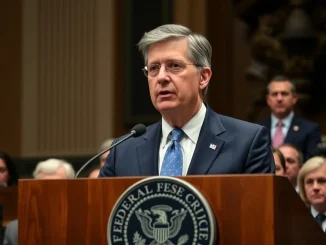
Washington, D.C., March 2025: In a highly anticipated statement, Federal Reserve Chair Jerome Powell delivered a crucial warning to markets and the public: while progress has been made, inflation has not yet reached the central bank’s longstanding 2% target. This declaration underscores the complex and persistent challenge of restoring price stability, a cornerstone of economic health that directly impacts everything from grocery bills to mortgage rates. Powell’s remarks signal a continued period of cautious monetary policy, tempering expectations for rapid interest rate cuts and setting the stage for a measured, data-dependent approach by the nation’s central bank.
Inflation Target: The Fed’s Unwavering Benchmark
The Federal Reserve’s 2% inflation target is not an arbitrary number. It represents a carefully considered balance. This target aims to provide a buffer against deflation—a damaging period of falling prices—while keeping price increases low and stable enough to support sustainable economic growth. For over a decade, this target has guided the Fed’s decisions. When Powell states inflation has not yet reached this target, he is affirming a core mandate. The central bank views its job as incomplete until price increases are consistently moderating at that level. This commitment provides clarity and predictability for businesses making long-term investments and for workers negotiating wages.
Recent data illustrates this gap. While the headline Consumer Price Index (CPI) has fallen significantly from its peak, core inflation—which strips out volatile food and energy prices—has proven more stubborn. Key service categories like shelter, healthcare, and insurance continue to show elevated price pressures. This “stickiness” in certain sectors is a primary reason for the Fed’s ongoing vigilance. Powell’s message reinforces that the battle against inflation is a marathon, not a sprint, requiring patience and persistence from policymakers and the public alike.
Jerome Powell’s Policy Framework and Historical Context
Chair Powell’s current stance must be understood within the historical context of the post-pandemic economic shock. The Federal Reserve, like central banks worldwide, deployed unprecedented stimulus to prevent economic collapse. This necessary action, combined with supply chain disruptions and shifting consumer demand, fueled the fastest price increases in forty years. The Fed’s subsequent response, a series of aggressive interest rate hikes beginning in 2022, was designed to cool demand and bring inflation to heel.
Powell now navigates a delicate phase. The rapid hiking cycle is over, but the “last mile” of inflation reduction is often the most difficult. History provides cautionary tales. In the 1970s, the Fed prematurely eased policy, allowing inflation to become entrenched and requiring even more painful measures later. Powell’s explicit communication that the target is not yet met is a direct effort to avoid repeating that mistake. It anchors public expectations and demonstrates the Fed’s resolve to see the job through, thereby maintaining its hard-won credibility.
- Policy Tools: The Fed’s primary lever is the federal funds rate, which influences borrowing costs across the economy.
- Data Dependence: Every decision is now framed as contingent on incoming economic reports, not a preset course.
- Forward Guidance: Powell’s speeches are a key tool for shaping market behavior and economic expectations.
The Ripple Effects on Markets and Main Street
The implications of Powell’s message are immediate and far-reaching. Financial markets, which often price in expectations for future rate cuts, must recalibrate. Expectations for the timing and pace of monetary easing are pushed further into the future. This typically leads to higher yields on government bonds, which can increase borrowing costs for businesses and homebuyers. For consumers, the message is twofold. First, relief from high prices is a gradual process. Second, the cost of credit—for cars, homes, and credit cards—is likely to remain elevated until the Fed is confident the target is within reach.
For the broader economy, the goal is a “soft landing”—cooling inflation without triggering a severe recession. Powell’s cautious stance is designed to walk that narrow path. By avoiding a declaration of victory too soon, he aims to prevent a resurgence of inflation that would necessitate even tougher policy later. This approach prioritizes long-term stability over short-term market gratification, a trade-off central to the Fed’s role as an independent institution.
Global Central Banking and the Inflation Fight
The Federal Reserve does not operate in a vacuum. Central banks from the European Central Bank (ECB) to the Bank of Japan face similar challenges, though their specific circumstances differ. Powell’s stance influences global capital flows and currency valuations. A U.S. central bank holding firm on higher rates for longer can strengthen the dollar, affecting international trade and emerging market economies. Furthermore, synchronized messaging from major central banks about the persistence of inflation can reinforce a global environment of tighter financial conditions. This international dimension adds another layer of complexity to the Fed’s calculations, as its policies have worldwide repercussions.
Conclusion: A Patient Path to Price Stability
Federal Reserve Chair Jerome Powell’s clear statement that the inflation target remains unmet is a definitive moment for economic policy. It serves as a necessary reality check, emphasizing that the journey back to 2% inflation requires steady resolve. This commitment to data-driven patience is essential for anchoring expectations and achieving durable price stability. For businesses, investors, and households, the message is to prepare for a prolonged period of cautious monetary policy. The ultimate goal—a stable price environment that fosters maximum employment and sustainable growth—remains firmly in sight, but Powell’s warning confirms the path forward demands continued vigilance. The Fed’s focus on its core inflation target is the guiding principle for all future policy decisions.
FAQs
Q1: What is the Federal Reserve’s inflation target and why is it 2%?
The Federal Reserve has a formal, symmetric inflation target of 2% as measured by the annual change in the Personal Consumption Expenditures (PCE) Price Index. This level is chosen to provide a sufficient buffer against deflation (harmful falling prices) while being low enough to not significantly distort economic decision-making. It represents price stability, a condition conducive to sustainable growth and employment.
Q2: What does Powell mean by “inflation has decreased but not reached our target”?
He is acknowledging that the rate of price increases has slowed considerably from its peak but remains above the Fed’s 2% goal. Key measures of underlying, or “core,” inflation are still elevated. The statement means the Fed’s job is not yet complete, and policy will remain restrictive until more convincing and sustained progress toward 2% is observed.
Q3: How does this statement affect interest rates and borrowing costs?
Powell’s message suggests the Federal Reserve is unlikely to cut its benchmark interest rate in the near term. This means borrowing costs for mortgages, auto loans, and business credit will likely remain at their current elevated levels until there is clearer evidence inflation is decisively moving toward 2%. It pushes back market expectations for imminent rate cuts.
Q4: What are the risks of declaring victory over inflation too early?
Historical precedent, notably from the 1970s, shows that if a central bank relaxes its policy before inflation is fully under control, price pressures can re-accelerate. This “stop-and-go” policy can lead to even higher inflation expectations becoming entrenched, ultimately requiring more severe and economically damaging rate hikes to restore stability later.
Q5: How does the Fed balance fighting inflation with avoiding a recession?
This is the central challenge of achieving a “soft landing.” The Fed uses its tools, primarily interest rates, to moderate economic demand enough to cool inflation without causing a sharp rise in unemployment. Powell’s current cautious, patient approach is designed to extend the period of observation, allowing the full effect of previous rate hikes to filter through the economy while avoiding the need for further aggressive tightening that could trigger a downturn.