Altcoin Season Index Climbs to 29: A Crucial Signal for Crypto Market Dynamics
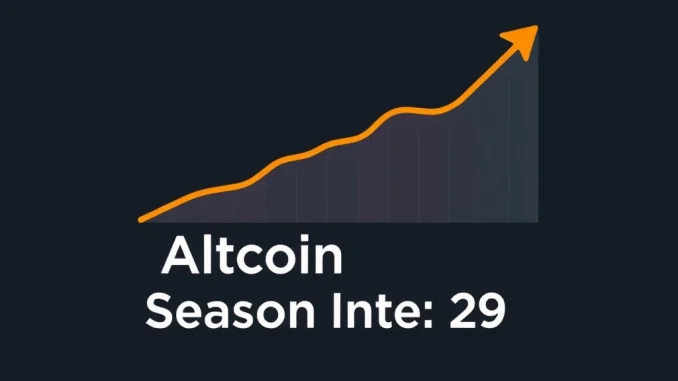
Global, April 2025: A subtle but notable shift is registering on a key cryptocurrency dashboard. CoinMarketCap’s Altcoin Season Index has climbed two points to 29, moving further from Bitcoin-dominated territory. This incremental rise offers a data-driven glimpse into the ongoing tug-of-war between the flagship cryptocurrency and the broader universe of alternative digital assets. While far from the 75-point threshold that officially declares an ‘altcoin season,’ the movement provides analysts and investors with a quantifiable pulse on market rotation trends.
Decoding the Altcoin Season Index: A Market Barometer
The Altcoin Season Index functions as a specialized market barometer, designed to cut through the noise of daily price fluctuations. Its methodology is specific and rule-based. The index analyzes the price performance of the top 100 cryptocurrencies by market capitalization, excluding stablecoins and wrapped tokens, over a rolling 90-day period. It then calculates what percentage of these assets have outperformed Bitcoin during that timeframe. The core premise is straightforward: when capital flows more aggressively into alternative cryptocurrencies relative to Bitcoin, the index rises. A score of 75 or above triggers the official ‘altcoin season’ designation, indicating that at least 75% of the top altcoins have beaten Bitcoin’s returns over the prior quarter. Conversely, a low score suggests a ‘Bitcoin season,’ where the pioneer cryptocurrency is leading the market.
From 27 to 29: Contextualizing the Two-Point Rise
A two-point increase, from 27 to 29, is a marginal move in absolute terms. However, in the context of market sentiment and historical patterns, even small movements can be significant. This rise suggests a slight broadening of market strength beyond Bitcoin. Several factors could be contributing to this subtle shift. Often, after a period of sustained Bitcoin strength driven by institutional adoption narratives or macroeconomic factors, investors begin seeking higher beta opportunities in select altcoins. This ‘rotation’ can be sparked by developments in specific sectors like Decentralized Finance (DeFi), non-fungible tokens (NFTs), or new layer-1 blockchain upgrades. The index does not specify which altcoins are driving the change, but the aggregate move indicates a marginally improved environment for a basket of major alternatives.
The Historical Rhythm of Crypto Market Cycles
Understanding the current index level of 29 requires a look at historical context. Cryptocurrency markets have historically moved in cycles, often characterized by periods of Bitcoin dominance followed by explosive ‘altcoin seasons.’ For instance, the major altcoin season of 2017 saw the index reach extreme highs as thousands of altcoins dramatically outpaced Bitcoin. A more recent, pronounced altcoin season occurred in early 2021, coinciding with the rise of DeFi and the NFT boom. The index’s value lies in its ability to provide a neutral, percentage-based view of this cyclical behavior. A reading of 29 sits firmly in ‘Bitcoin season’ territory but hints at the early, often volatile, stages where altcoins begin to attract relative interest. Market veterans watch for sustained upward momentum in the index, rather than single-day moves, to gauge a potential trend change.
Implications for Investors and the Market Structure
The rising index carries practical implications for different market participants. For long-term Bitcoin holders, a gradual rise in the Altcoin Season Index is not an alarm but a typical feature of a healthy, multi-asset ecosystem. It indicates that innovation and speculation are active elsewhere in the crypto space. For altcoin investors, a rising index, even from a low base, can signal improving risk appetite for their asset class. However, analysts consistently warn against interpreting a low-but-rising index as a direct investment signal. The path from 29 to 75 is long and non-linear. The index is best used as one of several tools for understanding market structure, not as a timing mechanism. It answers the question of ‘what is happening’ in terms of relative performance, not ‘what will happen next.’
The current market structure, as suggested by an index level of 29, likely features:
- Bitcoin Leadership: Bitcoin remains the dominant force in terms of relative performance over the past 90 days.
- Selective Altcoin Outperformance: A minority (29%) of major altcoins have managed to outpace Bitcoin, suggesting sector-specific or project-specific strength rather than a broad-based rally.
- Cautious Sentiment: The low absolute number reflects a market environment where capital preservation and focus on the largest, most established asset (Bitcoin) is still the prevailing theme.
Beyond the Number: The Index’s Role in a Maturing Market
As the cryptocurrency market matures, the value of metrics like the Altcoin Season Index evolves. In the industry’s early years, ‘altcoin season’ was a binary, frenzied event. Today, with trillions in total market capitalization and more sophisticated institutional involvement, rotations can be more nuanced. The index now serves as a gauge for the depth and breadth of market rallies. A future altcoin season driven by a few mega-cap altcoins might look different from one driven by hundreds of small-cap projects. The consistent tracking of this metric provides a historical dataset that helps researchers understand how market cycles are changing with adoption. Its rise to 29 is a single data point in this ongoing story of market evolution.
Conclusion: A Measured Step in the Market Cycle
The Altcoin Season Index’s increase to 29 represents a measured, incremental step within the larger cryptocurrency market cycle. It confirms that Bitcoin’s dominance remains strong but shows the first faint signs of capital testing the waters in alternative assets. For observers, the key will be monitoring whether this is a fleeting deviation or the start of a sustained trend toward a higher index reading. This metric, rooted in clear comparative performance, cuts through hype to offer a factual basis for discussing market rotation. As the crypto landscape continues to develop, tools like the Altcoin Season Index will remain essential for translating complex market dynamics into actionable intelligence, reminding us that beneath the volatility are measurable rhythms of capital flow.
FAQs
Q1: What exactly does an Altcoin Season Index of 29 mean?
An index level of 29 means that over the past 90 days, 29% of the top 100 cryptocurrencies (excluding stablecoins) have outperformed Bitcoin in terms of price appreciation. It indicates that Bitcoin is still the dominant performer, but a notable minority of altcoins are showing relative strength.
Q2: At what point is an ‘altcoin season’ officially declared?
According to the common metric used by CoinMarketCap and other analysts, an altcoin season is officially declared when the Altcoin Season Index reaches 75. This means at least 75% of the top altcoins have outperformed Bitcoin over the preceding 90-day period.
Q3: Does a rising Altcoin Season Index guarantee that altcoins will go up in price?
No. The index measures *relative* performance against Bitcoin. It is possible for the index to rise (more altcoins beating Bitcoin) even if both Bitcoin and altcoin prices are falling, provided altcoins are falling less sharply. It is a measure of market rotation, not absolute price direction.
Q4: How often is the Altcoin Season Index updated?
The index is typically updated daily, as it calculates performance over a rolling 90-day window. Each new day’s price action enters the calculation while the data from 91 days ago drops out.
Q5: What are common catalysts that cause the Altcoin Season Index to rise significantly?
Significant rises are often tied to major narratives or technological breakthroughs in the crypto space, such as the explosion of DeFi (2020), the NFT boom (2021), or the launch of major new blockchain ecosystems. These events can trigger massive capital rotation from Bitcoin into specific altcoin sectors, lifting the broader index.
Related News
- OKX FOGO Listing Sparks Major Trading Opportunity with January 15 Spot Market Debut
- Mirae Asset Digital Bond: South Korea's Pioneering Private Sector Breakthrough
- Aster Buyback Program Expands Dramatically with 40% Daily Fee Allocation to Boost Token Value
Related: Alarming New Scam: Fake Ledger and Trezor Letters Target Crypto Wallets
Related: Bayse Markets Integrates Solana: A Revolutionary Leap for Cross-Asset Trading
Related: Digital Asset Funds Suffer Fourth Week of Outflows as U.S. Investors Pull a Staggering $403M