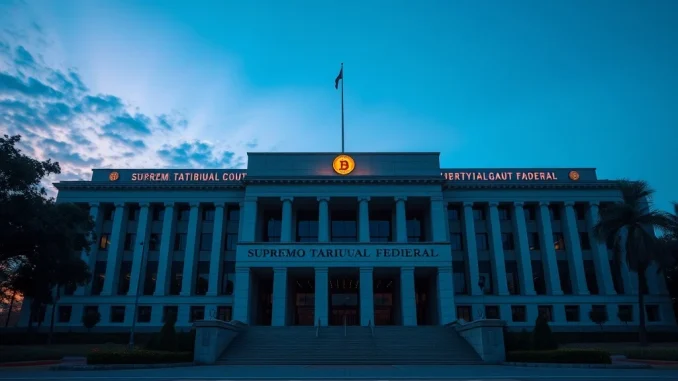
Brazil Supreme Court Reconsiders Cryptocurrency Ban in Election Campaigns: A Pivotal Review
Brasília, Brazil, March 2025: In a significant development for digital asset regulation and political finance, a judge on Brazil’s Federal Supreme Court (STF) has initiated a formal review of election rules, specifically targeting the existing prohibition on using cryptocurrency in political campaigns. This review, expected to conclude by late March, arrives just months before the nation’s pivotal general election on October 3, 2025. The move signals a potential landmark shift, coming just over a year after the court publicly affirmed the ban in February 2024. The reconsideration underscores the growing tension between established campaign finance laws and the rapid ascent of cryptocurrencies within Brazilian society, where adoption rates continue to climb and digital assets become an increasingly potent political issue.
Brazil Supreme Court Revisits Cryptocurrency Campaign Ban
The core of the judicial review centers on a regulation enforced by Brazil’s Superior Electoral Court (TSE). This rule explicitly bars political candidates and parties from accepting donations or making campaign-related payments using cryptocurrencies like Bitcoin. The rationale historically cited includes concerns over transparency, auditability, and the potential for illicit funding—common arguments in traditional financial systems wary of digital assets’ pseudonymous nature. The STF judge’s analysis will scrutinize whether this blanket ban remains constitutionally sound and proportionate, especially given the technological and regulatory advancements in crypto asset tracking and the formal recognition of digital assets as a payment method in the country. Legal experts note the review will likely weigh the principles of technological neutrality and innovation against the compelling state interest in ensuring clean and transparent elections.
The Political and Regulatory Landscape of Crypto in Brazil
Brazil’s relationship with cryptocurrency is complex and evolving rapidly, creating the backdrop for this legal challenge. The nation stands as a leader in crypto adoption in Latin America. Key developments include:
- Regulatory Framework: In late 2022, Brazil passed Law 14,478, establishing a comprehensive regulatory framework for virtual asset service providers (VASPs), placing them under the oversight of the central bank.
- Taxation: Cryptocurrencies are treated as financial assets for tax purposes, with clear reporting requirements for exchanges and individuals.
- Payment Use: A presidential decree in 2023 formally recognized cryptocurrencies as valid for payment purposes, further integrating them into the formal economy.
This regulatory maturation directly contrasts with the electoral ban, creating a legal dissonance where citizens can use crypto to buy real estate or goods but cannot use it to support a political cause or candidate. The table below outlines this regulatory juxtaposition:
| Aspect | General Financial/Commercial Use | Election Campaign Use (Current) |
|---|---|---|
| Legal Status | Recognized and regulated | Explicitly prohibited |
| Oversight Body | Central Bank of Brazil | Superior Electoral Court (TSE) |
| Primary Concern | Consumer protection, financial integrity | Transparency, anti-corruption |
| Technology Allowed | Blockchain analytics for compliance | Not applicable under ban |
The Rising Political Tide for Crypto Adoption
The push for reform is not occurring in a political vacuum. As cryptocurrency gains popularity with the Brazilian electorate, a growing number of politicians, particularly from newer and tech-focused parties, are advocating for its broader adoption. They argue that crypto donations could democratize political funding, allowing for smaller, grassroots contributions from a tech-savvy generation often disengaged from traditional politics. The issue has moved from a niche technical debate to a potential voter motivator. Previously, figures like presidential hopeful Renan Santos pointed to international examples, notably El Salvador’s President Nayib Bukele, suggesting Brazil could also strategically accumulate Bitcoin reserves. While the reserve argument is separate from campaign finance, it highlights how crypto has entered mainstream political discourse as a symbol of innovation and economic sovereignty.
Implications of a Potential Policy Reversal
Should the Supreme Court review lead to a modification or overturning of the ban, the consequences would be immediate and far-reaching. First, it would require the TSE to hastily develop and implement a robust regulatory framework for crypto campaign finance before the October election. This would likely mandate:
- Donation limits denominated in Brazilian Reais, with real-time conversion rates from crypto.
- Mandatory identification of donors through know-your-customer (KYC) procedures, eliminating anonymity.
- Use of licensed, regulated Brazilian exchanges as the sole conduits for converting crypto donations to fiat, ensuring a clear audit trail.
- Real-time public disclosure of all crypto-derived donations on official campaign financial reports.
Second, a change would instantly alter campaign strategies. Candidates could launch targeted fundraising drives in crypto communities, both domestically and within the global diaspora. It could also increase campaign costs initially, as teams invest in digital wallets, security, and financial advisors familiar with digital assets. Conversely, it could lower transaction costs for international supporters compared to traditional bank transfers. For voters, it presents a new dimension of scrutiny: evaluating not just a candidate’s policies but also their understanding and approach to a transformative technology.
Global Context and the Path Forward
Brazil’s deliberation is being closely watched internationally. Few major democracies have clear, permissive rules for cryptocurrency in political campaigns. The United States’ Federal Election Commission has allowed Bitcoin donations since 2014, but treats them as in-kind contributions subject to strict valuation and reporting rules. Other nations largely maintain prohibitions or operate in a gray area. A thoughtful, regulated opening by Brazil—a G20 nation and regional powerhouse—could provide a blueprint for other countries grappling with the same issue. The Supreme Court’s decision, expected imminently, will therefore resonate beyond its borders, offering a case study on balancing innovation with electoral integrity in the digital age. The outcome will signal whether the country’s institutions view cryptocurrency as a manageable tool within a modern democracy or an unmanageable risk to its foundational processes.
Conclusion
The Brazil Supreme Court’s review of the cryptocurrency ban in election campaigns represents a critical juncture at the intersection of law, technology, and democracy. The decision, due ahead of the October 2025 general election, will either reaffirm a cautious approach prioritizing traditional controls or embrace a regulated pathway for digital asset integration into political life. This move reflects the undeniable reality of cryptocurrency’s growing footprint in Brazil and the increasing political pressure to modernize corresponding institutions. The ruling will not only shape the financial tactics of the upcoming election but will also define Brazil’s posture as either a follower or a potential leader in crafting 21st-century digital democracy frameworks. The world is watching as Brazil’s highest court weighs the future of political engagement in the crypto era.
FAQs
Q1: What is the current law on cryptocurrency and election campaigns in Brazil?
A1: Currently, Brazil’s Superior Electoral Court (TSE) prohibits political candidates and parties from accepting donations or making payments using any form of cryptocurrency. This ban is the specific regulation under review by the Federal Supreme Court.
Q2: Why is the Supreme Court reconsidering the ban now?
A2: The review is likely driven by the rapid growth and formal regulation of cryptocurrencies in Brazil’s general economy, creating a legal inconsistency. Additionally, rising political advocacy for crypto and its relevance to voters ahead of the October 2025 election have increased pressure for a reassessment.
Q3: How do other countries handle cryptocurrency political donations?
A3: Policies vary widely. The United States allows them as in-kind contributions with strict reporting. Many European nations effectively prohibit them due to strict anti-money laundering rules. Brazil’s decision could set a significant precedent for other major democracies.
Q4: What would need to happen if the ban is lifted?
A4: The electoral authorities would need to quickly establish a detailed regulatory framework. This would include rules for donor identification (KYC), donation limits, real-time valuation against the Brazilian Real, mandatory use of licensed exchanges, and full transparency in campaign financial disclosures.
Q5: Could this change affect the outcome of the 2025 Brazilian election?
A5: While unlikely to single-handedly determine the winner, it could influence campaign strategies and funding sources. It may energize younger, tech-oriented voters and allow candidates to tap into new donor networks, potentially affecting competitive races where financing is a key factor.
Related News
- Crypto Standards: The Revolutionary Key to Unlocking Truly Autonomous AI Agents
- Exciting Binance ZBT Listing: Zerobase (ZBT) Joins HODLer Airdrop on Oct. 17
- Trump Memecoin Event: Potential Federal Law Violation Sparks Controversy
Related: Alarming New Scam: Fake Ledger and Trezor Letters Target Crypto Wallets
Related: Bayse Markets Integrates Solana: A Revolutionary Leap for Cross-Asset Trading
Related: Digital Asset Funds Suffer Fourth Week of Outflows as U.S. Investors Pull a Staggering $403M