Global Financial Markets, May 2025: A persistent decline in the value of the U.S. dollar, a phenomenon historically viewed as a potential tailwind for Bitcoin, is failing to ignite the cryptocurrency’s price. According to a detailed on-chain analysis, the traditional inverse correlation between the dollar and Bitcoin has broken down under current market conditions, revealing a more complex relationship dependent on broader macroeconomic forces.
Why a weaker dollar isn’t boosting Bitcoin in 2025
The foundational thesis that Bitcoin acts as a hedge against dollar devaluation is facing a significant stress test. Analysis from GugaOnChain, a noted CryptoQuant contributor, indicates that a weaker dollar alone is insufficient to catalyze a Bitcoin rally. The critical missing ingredients, according to the report, are specific macroeconomic conditions: high inflation and abundant market liquidity. In the absence of these factors, dollar weakness does not automatically translate into capital flows toward perceived alternative stores of value like Bitcoin. This insight challenges a widely held assumption among cryptocurrency investors and underscores the asset’s evolving role within the global financial system. The current environment, characterized by uncertainty, demonstrates that Bitcoin’s price drivers are multifaceted and context-dependent.
The crucial role of macroeconomic conditions
Historical precedent shows that Bitcoin has thrived during periods of dollar weakness when accompanied by expansive fiscal and monetary policy. For instance, during the high-inflation period of 2021-2022, massive liquidity injections and a weakening dollar correlated with significant Bitcoin appreciation. The analyst’s framework clarifies the distinction:
- Supportive Environment: Dollar weakness + High Inflation + Abundant Liquidity = Bullish for Bitcoin. This combination suggests a search for hard assets outside the traditional system.
- Non-Supportive Environment: Dollar weakness + Risk-Aversion + Liquidity Contraction = Bearish or Neutral for Bitcoin. Capital seeks safety, not speculation.
In 2025, markets are grappling with the latter scenario. Central banks, having learned from previous inflationary bouts, maintain a cautious stance on liquidity. Furthermore, inflation, while present, is not at the crisis levels seen earlier in the decade. This creates a “middle ground” where the dollar can weaken without triggering the flight to crypto assets that many anticipate.
Understanding the flight to safety and gold’s appeal
When fear dominates market psychology, investor behavior follows predictable patterns. The current “risk-off” sentiment, a term describing the broad movement of capital away from risky assets, is directing funds toward instruments with centuries of established trust. Gold, the quintessential safe-haven asset, benefits directly from this environment. Its price often exhibits strength during periods of dollar weakness coupled with geopolitical or financial stress, as it is perceived as a neutral, physical store of value devoid of counterparty risk. Bitcoin, despite its “digital gold” narrative, still contends with perceptions of volatility and its relatively short 16-year history. In times of extreme risk aversion, the market overwhelmingly favors the established track record of gold over the technological promise of Bitcoin.
When dollar devaluation signals crisis
The analysis presents a crucial, often overlooked scenario: a dollar devaluation stemming from a crisis of confidence. If the dollar weakens not due to cyclical factors but because of a fundamental loss of faith in U.S. economic management or extreme global risk aversion, the outcome for cryptocurrencies is typically negative. In such crises, correlations between asset classes break down or converge negatively. Both traditional equities (the S&P 500) and risk-on digital assets like Bitcoin can decline in tandem, as was witnessed during the liquidity crunch of March 2020 and the market turmoil of 2022. Investors liquidate positions across the board to raise cash, favoring the most liquid and least volatile assets, regardless of their long-term thesis. This dynamic highlights that Bitcoin is not yet a “panic buy” asset but remains, in many portfolios, a “risk-on” growth asset subject to broader market sell-offs.
The historical context of Bitcoin-dollar correlation
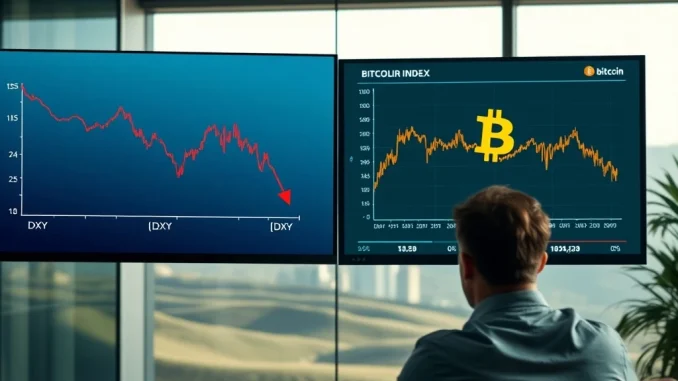
Examining the Bitcoin (BTC) to U.S. Dollar Index (DXY) chart over the past decade reveals a non-linear relationship. Periods of strong inverse correlation, where a falling DXY coincided with a rising BTC, were often punctuated by phases of positive correlation, especially during market-wide deleveraging events. The relationship is conditional, not absolute. Factors such as regulatory developments, Bitcoin-specific network adoption metrics (like hash rate and active addresses), and institutional investment flows (via ETFs) now play equally important roles. Therefore, attributing Bitcoin’s price action solely to dollar movements is an oversimplification that the current market is actively correcting.
Conclusion
The 2025 market landscape delivers a clear lesson: a weaker U.S. dollar is not a standalone catalyst for Bitcoin appreciation. The analysis confirms that macroeconomic context is paramount. Without the accompanying conditions of high inflation and robust liquidity, dollar weakness may simply reflect broader risk aversion, which drives capital toward traditional safe havens like gold. For Bitcoin to decouple and rally amid a falling dollar, the market requires a narrative of monetary debasement and a search for sovereign-free assets, not one of fear and capital preservation. This nuanced understanding is essential for investors navigating the complex interplay between traditional finance and the evolving cryptocurrency market.
FAQs
Q1: Why has the US dollar been weakening?
Answer: The U.S. dollar can weaken due to various factors, including relative interest rate expectations compared to other central banks, concerns about U.S. fiscal policy and debt levels, or a broader improvement in global economic sentiment that reduces demand for the dollar as a safe haven.
Q2: What does “risk-off sentiment” mean?
Answer: Risk-off sentiment describes a market environment where investors become cautious and prioritize capital preservation over growth. They sell riskier assets like stocks, high-yield bonds, and cryptocurrencies and move capital into perceived safer assets like government bonds, the U.S. dollar (in some cases), and gold.
Q3: Has Bitcoin ever gone up when the dollar is strong?
Answer: Yes. There have been periods, particularly during phases of intense adoption or speculative fervor, where Bitcoin’s price has risen alongside a strengthening dollar. This demonstrates that Bitcoin’s price is driven by multiple factors, including its own network adoption and investor sentiment, not just dollar valuation.
Q4: What macroeconomic conditions are best for Bitcoin?
Answer: Historically, Bitcoin has performed well in environments characterized by expansive monetary policy (low interest rates, quantitative easing), high or rising inflation expectations, and a weakening dollar driven by a search for alternative stores of value, not by panic.
Q5: Is Bitcoin still considered a hedge against inflation?
Answer: The debate continues. While Bitcoin was designed with scarcity to resist inflationary monetary policy, its short history and high volatility mean its performance as a reliable short-term inflation hedge is inconsistent. In the long term, many proponents believe its fixed supply gives it inherent hedging properties, but this is not guaranteed in all market climates.