Nairobi, Kenya – February 2025: Across the African continent, a quiet financial revolution is unfolding. As inflation erodes savings and traditional remittance systems remain costly and slow, a growing number of individuals and businesses are turning to stablecoins. These digital currencies, pegged to stable assets like the US dollar, are no longer just speculative crypto assets but are becoming essential tools for daily commerce, cross-border trade, and preserving wealth against volatile local currencies.
Stablecoins Fill Critical Gaps in African Economies
The adoption of stablecoins in Africa is fundamentally driven by solving real-world economic problems. Speaking at the recent World Economic Forum in Davos, economist Vera Songwe highlighted a pivotal shift: remittances now contribute more to African economies than foreign aid. However, the traditional channels for sending this vital money home are fraught with inefficiency. Services like Western Union or MoneyGram can charge fees as high as 6-8% per transaction, and settlements can take several business days. For a small business waiting on a payment or a family relying on funds for immediate needs, these delays and costs are prohibitive.
Stablecoins, built on blockchain technology, offer a stark contrast. Transactions can be completed in minutes, often for a fraction of a cent, regardless of the amount sent. This efficiency is transforming cash flow management for millions. The post-COVID inflationary surge has further accelerated this trend. In approximately 12 to 15 African nations, annual inflation has exceeded 20%, devastating the purchasing power of local currencies like the Nigerian naira, Ghanaian cedi, and Egyptian pound. Holding savings in a dollar-pegged stablecoin provides a digital safe haven, protecting value from rapid depreciation.
The SME and Remittance Engine Driving Everyday Use
Unlike in some Western markets where cryptocurrency is often associated with investment, in Africa, stablecoin usage is dominated by pragmatic, commercial applications. Small and medium-sized enterprises (SMEs) are at the forefront of this adoption. These businesses, which form the backbone of African economies, face significant hurdles: limited access to formal banking, stringent capital controls that restrict foreign currency movement, and the constant threat of inflation.
Stablecoins directly address these pain points:
- Access: With over 650 million Africans unbanked, a smartphone is often the first and only gateway to digital finance. Stablecoin wallets require only an internet connection.
- Trade: SMEs use stablecoins to pay for imports from international suppliers, bypassing slow and expensive bank wire transfers.
- Remittances: The diaspora sends funds home via stablecoins, which recipients can then convert to local currency or use directly with growing merchant acceptance.
Songwe identified Egypt, Nigeria, Ethiopia, and South Africa as hotspots for this activity. Each country grapples with a unique mix of currency pressure, high inflation, or capital controls, making the neutral, borderless nature of stablecoins particularly attractive.
Regulatory Landscape: A Continent of Contrasts
The rapid growth of stablecoin and broader cryptocurrency use has prompted varied responses from African regulators, reflecting a balancing act between innovation and risk management. A September 2024 Chainalysis report cemented Sub-Saharan Africa’s status as one of the world’s fastest-growing crypto regions, with on-chain value received jumping 52% year-over-year to surpass $205 billion.
Governments are taking notice:
- South Africa: The South African Reserve Bank has issued warnings, noting that widespread crypto asset adoption could pose risks to financial stability and has advocated for a cautious regulatory approach.
- Nigeria: In a move focused on oversight and taxation, Nigerian authorities introduced rules in January 2025 requiring cryptocurrency platforms to link transactions to users’ Tax Identification Numbers (TINs).
- Ghana: Taking a more progressive stance, Ghana passed legislation in December 2024 to legalize and regulate cryptocurrency trading. Bank of Ghana Governor Johnson Asiama stated the framework aims to foster innovation while equipping regulators with necessary monitoring tools.
This regulatory divergence creates a complex environment for users and service providers but indicates a serious continental engagement with the digital asset space.
Beyond Speculation: A Tool for Financial Inclusion
The narrative around stablecoins in Africa crucially differs from the speculative frenzy often seen elsewhere. The data suggests primary use cases are utilitarian—savings preservation and payment facilitation—not short-term trading. This is evidenced by the dominance of stablecoin transactions relative to more volatile cryptocurrencies like Bitcoin in many African markets.
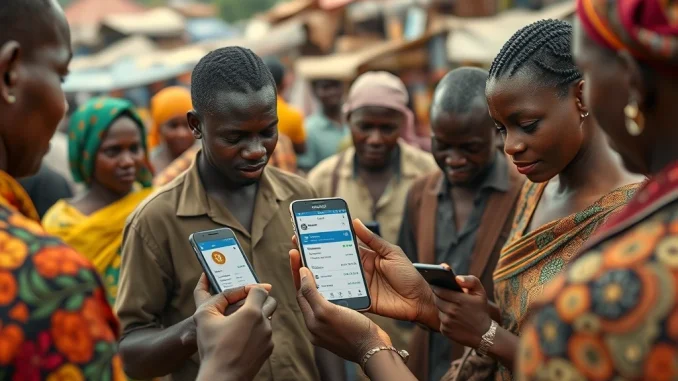
For the user, the value proposition is straightforward. A merchant in Lagos can receive payment in USDC from a client in London within minutes, convert it to naira on a local peer-to-peer platform, and have the funds in their bank account often faster and cheaper than through a traditional international wire. A teacher in Nairobi can allocate a portion of their salary to a dollar-pegged stablecoin, shielding it from the shilling’s fluctuations. This represents a profound leap in personal financial sovereignty and access to global finance.
Conclusion
The surge of stablecoins across Africa is a direct response to systemic economic challenges. They are not merely a technological novelty but are evolving into a critical piece of financial infrastructure for both the banked and unbanked. By offering a faster, cheaper alternative for remittances and a more stable store of value against inflation, stablecoins are gaining ground where traditional systems have failed. As adoption grows, the focus for African nations will likely center on developing clear, balanced regulatory frameworks that protect consumers and ensure financial stability without stifling the innovation that is providing tangible economic benefits to millions.
FAQs
Q1: What is a stablecoin and how is it different from Bitcoin?
A stablecoin is a type of cryptocurrency designed to have a stable value, typically by being pegged to a reserve asset like the US dollar. Bitcoin is a volatile cryptocurrency whose price fluctuates based on market speculation. Stablecoins aim for price stability, making them more suitable for everyday payments and savings.
Q2: Why are stablecoins becoming popular in Africa specifically?
High inflation devalues local currencies, making dollar-pegged stablecoins attractive for saving. Additionally, traditional cross-border remittance services are slow and expensive, while stablecoin transactions are fast and cheap, solving a major pain point for families and businesses.
Q3: Are stablecoins legal in African countries?
The legality varies by country. Some, like Ghana, have established legal frameworks. Others, like Nigeria, are implementing registration rules. Several nations are still studying the issue. Users must check the specific regulations in their country.
Q4: How do people in Africa access and use stablecoins?
Most access is via smartphone apps (crypto wallets or exchange apps). People can buy stablecoins with local currency on exchanges or receive them from abroad. They can be held as savings, sent to others, or used to pay merchants who accept them.
Q5: What are the risks of using stablecoins in Africa?
Key risks include regulatory uncertainty, potential for scams on unregulated platforms, technical complexity for new users, and the fact that the peg to the US dollar is usually managed by a private company, which carries some counterparty risk.