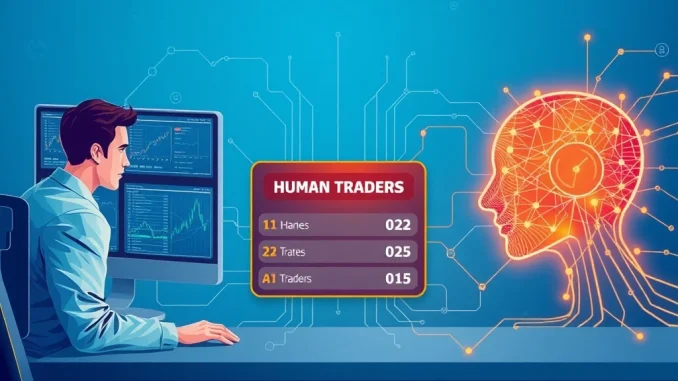
The decentralized finance landscape witnesses a pivotal evolution as Aster, a prominent decentralized exchange (DEX), officially launches the highly anticipated second season of its ‘User vs. AI’ trading competition. This innovative event, announced via the company’s official X account, directly pits human intuition against algorithmic precision in a live-market environment, with 100 participants already engaged. Consequently, this initiative not only tests trading strategies but also explores the evolving synergy between human traders and artificial intelligence within the volatile cryptocurrency markets.
Aster DEX Human vs AI Trading Competition Enters New Phase
Aster’s competition represents a significant experiment in decentralized finance. The DEX enables real-time monitoring of the contest’s progress, providing unprecedented transparency. Furthermore, the event’s structure extends beyond mere participation. Interested observers can actively engage by wagering on outcomes through established decentralized prediction market platforms. Specifically, these platforms include Polymarket, Opinion Labs, and Probable.
This integration creates a multifaceted ecosystem around the core competition. Additionally, Aster facilitates direct interaction with the AI’s strategy. Users can employ copy-trading services to mirror the artificial intelligence’s market orders. Available services for this function include Hyperbot, SOON, EchoSync, and SIANEXX. Therefore, the competition serves as both a battleground and a public laboratory for AI-driven trading logic.
The Broader Context of AI in Decentralized Finance
The integration of artificial intelligence into cryptocurrency trading is not novel, but Aster’s formalized competition structure marks a progression. Historically, AI and machine learning models have been used for:
- Market Prediction: Analyzing historical data to forecast price movements.
- Arbitrage Detection: Identifying price discrepancies across exchanges at high speed.
- Portfolio Management: Automating rebalancing and risk assessment strategies.
However, a public, head-to-head format between curated human traders and a designated AI brings a new layer of scrutiny and data collection. For context, traditional finance has explored similar concepts through quantitative hedge funds, but rarely with this level of public accessibility and real-time data sharing.
Expert Analysis on the Experiment’s Significance
Industry analysts highlight several key implications of Aster’s initiative. Primarily, it generates valuable, transparent data on AI performance versus human discretion in a non-custodial, on-chain environment. This data could influence future DeFi product development. Moreover, by incorporating prediction markets, Aster effectively crowdsources market sentiment on AI efficacy, creating a decentralized consensus mechanism on the technology’s value.
The timeline is also critical. The launch of Season 2 follows an initial pilot, suggesting Aster has refined the model based on prior results. This iterative approach demonstrates a commitment to long-term research and development within the DEX’s ecosystem. The impact extends beyond entertainment; it contributes to the academic and practical understanding of autonomous agents in peer-to-peer financial systems.
Mechanics and Market Integration of the Competition
Aster’s competition cleverly leverages multiple DeFi primitives. The core trading activity occurs on its own liquidity pools. Simultaneously, it feeds outcome data to external prediction markets. This cross-protocol functionality showcases the composable nature of Web3. Below is a simplified view of the integrated ecosystem:
| Component | Platform/Service | Primary Function |
|---|---|---|
| Competition Venue | Aster DEX | Hosts live trading between humans and AI. |
| Outcome Wagering | Polymarket, Opinion Labs, Probable | Allows speculative betting on competition results. |
| Strategy Replication | Hyperbot, SOON, EchoSync, SIANEXX | Enables users to copy the AI’s trading signals automatically. |
This structure creates a feedback loop. Prediction market odds may reflect perceived AI strength, potentially influencing copy-trading volume. Subsequently, this volume could impact market movements within the competition itself. Such complexity mirrors the interconnected reality of modern digital asset markets.
Potential Implications for Retail Traders and DeFi
For the average DeFi user, Aster’s project offers both spectacle and utility. The real-time leaderboard provides an educational view of different trading approaches. Meanwhile, the copy-trading option democratizes access to a sophisticated AI strategy, which would typically be gatekept by institutional players. This aligns with a core DeFi tenet: permissionless access to financial tools.
Nevertheless, participants and observers must consider inherent risks. AI models can fail or act unpredictably in novel market conditions. Similarly, prediction markets carry financial risk. Aster’s experiment, while pioneering, should be viewed as a high-stakes research project rather than a guaranteed profit opportunity. The long-term effect may be a more informed community regarding the capabilities and limitations of automated trading systems.
Conclusion
Aster’s launch of Season 2 for its human vs AI trading competition signifies a mature step in blending decentralized finance with artificial intelligence. The event transcends a simple contest by integrating real-time monitoring, prediction markets, and copy-trading services into a cohesive ecosystem. Ultimately, this initiative provides a transparent, on-chain dataset comparing human and machine trading prowess. As the competition progresses, it will undoubtedly offer critical insights that could shape the development of future AI-driven DeFi products and strategies, solidifying the role of such experiments in the evolution of open finance.
FAQs
Q1: What is the Aster DEX human vs AI trading competition?
The competition is a structured event hosted on the Aster decentralized exchange where selected human traders compete against a proprietary artificial intelligence system. Their goal is to achieve superior trading performance within a defined period, with results tracked and displayed publicly.
Q2: How can I follow or participate in the Aster competition?
While direct trading participation is likely by application or invitation, anyone can monitor the competition’s progress in real-time through Aster’s platforms. Additionally, you can engage by wagering on outcomes via prediction markets like Polymarket or by using copy-trading services to replicate the AI’s trades.
Q3: What are the risks of copy-trading the AI in this competition?
Copy-trading any strategy carries significant risk, including the potential for substantial financial loss. The AI may perform well in specific conditions but could fail in others. Past performance is never indicative of future results, especially in volatile crypto markets.
Q4: How does this competition benefit the broader DeFi ecosystem?
It generates transparent, real-world data on AI trading performance in a decentralized environment. This data can inform developers, researchers, and users about the practical strengths and weaknesses of automated trading systems, potentially guiding safer and more effective product development.
Q5: Are there similar human vs AI competitions in traditional finance?
While head-to-head public competitions are rare, the concept of pitting quantitative (AI-driven) funds against discretionary (human) fund managers is common. However, these are typically private, with results not shared in real-time. Aster’s model is notable for its public and participatory nature within the DeFi space.