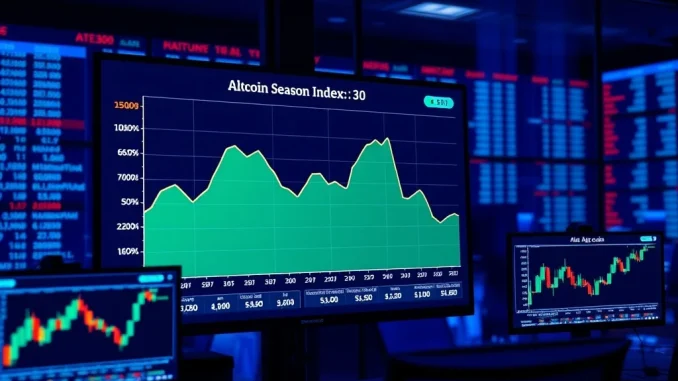
Altcoin Season Index Plummets to Critical 30 Level as Bitcoin Reclaims Market Dominance
The cryptocurrency market witnessed a significant shift on March 15, 2025, as CoinMarketCap’s Altcoin Season Index plunged to 30, marking a dramatic two-point decline from the previous day and signaling Bitcoin’s resurgence as the dominant market force. This critical metric, which measures whether altcoins collectively outperform Bitcoin, now sits at its lowest level in eight months, indicating a substantial rotation of capital away from alternative cryptocurrencies. Market analysts immediately noted the implications of this movement, particularly as institutional investors re-evaluate their portfolio allocations ahead of the second quarter. The index’s descent below key psychological levels suggests changing investor sentiment across global cryptocurrency exchanges from New York to Singapore.
Understanding the Altcoin Season Index Mechanism
CoinMarketCap’s Altcoin Season Index operates as a sophisticated market timing tool that compares the performance of the top 100 cryptocurrencies by market capitalization against Bitcoin over a 90-day rolling period. The calculation specifically excludes stablecoins and wrapped tokens to provide a pure measure of speculative versus store-of-value assets. According to the platform’s methodology, an official “altcoin season” declaration requires 75% of these top assets to outperform Bitcoin during the measurement window. Consequently, readings closer to 100 indicate stronger altcoin performance, while lower numbers suggest Bitcoin dominance. The index serves as a crucial barometer for traders and long-term investors alike, offering quantitative insight into market cycle phases.
Historical data reveals distinct patterns in index behavior across previous market cycles. For instance, during the 2021 bull market, the index sustained readings above 75 for approximately five consecutive months. Conversely, the 2022 bear market saw prolonged periods below 25 as investors flocked to Bitcoin’s relative stability. The current reading of 30 places the market in a transitional phase that typically precedes either Bitcoin-led rallies or broader market consolidation. Market technicians particularly watch the 25-35 range as a potential inflection zone where capital rotation accelerates between asset classes.
Analyzing the Current Cryptocurrency Market Context
Several concurrent developments provide context for the index’s decline to 30. First, Bitcoin’s dominance metric—which measures its share of total cryptocurrency market capitalization—has increased by 4.2% over the past thirty days, reaching 54.3% according to TradingView data. Second, regulatory clarity in major markets like the European Union and United States has disproportionately benefited Bitcoin, which institutions perceive as more compliant than many altcoins. Third, macroeconomic factors including interest rate decisions and inflation data have driven investors toward assets with proven track records during economic uncertainty. Finally, the upcoming Bitcoin halving event in April 2025 continues to focus attention on the original cryptocurrency’s supply dynamics.
The performance divergence becomes particularly evident when examining specific cryptocurrency categories. Layer-1 blockchain tokens like Solana (SOL) and Avalanche (AVAX) have underperformed Bitcoin by 18% and 22% respectively over the past month. Similarly, decentralized finance (DeFi) tokens and non-fungible token (NFT) platform tokens have shown relative weakness. This sector rotation follows a predictable pattern observed in previous cycles where investors initially take profits from high-beta altcoins before potentially reallocating to Bitcoin. Market depth analysis reveals decreasing liquidity for smaller-cap altcoins, suggesting reduced trading activity beyond the top twenty assets by market capitalization.
Expert Perspectives on Market Phase Transition
Leading cryptocurrency analysts emphasize the importance of interpreting the Altcoin Season Index within broader market contexts. Dr. Elena Rodriguez, Chief Research Officer at Digital Asset Analytics, notes: “The index serves as a reliable sentiment indicator rather than a predictive tool. A reading of 30 suggests we’re in a transitional phase where Bitcoin typically strengthens before potential altcoin rallies later in the cycle. Historical data from 2017 and 2021 shows similar patterns where Bitcoin dominance increased mid-cycle before altcoins eventually outperformed.” Rodriguez references comprehensive backtesting of the index against previous market cycles, demonstrating its correlation with capital flow patterns.
Meanwhile, institutional analysts point to on-chain metrics that support the index reading. Bitcoin’s network activity shows increasing accumulation by long-term holders, with approximately 68% of the supply remaining unmoved for over six months according to Glassnode data. Simultaneously, altcoin exchange inflows have increased by 15% over the past week, suggesting potential distribution. These technical factors combine with fundamental developments including Bitcoin exchange-traded fund (ETF) inflows averaging $250 million daily and growing corporate treasury allocations. The convergence of these data points creates a coherent narrative explaining the index movement.
Historical Patterns and Future Market Implications
Examining previous cryptocurrency cycles reveals instructive patterns regarding the Altcoin Season Index. During the 2017-2018 cycle, the index spent 42 consecutive days below 30 before altcoins eventually rallied to produce the dramatic “altcoin season” of early 2018. Similarly, in 2021, a brief dip to 28 preceded the strongest altcoin performance of that cycle. These historical precedents suggest that current low readings may indicate accumulation opportunities rather than permanent altcoin weakness. However, market structure differences in 2025—including increased institutional participation and regulatory frameworks—create unique conditions that may alter historical patterns.
The table below illustrates key Altcoin Season Index thresholds and their historical market implications:
| Index Range | Market Phase | Typical Duration | Historical Example |
|---|---|---|---|
| 75-100 | Strong Altcoin Season | 3-6 months | Q1 2021 |
| 50-74 | Moderate Altcoin Strength | 1-3 months | August 2023 |
| 25-49 | Transition/Bitcoin Strength | 2-8 weeks | Current Phase |
| 0-24 | Bitcoin Dominance | Variable | Q2 2022 |
Several factors could influence the index’s trajectory in coming weeks. Upcoming network upgrades for major altcoins, particularly Ethereum’s next consensus layer improvement, could shift momentum. Additionally, traditional market correlations remain significant, with cryptocurrency markets continuing to show sensitivity to equity market movements and dollar strength. The Federal Reserve’s monetary policy decisions scheduled for April 2025 will likely impact risk asset allocations across all cryptocurrency categories. Finally, technological breakthroughs in layer-2 scaling solutions or zero-knowledge proof implementations could reignite interest in specific altcoin sectors regardless of broader index readings.
Practical Implications for Investors and Traders
For market participants, the Altcoin Season Index provides actionable information beyond mere market observation. Portfolio managers typically use the metric to adjust allocation weights between Bitcoin and altcoin baskets. A reading of 30 suggests several strategic approaches:
- Risk Management: Increasing Bitcoin allocation for portfolio stability
- Dollar-Cost Averaging: Continuing systematic purchases of fundamentally strong altcoins
- Sector Rotation: Monitoring specific cryptocurrency categories for early strength signals
- Volatility Preparation: Expecting increased price swings during phase transitions
Technical analysts particularly watch for divergence signals between the index and price action. If major altcoins begin showing relative strength despite low index readings, this could indicate early accumulation before a broader rally. Conversely, continued weakness alongside declining index values would confirm Bitcoin dominance persistence. The index also correlates with exchange volume ratios, with Bitcoin typically capturing greater market share during low index periods. These relationships provide multiple confirmation points for trading decisions and risk assessment.
The Regulatory Landscape’s Impact on Market Structure
Evolving global cryptocurrency regulations significantly influence the Altcoin Season Index dynamics. The European Union’s Markets in Crypto-Assets (MiCA) framework, fully implemented in December 2024, has created clearer compliance pathways for Bitcoin-related products than for many altcoins. Similarly, the United States Securities and Exchange Commission’s approach to cryptocurrency classification continues to affect institutional participation. These regulatory developments create structural advantages for Bitcoin that extend beyond pure market dynamics. As regulatory clarity improves for specific altcoin categories—particularly those with clear utility rather than speculative characteristics—index readings may respond accordingly.
International variations further complicate the picture. Asian markets, particularly Japan and Singapore, have implemented distinct regulatory approaches that affect altcoin accessibility. Meanwhile, emerging markets in Latin America and Africa show stronger retail interest in certain altcoin categories for practical applications like remittances and payments. These geographical differences create pockets of relative strength even during periods of overall index weakness. Savvy investors monitor regional exchange flows and regulatory announcements for early signals of shifting momentum between cryptocurrency categories.
Conclusion
The Altcoin Season Index decline to 30 represents a significant market development with implications for all cryptocurrency participants. This movement reflects Bitcoin’s renewed dominance amid changing macroeconomic conditions, regulatory developments, and institutional preferences. While historical patterns suggest such readings often precede eventual altcoin strength, current market structure differences warrant careful analysis rather than automatic historical extrapolation. Investors should monitor multiple indicators including Bitcoin dominance, exchange flows, and regulatory announcements alongside the index itself. The cryptocurrency market’s evolving nature ensures that today’s metrics will interact with tomorrow’s developments in unpredictable ways, making continuous analysis essential for informed participation in this dynamic asset class.
FAQs
Q1: What does an Altcoin Season Index reading of 30 actually mean?
The index at 30 indicates that only approximately 30% of top cryptocurrencies have outperformed Bitcoin over the past 90 days. This suggests Bitcoin dominance rather than altcoin leadership, with capital rotating toward the original cryptocurrency.
Q2: How often does CoinMarketCap update the Altcoin Season Index?
CoinMarketCap updates the index daily, using rolling 90-day performance data. The calculation occurs at approximately 00:00 UTC each day, incorporating the previous day’s closing prices across major exchanges.
Q3: Has the index ever been wrong about predicting market phases?
Like all indicators, the index provides information rather than perfect predictions. During sudden market events or unprecedented conditions, the index may not immediately reflect fundamental shifts. It works best as one tool within a comprehensive analysis framework.
Q4: Do all altcoins move together during seasons indicated by the index?
No, significant variation exists within altcoin categories. During “altcoin seasons,” some sectors typically lead while others lag. The index measures collective performance rather than individual asset movements, making sector analysis crucial alongside index monitoring.
Q5: How should long-term investors use the Altcoin Season Index?
Long-term investors might use extreme readings (very high or very low) as potential rebalancing signals rather than trading indicators. The index helps identify market cycle phases but shouldn’t override fundamental investment theses about specific blockchain projects.
Related News
- XYZ and SOL Skyrocket as Bitcoin Cools Off—Is This the Start of an Altcoin Season?
- Ark Invest’s Cathie Wood Says There’s More Clarity for Investments
- MicroStrategy's BTC-Fueled Trading Volume Surpasses Apple, Amazon, Meta Combined
Related: Spartans' Lil Baby Deal Reshapes Sportsbook Competition Against bet365 and Choplife Gaming
Related: Aviva Investors Pioneers European Asset Management with Ripple to Tokenise Funds on XRPL