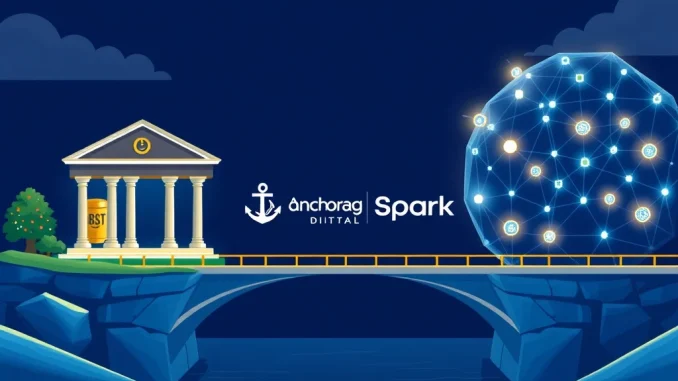
Institutional cryptocurrency adoption reached a pivotal milestone this week as Anchorage Digital, the first federally chartered crypto bank, partnered with Spark, a leading DeFi lending protocol, to launch a revolutionary financial product. This innovative solution enables on-chain loans secured by off-chain collateral, effectively bridging the gap between traditional finance and decentralized ecosystems. The announcement, first reported by The Block on October 26, 2024, represents a significant evolution in how large-scale investors access blockchain-based liquidity while maintaining familiar custodial security.
On-Chain Loans with Off-Chain Collateral: A New Financial Paradigm
This partnership introduces a hybrid lending model that directly addresses a major barrier for institutional entry into decentralized finance. Traditionally, DeFi protocols require users to lock their digital assets directly into on-chain smart contracts as collateral. However, many institutional clients, including hedge funds, family offices, and asset managers, remain hesitant to fully transfer substantial holdings onto public blockchains due to operational complexity and perceived custody risks. Consequently, Anchorage Digital and Spark developed a system where the collateral remains securely held in Anchorage’s qualified custodial wallets, while the loan issuance and management occur transparently on-chain via Spark’s protocol.
The mechanics involve a verifiable attestation process. Anchorage, acting as the custodian, cryptographically attests to the ownership and value of the off-chain collateral. Subsequently, Spark’s smart contracts, operating on the Ethereum blockchain, verify these attestations and mint a corresponding loan amount in a stablecoin like DAI directly to the borrower’s wallet. This process maintains the self-custody and transparency benefits of DeFi while leveraging the institutional-grade security and regulatory compliance of a chartered bank.
Addressing the Institutional Liquidity Gap
For years, a significant liquidity gap has existed between traditional finance (TradFi) and decentralized finance (DeFi). Institutional capital has largely remained on the sidelines, despite the attractive yields and efficiency of DeFi lending markets. A 2023 report by BCG and ADDX estimated the total addressable market for institutional DeFi to exceed $1 trillion by 2025, but cited custody and operational friction as primary constraints. This new product directly targets those constraints. By allowing institutions to pledge assets like Bitcoin (BTC), Ethereum (ETH), or stablecoins held with Anchorage as collateral, they can now tap into DeFi liquidity pools without moving funds, thereby reducing settlement risk and streamlining compliance.
The Strategic Partnership: Anchorage Digital Meets Spark Protocol
Anchorage Digital brings critical regulatory and security infrastructure to this collaboration. As an OCC-chartered digital asset bank, it provides a level of trust and oversight that institutional mandates often require. Its clients include some of the world’s largest asset managers and corporations. Spark, on the other hand, is a sophisticated DeFi lending protocol best known for its efficiency and deep liquidity, primarily for the DAI stablecoin. It is a core component of the MakerDAO ecosystem, which manages over $5 billion in total value locked (TVL).
This partnership is not merely a technical integration but a strategic alignment of philosophies. Anchorage’s President, Nathan McCauley, stated in a recent industry panel that “the future of finance is not a choice between TradFi and DeFi, but a synthesis of the best parts of both.” Spark’s development team has consistently focused on creating permissionless, transparent, and efficient financial primitives. Together, they create a permissioned gateway to a permissionless system, a model likely to be replicated across the industry.
The initial product offering will support major digital assets already custodied by Anchorage. The loan-to-value (LTV) ratios, interest rates, and liquidation parameters will be governed by Spark’s decentralized governance, ensuring market-driven and transparent terms. However, the off-chain collateral verification adds a unique layer where Anchorage acts as a verified oracle, a role underpinned by its regulatory obligations and financial guarantees.
Comparative Analysis: Traditional vs. New Hybrid Model
| Feature | Traditional Bank Loan | Pure DeFi Loan | Anchorage-Spark Hybrid Loan |
|---|---|---|---|
| Collateral Location | Off-Chain (Bank Vault/Ledger) | On-Chain (Smart Contract) | Off-Chain (Qualified Custody) |
| Loan Issuance | Off-Chain (Bank Internal) | On-Chain (Protocol) | On-Chain (Protocol) |
| Transparency | Low (Opaque Process) | High (Public Blockchain) | High (Public Loan Terms) |
| Speed & Settlement | Days/Weeks | Minutes | Minutes/Hours |
| Custody Risk | Counterparty (Bank) | Smart Contract & Self-Custody | Qualified Custodian + Smart Contract |
| Primary Audience | General Businesses/Individuals | Retail/Advanced Crypto Users | Institutional Crypto Holders |
Broader Implications for the Crypto and Financial Ecosystem
The launch signals a maturation phase for the entire digital asset industry. Firstly, it validates the composability of blockchain infrastructure, where regulated entities can plug into decentralized protocols to create novel services. Secondly, it could catalyze a wave of institutional capital into DeFi. Analysts at firms like Bernstein have suggested that credible, regulated on-ramps are the missing link for large-scale adoption. This product functions as precisely such an on-ramp for institutional liquidity.
Furthermore, the development has positive implications for market stability. Institutional participation often brings larger, more stable capital flows compared to the sometimes volatile retail-driven activity in DeFi. It could lead to deeper liquidity pools, narrower borrowing-lending spreads, and more robust financial markets on-chain. Regulatory bodies, particularly the OCC and SEC, will likely monitor this model closely as a potential blueprint for compliant digital asset finance.
Potential challenges remain, however. The model introduces a degree of reliance on Anchorage as the attestation oracle. While its charter provides assurance, it represents a point of centralization in a decentralized system. Additionally, the legal treatment of these hybrid instruments—whether they are viewed as securities, loans, or novel contracts—may require further clarification as volumes grow.
Expert Perspectives on the Market Impact
Industry experts have largely reacted positively to the news. Sarah Johnson, a fintech analyst at a major investment bank, noted, “This is a logical and necessary step. Institutions want yield and efficiency, but not at the expense of their compliance and custody standards. This hybrid model checks both boxes.” Meanwhile, developers within the DeFi community see it as a sign of legitimacy. A core contributor to the MakerDAO ecosystem, who requested anonymity, commented, “It shows that our building blocks are robust and valuable enough for the most demanding clients. This brings real-world assets and credibility on-chain in a new way.”
The timeline for impact is expected to be gradual but significant. The product will enter a limited pilot phase with select Anchorage clients in Q1 2025, with a full public rollout anticipated by mid-2025. Success metrics will include total value of loans originated, the diversity of institutional participants, and the stability of the integration during market stress events.
Conclusion
The collaboration between Anchorage Digital and Spark to facilitate on-chain loans with off-chain collateral marks a transformative moment in digital finance. By merging the regulatory trust and security of a chartered bank with the transparency and efficiency of a DeFi protocol, this model effectively dismantles a key barrier to institutional adoption. It provides a clear, compliant pathway for billions of dollars in institutional capital to engage with on-chain liquidity. As this hybrid approach gains traction, it promises to deepen market liquidity, foster innovation, and accelerate the convergence of traditional and decentralized financial systems. The success of these on-chain loans will likely serve as a critical benchmark for the next phase of blockchain integration into the global economy.
FAQs
Q1: What exactly are “on-chain loans with off-chain collateral”?
A1: This refers to a lending system where the loan is created and managed via a blockchain-based smart contract (on-chain), but the assets used as security for that loan are held in a traditional, regulated custodial account (off-chain), rather than being locked in the smart contract itself.
Q2: Why would an institution choose this over a traditional bank loan or a pure DeFi loan?
A2: Institutions choose this for its unique blend of benefits: the speed, transparency, and market-based rates of DeFi, combined with the regulatory compliance, familiar custody, and risk management frameworks provided by a chartered bank like Anchorage Digital. It mitigates the operational and security concerns of moving large sums on-chain.
Q3: How does Spark verify the off-chain collateral held by Anchorage?
A3: Anchorage Digital acts as a verified oracle. It provides cryptographically signed attestations to the Spark protocol, confirming the type, amount, and ownership of the collateral held in its custody. Spark’s smart contracts are programmed to trust these attestations from Anchorage’s specific, authorized address.
Q4: What happens if the value of the off-chain collateral falls below the required threshold?
A4: The liquidation process is managed on-chain by the Spark protocol. If the loan becomes undercollateralized based on Anchorage’s price feeds and attestations, Spark’s liquidation engine can be triggered. The process to settle the loan would involve coordination between the protocol and the custodian, as outlined in the legal and technical agreements.
Q5: Does this product make DeFi more centralized?
A5: It introduces a point of centralization in the collateral verification process, as it relies on Anchorage’s attestation. However, the loan terms, interest rates, and liquidation mechanisms remain governed by Spark’s decentralized community. It is a pragmatic trade-off that increases accessibility for a specific user base (institutions) while preserving core DeFi properties for the loan itself.
Q6: What assets can be used as collateral in this initial offering?
A6: While the final list is set during the pilot phase, it is expected to include major, liquid digital assets that Anchorage already custodies for institutions, such as Bitcoin (BTC), Ethereum (ETH), and leading stablecoins like USDC. The specific loan-to-value ratios will be set by Spark’s governance.