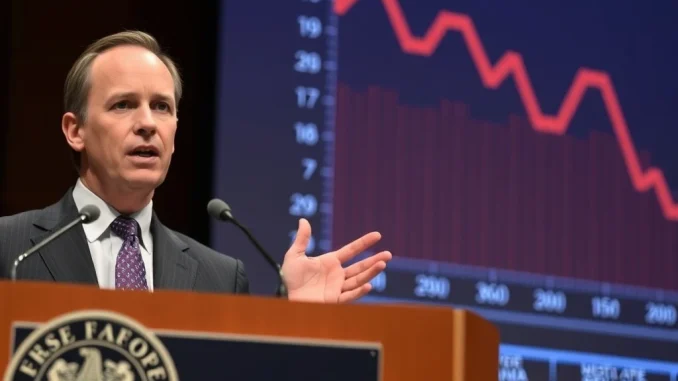
CHICAGO, March 2025 – In a statement with significant implications for markets and the broader economy, Federal Reserve Bank of Chicago President Austan Goolsbee has publicly outlined his expectation for an interest rate cut within the year. This pivotal commentary marks a crucial shift in tone from a key monetary policymaker, signaling growing confidence that the Fed’s long battle against inflation is entering a new phase. Consequently, investors and economists are now closely parsing his conditional stance, which hinges on continued positive economic data.
Analyzing the Federal Reserve Rate Cut Expectation
Austan Goolsbee, a voting member of the Federal Open Market Committee (FOMC) in 2025, articulated a cautiously optimistic view. He stated the need for more data review before confirming any policy move. This position reflects the central bank’s current data-dependent framework. Importantly, Goolsbee’s comments align with recent trends showing a sustained cooling of inflation toward the Fed’s 2% target. The Personal Consumption Expenditures (PCE) price index, the Fed’s preferred gauge, has shown consistent moderation over the past four quarters.
Transitioning to a lower-rate environment requires careful calibration. The Fed must balance the risk of reigniting inflation against the risk of overly restricting economic growth. Recent labor market reports show resilience but with moderating wage growth, a combination that supports a potential policy easing. Furthermore, consumer spending data indicates softening, which reduces demand-pull inflationary pressures. Therefore, Goolsbee’s expectation is not an isolated opinion but is rooted in observable macroeconomic trends.
The Path to Lower Interest Rates in 2025
The journey toward the first Federal Reserve rate cut since the hiking cycle began has been methodical. After aggressively raising the federal funds rate to a target range of 5.25%-5.50% to combat post-pandemic inflation, the FOMC paused hikes in mid-2024. Since then, the committee has maintained a restrictive stance, allowing previous hikes to fully permeate the economy. This lag effect is a critical component of monetary policy transmission.
Several key indicators will dictate the timing of any rate reduction:
- Core Inflation Metrics: Sustained monthly prints at or below 0.2%.
- Labor Market Slack: A gradual rise in the unemployment rate toward 4.0-4.2%.
- Consumer Behavior: Further evidence of tempered spending and credit usage.
- Global Economic Conditions: Stability in major foreign economies and supply chains.
Market pricing, as seen in Fed Funds futures, currently implies a high probability of at least one 25-basis-point cut by the September 2025 FOMC meeting. However, the exact timing remains data-contingent, exactly as Goolsbee emphasized.
Goolsbee’s Dovish Stance in Historical Context
President Goolsbee has historically been viewed as leaning toward the more “dovish” side of the FOMC, prioritizing maximum employment alongside price stability. His academic background as a former economics professor at the University of Chicago Booth School of Business informs his focus on real economic impacts. For instance, during the 2023-2024 hiking cycle, he often highlighted the risks of overtightening and the potential for causing unnecessary job losses.
His current expectation for a rate cut this year places him in alignment with other centrist and dovish committee members. However, it may contrast with more “hawkish” members who advocate maintaining higher rates for longer to ensure inflation is definitively conquered. This internal debate will shape the committee’s official dot plot projections at upcoming meetings. The table below contrasts recent FOMC member viewpoints:
| Policy Stance | Representative Member(s) | Key Concern | Preferred Action |
|---|---|---|---|
| Dovish/Centrist | Austan Goolsbee (Chicago) | Overtightening, labor market | Cut in 2025 if data allows |
| Hawkish | Neel Kashkari (Minneapolis) | Sticky services inflation | Hold until 2026, cut only with clear evidence |
| Centrist | Jerome Powell (Chair) | Balanced risks | Data-dependent, open to 2025 cut |
Potential Impacts of a Monetary Policy Shift
A Federal Reserve rate cut would send powerful signals across financial markets and the real economy. Initially, financial markets would likely react positively. Bond yields would fall, and equity markets, particularly rate-sensitive sectors like technology and real estate, could see a boost. The US dollar might weaken slightly, providing relief to multinational corporations and emerging markets.
For Main Street, the effects would materialize more gradually. Lower borrowing costs would eventually filter through to consumers and businesses. Mortgage rates would decline from current levels, potentially stimulating a housing market that has been subdued by high financing costs. Similarly, auto loans and credit card APRs would become less burdensome. For businesses, cheaper capital could spur investment in expansion, equipment, and hiring. However, the Fed will proceed cautiously to avoid a premature surge in asset prices or a reversal of inflation progress.
Conversely, the global implications are profound. Many central banks worldwide often take cues from Fed policy. A cutting cycle in the United States could provide cover for other major economies to ease their own monetary policies, supporting global growth. This interconnectedness underscores the weight of statements from officials like President Goolsbee.
The Critical Role of Upcoming Economic Data
Goolsbee explicitly stated the need to review more data. The upcoming Consumer Price Index (CPI) and PCE reports for March and April 2025 will be especially scrutinized. Any re-acceleration in inflation, particularly in core services excluding housing, could delay the expected rate cut. Similarly, a surprisingly strong jobs report with robust wage growth could give pause to the doves on the committee.
Other vital data points include the JOLTS report on job openings, which indicates labor market tightness, and the quarterly GDP reports. The Fed seeks a “goldilocks” scenario: cooling but not collapsing inflation alongside a labor market that is softening gradually, not abruptly. Achieving this balance is the central challenge for 2025 monetary policy.
Conclusion
Chicago Fed President Austan Goolsbee’s expectation for a Federal Reserve rate cut in 2025 represents a significant milestone in the post-inflation fight era. His data-dependent stance underscores the committee’s cautious yet increasingly confident approach. As key inflation and employment metrics continue to evolve, the FOMC appears poised to transition from a restrictive policy stance to a more neutral one. This potential pivot, while not yet guaranteed, carries profound implications for investment strategy, business planning, and household finances across the nation and the globe. The coming months of economic data will ultimately write the final decision.
FAQs
Q1: What did Chicago Fed President Austan Goolsbee say about interest rates?
Austan Goolsbee said he expects an interest rate cut within the year but emphasized that the Federal Reserve needs to review more economic data before confirming such a move.
Q2: Why is a Federal Reserve rate cut significant?
A rate cut lowers borrowing costs across the economy, affecting mortgages, business loans, and credit cards. It signals a shift in policy from fighting high inflation to supporting economic growth, influencing both financial markets and Main Street.
Q3: What economic data will the Fed review before cutting rates?
The Fed will closely monitor inflation reports (CPI and PCE), employment data (unemployment rate, wage growth), consumer spending figures, and broader indicators of economic growth to ensure inflation is sustainably moving toward its 2% target.
Q4: How does Goolsbee’s view compare to other Fed officials?
Goolsbee’s expectation aligns with more dovish and centrist members who are open to cutting in 2025. It may differ from more hawkish members who prefer holding rates higher for longer to ensure inflation is fully contained.
Q5: When could the first rate cut happen in 2025?
Based on current market expectations and Fed commentary, the first 25-basis-point cut could occur as early as the July or September 2025 FOMC meeting, but this is entirely dependent on the evolution of incoming economic data.