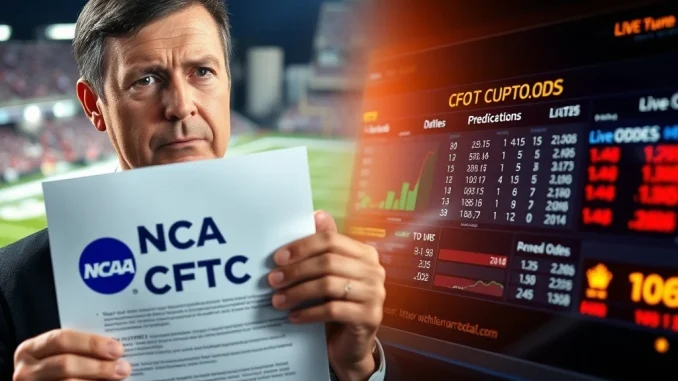
WASHINGTON, D.C. – March 2025 – The National Collegiate Athletic Association has launched a dramatic regulatory offensive, formally requesting the Commodity Futures Trading Commission to immediately suspend all sports prediction markets. This urgent plea highlights growing tensions between emerging financial technologies and traditional sports governance frameworks. The NCAA’s letter, obtained by multiple news outlets, argues these platforms operate in dangerous regulatory gray areas while exposing athletes and consumers to unprecedented risks.
NCAA CFTC Sports Prediction Markets Face Immediate Scrutiny
The NCAA’s direct appeal to the CFTC represents a significant escalation in the organization’s approach to gambling-related threats. According to the detailed correspondence, prediction markets currently function under the Commodity Exchange Act’s broad definitions. However, they systematically bypass crucial state-level protections that govern licensed sportsbooks. Consequently, these platforms avoid mandatory age verification systems, responsible gambling protocols, and advertising restrictions.
Furthermore, the association emphasizes the complete absence of integrity monitoring mechanisms. Licensed operators must report suspicious betting patterns to regulatory bodies and sports organizations. Prediction markets maintain no such obligations, creating potential vulnerabilities for match-fixing and insider manipulation. The NCAA specifically cites concerns about amateur athletes facing sophisticated financial pressures from unregulated global markets.
Regulatory Gaps in Sports Betting Ecosystems
The current regulatory landscape reveals substantial inconsistencies between different gambling formats. Traditional sportsbooks operate under strict state licensing regimes established after the 2018 Supreme Court decision. Meanwhile, prediction markets exploit their classification as financial instruments rather than gambling products. This technical distinction allows them to offer contracts on sports outcomes without adhering to gambling-specific regulations.
Key regulatory differences include:
- Age Restrictions: Licensed sportsbooks must verify users are 21+, while prediction markets often accept 18+ participants
- Advertising Standards: Regulated operators follow strict marketing guidelines absent from prediction platforms
- Problem Gambling Resources: Mandatory responsible gambling tools don’t apply to prediction markets
- Tax Contributions: Sportsbooks pay substantial state taxes that prediction markets typically avoid
- Integrity Monitoring: Only licensed operators participate in official integrity reporting systems
Historical Context and Legal Precedents
This confrontation follows years of evolving attitudes toward sports gambling in America. The Professional and Amateur Sports Protection Act’s 2018 overturning created a patchwork of state regulations. Simultaneously, prediction markets like PredictIt and Kalshi gained traction by offering binary options on sports outcomes. These platforms have consistently argued their products represent financial instruments for price discovery rather than gambling vehicles.
However, the CFTC has previously demonstrated willingness to intervene in similar markets. In 2022, the commission ordered PredictIt to wind down operations, citing violations of its no-action letter conditions. That decision faced legal challenges and created ongoing uncertainty about permissible market structures. The NCAA’s request essentially asks the CFTC to extend similar scrutiny to all sports prediction platforms immediately.
Consumer Protection Concerns in Unregulated Markets
The NCAA’s letter extensively documents consumer protection deficiencies in current prediction markets. Unlike regulated sportsbooks, these platforms don’t guarantee fund segregation or participate in deposit insurance programs. Users potentially face complete loss of funds if operators encounter financial difficulties. Additionally, dispute resolution mechanisms remain largely undefined, leaving participants without clear recourse for platform errors or contested outcomes.
Market manipulation represents another significant concern. Prediction markets typically feature lower liquidity than major sportsbooks, making them more susceptible to price distortion. A single large participant could theoretically manipulate odds to create artificial market signals. These manipulated prices might then influence perceptions about game outcomes or participant performances.
| Feature | Regulated Sportsbooks | Prediction Markets |
|---|---|---|
| Legal Framework | State gambling laws | Commodity Exchange Act |
| Minimum Age | 21 years | 18 years typically |
| Integrity Monitoring | Mandatory reporting | No requirement |
| Consumer Protections | Comprehensive regulations | Limited safeguards |
| Tax Treatment | Gambling winnings tax | Capital gains treatment |
Expert Perspectives on Market Integrity
Sports law specialists have expressed divided opinions about the NCAA’s approach. Professor Alan Goldberg of Georgetown University’s Sports Law Institute notes, “The NCAA correctly identifies genuine regulatory gaps. However, outright suspension might represent an overly broad solution that ignores prediction markets’ potential benefits for information aggregation.” Conversely, consumer protection advocate Maria Rodriguez argues, “These platforms essentially provide gambling services while avoiding gambling regulations. This regulatory arbitrage cannot continue indefinitely without harming vulnerable populations.”
Financial regulators themselves face complex jurisdictional questions. The CFTC traditionally oversees derivatives markets but lacks specialized expertise in sports integrity matters. Meanwhile, state gambling commissions possess relevant experience but lack authority over federally regulated prediction markets. This jurisdictional divide creates enforcement challenges that the NCAA’s request directly addresses.
Potential Impacts on College Athletics Programs
The NCAA’s concerns extend beyond theoretical regulatory issues to practical impacts on athletic programs. College sports already grapple with gambling-related challenges, including athlete education and compliance monitoring. Prediction markets introduce additional complexities because they allow wagering on specific player performances or game events. Such granular betting markets potentially increase risks of point-shaving or individual performance manipulation.
Moreover, the association worries about normalization effects. Younger fans accessing prediction markets might develop gambling behaviors before reaching legal sportsbook age. This early exposure could accelerate problem gambling development despite platforms’ technical classification as financial instruments. The NCAA’s educational programs currently focus on traditional sports betting, leaving prediction markets largely unaddressed in athlete training materials.
Financial implications also merit consideration. Some analysts suggest prediction markets might eventually compete with licensed sportsbooks for market share. This competition could reduce state tax revenues that often support problem gambling treatment programs. Additionally, sports leagues’ integrity monitoring systems receive funding from licensed operators through partnership agreements that prediction markets don’t replicate.
International Precedents and Comparative Approaches
Other jurisdictions have addressed similar regulatory challenges with varying approaches. The United Kingdom’s Gambling Commission explicitly regulates prediction markets as gambling products, requiring full licensing compliance. Australia treats them as financial markets under corporate regulator oversight. Canada maintains a more ambiguous position similar to current U.S. approaches.
These international examples demonstrate that prediction markets don’t inherently defy regulation. Rather, they require deliberate policy decisions about appropriate regulatory homes. The NCAA essentially urges American regulators to make such determinations promptly rather than allowing continued ambiguity. The association specifically recommends either bringing prediction markets under existing gambling frameworks or creating bespoke regulations addressing their unique characteristics.
Technological Considerations and Future Developments
Prediction market platforms often emphasize their technological sophistication compared to traditional sportsbooks. Many utilize blockchain technology for transparent transaction recording and automated settlement. Proponents argue these technological features actually enhance integrity compared to opaque traditional systems. However, the NCAA counters that technology alone cannot replace comprehensive regulatory oversight.
Emerging technologies like smart contracts could potentially address some regulatory concerns. Programmable conditions might enforce age verification or betting limits directly within market protocols. Nevertheless, such technological solutions remain largely theoretical rather than implemented features. The NCAA maintains that proven regulatory frameworks should precede technological experimentation when consumer protection is at stake.
Conclusion
The NCAA’s request for CFTC intervention represents a pivotal moment for sports prediction markets in America. These platforms occupy uncertain territory between financial innovation and unregulated gambling. While they offer novel approaches to information aggregation, they currently operate without essential safeguards protecting athletes and consumers. The NCAA CFTC sports prediction markets confrontation will likely shape regulatory approaches for years. Ultimately, balanced solutions must preserve market innovations while ensuring comprehensive protections for all stakeholders in collegiate athletics.
FAQs
Q1: What exactly are sports prediction markets?
Sports prediction markets are platforms allowing participants to trade contracts based on sports outcomes. Unlike traditional sports betting, these contracts often resemble financial instruments with prices reflecting probability estimates.
Q2: Why does the NCAA want these markets halted?
The NCAA cites multiple concerns including inadequate age verification, absent integrity monitoring, insufficient consumer protections, and potential threats to athlete welfare and game integrity.
Q3: How do prediction markets differ from regular sports betting?
Prediction markets typically operate under financial regulations rather than gambling laws. This different legal classification allows them to bypass many gambling-specific requirements while offering similar outcome-based contracts.
Q4: What authority does the CFTC have over these markets?
The Commodity Futures Trading Commission regulates derivatives markets in the United States. Since prediction markets often structure contracts as binary options or event derivatives, they generally fall under CFTC jurisdiction rather than state gambling commissions.
Q5: What happens if the CFTC grants the NCAA’s request?
If the CFTC orders suspension, prediction market operators would need to cease sports-related contracts immediately. This could trigger legal challenges while regulators develop appropriate frameworks for potential relaunch under new guidelines.
Q6: Are there any prediction markets that currently operate legally?
Some platforms operate under specific CFTC no-action letters or experimental licenses. However, the NCAA argues these limited permissions don’t adequately address broader regulatory concerns about consumer protection and sports integrity.