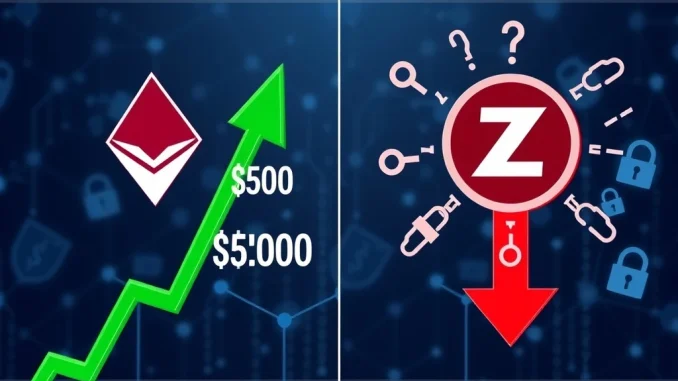
The cryptocurrency landscape witnessed a dramatic privacy coin reversal this week as Monero (XMR) breached the psychologically significant $500 threshold for the first time since 2021, while rival Zcash (ZEC) plunged over 20% amid a devastating governance crisis that has reshaped investor sentiment across the sector. January 2025’s market movements reveal how internal project stability can dramatically influence cryptocurrency valuations, particularly within specialized niches like privacy-focused digital assets.
Monero’s Remarkable Resurgence and Technical Breakthrough
Monero achieved a notable milestone by reaching $500.66 before stabilizing, representing a weekly gain exceeding 20%. This resurgence marks the privacy-focused cryptocurrency’s strongest performance in nearly four years, signaling renewed institutional and retail interest in fungible digital assets. The rally demonstrates how established projects with consistent development roadmaps can capitalize during periods of competitor instability.
Technical analysts immediately identified the $500-$520 range as critical historical resistance. Since 2021, every attempt to surpass this threshold has resulted in significant corrections ranging from 40% to 95%. Consequently, market observers closely monitor whether Monero can establish sustained support above this level, which would potentially invalidate previous bearish patterns and establish new bullish momentum.
Institutional Validation and Market Positioning
Recent institutional reports from Grayscale and Coinbase have highlighted the growing importance of privacy coins within diversified cryptocurrency portfolios. These analyses emphasize Monero’s technological consistency and its maintained focus on transactional privacy through ring signatures and stealth addresses. Meanwhile, the project’s development team has continued regular network upgrades without the governance controversies affecting competing privacy-focused cryptocurrencies.
Zcash Governance Crisis Triggers Investor Exodus
Parallel to Monero’s ascent, Zcash experienced a dramatic 20% decline following a collective resignation within the Electric Coin Company, the primary development team responsible for the cryptocurrency’s protocol evolution. This governance crisis represents the most significant challenge to Zcash’s stability since its 2016 launch, raising fundamental questions about project leadership and future direction.
The situation deteriorated further due to tensions surrounding the Bootstrap Project and concerns regarding fund management transparency. These developments triggered a massive transfer of cryptocurrency investors from ZEC to alternative privacy coins, with Monero emerging as the primary beneficiary. Market data indicates that over $200 million in institutional capital reallocated between these assets during the crisis period.
Comparative Analysis of Privacy Coin Fundamentals
Privacy cryptocurrencies employ different technological approaches to achieve transactional anonymity. The following table outlines key distinctions between Monero and Zcash that have influenced recent market movements:
| Feature | Monero (XMR) | Zcash (ZEC) |
|---|---|---|
| Privacy Technology | Mandatory ring signatures & stealth addresses | Optional zk-SNARKs (shielded transactions) |
| Governance Model | Community-driven with regular scheduled upgrades | Originally Electric Coin Company-led |
| Transaction Privacy | Always private by default | Selective privacy (transparent or shielded) |
| Recent Stability | Consistent development timeline | Governance crisis affecting leadership |
These fundamental differences explain why investors perceive Monero as having greater consistency in its privacy implementation and development roadmap. The optional privacy feature of Zcash has historically created adoption challenges, as many users default to transparent transactions that lack privacy protections.
Technical Analysis: Critical Resistance and Potential Scenarios
Cryptocurrency analysts identify two primary scenarios for Monero’s price trajectory following its breakthrough above $500. The first scenario involves rejection at the $520 resistance level, potentially triggering a correction toward the $200-$270 support zone based on historical patterns. This outcome would align with previous market behavior where privacy coin rallies faced substantial profit-taking at psychologically significant levels.
Alternatively, sustained momentum above $520 could initiate a new bullish phase targeting $775 based on Fibonacci extension levels drawn from the 2021-2024 bear market. This projection represents a 55% increase from current levels and would position Monero among the year’s best-performing digital assets. Several factors support this optimistic scenario:
- Institutional accumulation: On-chain data indicates increased exchange outflows suggesting institutional accumulation
- Network activity: Daily transaction counts have increased 34% month-over-month
- Hash rate stability: Mining participation remains consistent despite price volatility
- Regulatory clarity: Recent guidance has distinguished between privacy coins and mixing services
Market Psychology and Privacy Coin Sentiment
The dramatic divergence between Monero and Zcash reflects broader market psychology regarding project governance and development consistency. Cryptocurrency investors increasingly prioritize teams with transparent communication, predictable upgrade schedules, and resilient organizational structures. The Zcash crisis has highlighted how governance vulnerabilities can rapidly undermine investor confidence, even in technologically sophisticated projects.
Meanwhile, privacy coins as a category have gained renewed attention due to growing mainstream awareness of financial surveillance and data privacy concerns. Legislative developments in various jurisdictions have created uncertainty about traditional financial privacy protections, potentially driving increased demand for cryptographic privacy solutions.
Historical Context and Privacy Coin Evolution
The current market dynamics continue a long-standing rivalry between different approaches to cryptocurrency privacy. Monero originated in 2014 as a fork of Bytecoin, emphasizing mandatory privacy through Cryptonote protocol implementation. Zcash launched in 2016 with academic backing and innovative zero-knowledge proof technology but optional privacy features.
Over the past decade, privacy coins have navigated regulatory scrutiny, exchange delistings, and technological challenges. The sector’s resilience demonstrates persistent demand for financial privacy tools, though implementation approaches have evolved significantly. Recent developments suggest market preference shifting toward projects with consistent privacy implementation rather than optional features.
Regulatory Landscape and Future Considerations
Privacy coins operate within an increasingly complex regulatory environment. Financial authorities worldwide have expressed concerns about potential misuse while acknowledging legitimate privacy needs. The current regulatory approach appears focused on distinguishing between privacy-preserving technologies and outright obfuscation tools, creating potential pathways for compliant privacy coin adoption.
Recent guidance from international regulatory bodies has emphasized transaction monitoring at exchange points rather than protocol-level restrictions. This nuanced approach could benefit established privacy coins with transparent development teams and compliance mechanisms. Projects demonstrating responsible stewardship may navigate regulatory challenges more effectively than those experiencing internal governance crises.
Conclusion
The dramatic divergence between Monero and Zcash illustrates how governance stability and technological consistency increasingly influence cryptocurrency valuations. Monero’s surge past $500, fueled by Zcash’s governance crisis, represents a significant realignment within the privacy coin sector. Technical analysis suggests critical resistance at $520 will determine whether this movement initiates a sustained bullish phase or triggers another correction. Regardless of short-term price action, these developments highlight growing market sophistication in evaluating cryptocurrency fundamentals beyond mere price speculation. The privacy coin segment’s evolution continues reflecting broader trends toward financial digitization and personal data protection, with project governance emerging as a crucial differentiator for long-term viability.
FAQs
Q1: What caused Monero’s price to surge past $500?
Monero’s price increase resulted from multiple factors including Zcash’s governance crisis triggering investor migration, renewed institutional interest documented in Grayscale and Coinbase reports, and broader market recognition of consistent privacy technology implementation. Technical breakout patterns and increased network activity contributed to the momentum.
Q2: How does Zcash’s governance crisis affect its long-term prospects?
The Electric Coin Company resignations create immediate development uncertainty, though the open-source nature of Zcash means community contributors could maintain the project. Historical precedents suggest governance crises can permanently alter project trajectories unless resolved transparently and rapidly, potentially affecting adoption and investor confidence.
Q3: What are the main technological differences between Monero and Zcash?
Monero employs mandatory privacy through ring signatures and stealth addresses, making all transactions private by default. Zcash uses optional zk-SNARKs technology allowing users to choose between transparent and shielded transactions, creating different privacy guarantees and adoption patterns.
Q4: Why is the $500-$520 range significant for Monero’s price?
This range represents historical resistance where previous rally attempts since 2021 have failed, triggering corrections between 40-95%. A sustained breakthrough would invalidate previous bearish patterns and potentially establish new support levels for continued upward movement.
Q5: How are institutional investors approaching privacy coins in 2025?
Institutional analysis increasingly distinguishes between privacy technologies and mixing services, with growing recognition of legitimate financial privacy use cases. Reports highlight portfolio diversification benefits and hedging against surveillance concerns, though regulatory compliance remains a primary consideration for institutional adoption.