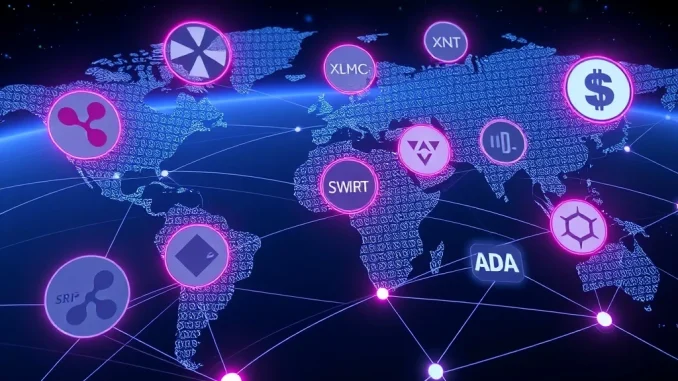
The global financial landscape is constantly evolving, with innovations promising to reshape how money moves across borders. At the forefront of this transformation is XRP, the digital asset designed for fast, low-cost cross-border payments. Ripple CEO Brad Garlinghouse has recently reignited the debate, presenting a compelling vision for XRP to challenge and potentially supersede the long-standing SWIFT system. This bold ambition highlights the inefficiencies plaguing traditional finance and positions XRP as a crucial player in the future of global commerce.
What’s Wrong with SWIFT? Unpacking the 6% Error Rate
Garlinghouse points out that the current SWIFT system, while foundational, is riddled with inefficiencies. He specifically highlighted a reported 6% error rate in transactions, a figure he likens to a catastrophic failure in modern consumer technology. Imagine if 6% of your daily Google searches simply failed – that’s the level of friction impacting global finance.
These errors aren’t just minor glitches; they translate into significant operational costs, requiring extensive human intervention and leading to costly delays. For large corporations, the financial impact is substantial, with some Fortune 50 companies reportedly experiencing error rates as high as 11% in certain payment contexts. This underscores the urgent need for a more robust and reliable system for cross-border payments.
The $10 Trillion Opportunity: How XRP Aims to Unlock Liquidity
One of the most critical economic bottlenecks in the traditional banking system is the staggering amount of capital locked up in pre-funded accounts. Approximately $10 trillion in liquidity is currently tied up globally to sustain the correspondent banking model that underpins SWIFT. This trapped capital represents a massive opportunity cost for financial institutions, hindering their ability to deploy funds efficiently and invest in growth.
XRP offers a potential solution by enabling on-demand liquidity. By facilitating near-instantaneous and cost-effective cross-border payments, XRP could unlock these vast sums of capital, allowing banks and businesses to utilize their funds more effectively. This shift could fundamentally reshape the economics of global commerce, driving down costs and increasing financial fluidity worldwide.
Ripple’s Bold Vision: Projecting a 14% Market Share in Global Payments
Ripple’s strategic focus is clear: to modernize global finance by offering a superior alternative for international settlements. Brad Garlinghouse has reiterated an ambitious projection that XRP could capture up to 14% of SWIFT’s transaction volume within the next five years. This significant market share would be achieved by directly addressing SWIFT’s current inefficiencies, including high error rates and slow settlement times.
This vision draws parallels to historical disruptions, such as SWIFT itself displacing the Telex system in 1977. Ripple believes XRP is poised to follow a similar trajectory, offering a faster, cheaper, and more reliable method for global payments. While ambitious, this projection highlights the company’s confidence in XRP’s technological advantages and its potential to reshape the landscape of international finance.
Navigating the Hurdles: Can XRP Truly Replace SWIFT?
While the promise of XRP is compelling, its path to widespread adoption and potential replacement of SWIFT faces considerable hurdles. The feasibility of XRP fully displacing SWIFT depends on overcoming challenges such as achieving widespread regulatory alignment across diverse jurisdictions, ensuring robust scalability to handle global transaction volumes, and securing broad adoption rates among financial institutions.
Critics often point to SWIFT’s deeply entrenched role in high-value transactions and its robust compliance frameworks as formidable barriers to displacement. SWIFT has spent decades building trust and a comprehensive network. For Ripple and XRP to truly succeed, they must not only demonstrate superior speed and cost-efficiency but also replicate SWIFT’s stringent trust mechanisms, security protocols, and regulatory compliance without compromise. The 14% market share projection, while a strong statement from Ripple, remains speculative and has not been independently verified by external analysts. The journey for XRP is one of innovation meeting entrenched systems, and the outcome will be a testament to both technological prowess and strategic market penetration.
Key Benefits of XRP’s Vision:
- Reduced Costs: Lower transaction fees compared to traditional banking rails.
- Faster Settlements: Near-instantaneous cross-border payments, reducing delays from days to seconds.
- Unlocking Liquidity: Freeing up trillions of dollars currently trapped in pre-funded accounts.
- Improved Efficiency: Significantly lower error rates compared to legacy systems.
- Enhanced Transparency: Blockchain technology offers a more transparent and auditable transaction ledger.
Challenges and Considerations:
- Regulatory Uncertainty: Navigating diverse global regulations remains a significant hurdle.
- Adoption Barriers: Convincing traditional financial institutions to transition from established systems.
- Scalability: Ensuring the network can handle the immense volume of global transactions.
- Network Effect: SWIFT benefits from its vast, established network; XRP needs to build its own.
- Security & Compliance: Replicating SWIFT’s robust security and anti-money laundering (AML) compliance.
Conclusion:
Ripple’s ambition for XRP to become a dominant force in cross-border payments, potentially overshadowing SWIFT, highlights a pivotal shift in the fintech landscape. While the technological advantages of XRP in terms of speed, cost, and efficiency are undeniable, the journey to widespread adoption is complex. It involves not just technological superiority but also navigating intricate regulatory frameworks and building unwavering trust within the global financial community. The debate between decentralized solutions like XRP and centralized systems like SWIFT underscores an evolving narrative: whether innovation can truly disrupt deeply entrenched infrastructures. For now, the future likely involves a gradual evolution, where blockchain-based alternatives coexist and increasingly integrate with traditional systems, ultimately aiming to create a more efficient and accessible global financial ecosystem.
Frequently Asked Questions (FAQs)
- What is SWIFT and why is Ripple targeting it?
SWIFT (Society for Worldwide Interbank Financial Telecommunication) is a global messaging network used by financial institutions to send and receive information about financial transactions. Ripple targets it due to perceived inefficiencies, including high error rates (around 6%) and the need for significant pre-funded liquidity, which locks up capital. - How does XRP aim to reduce transaction error rates?
XRP leverages blockchain technology for real-time, immutable transactions. This distributed ledger technology inherently reduces the need for manual reconciliation and human intervention, which are common sources of errors in traditional systems like SWIFT. - What does “unlocking $10 trillion in liquidity” mean?
In the traditional correspondent banking model, banks must pre-fund accounts in various currencies globally to facilitate cross-border payments. This ties up approximately $10 trillion in capital. XRP’s On-Demand Liquidity (ODL) solution aims to eliminate this need by using XRP as a bridge currency, allowing banks to send payments without pre-funding, thus freeing up capital. - Is Ripple’s projection of 14% market share realistic?
Ripple CEO Brad Garlinghouse has projected XRP could capture up to 14% of SWIFT’s transaction volume within five years. While ambitious and not independently verified, this projection is based on XRP’s potential to offer faster, cheaper, and more reliable cross-border payments compared to existing systems. - What are the biggest challenges for XRP in replacing SWIFT?
Key challenges include navigating complex global regulatory environments, achieving widespread adoption among diverse financial institutions, ensuring the scalability of the XRP Ledger for massive transaction volumes, and building the same level of trust and compliance frameworks that SWIFT has established over decades. - Will SWIFT be completely replaced by XRP?
While Ripple aims to offer a superior alternative, a complete replacement of SWIFT is a monumental task given its entrenched global network and regulatory integration. It’s more likely that blockchain-based solutions like XRP will increasingly integrate with and gradually disrupt traditional systems, leading to a hybrid financial landscape rather than an abrupt overhaul.