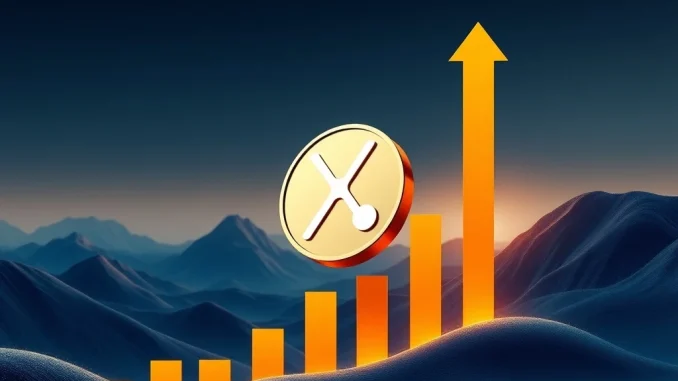
Are you an XRP enthusiast or a crypto investor keenly watching the charts? Today, the digital asset XRP stands at a pivotal moment, testing a critical resistance level that could define its trajectory for the coming months. With analysts pointing to ambitious targets and on-chain data signaling a significant shift, the question on everyone’s mind is: Is an XRP price breakout imminent?
Is XRP Poised for a Massive Breakthrough? Understanding the Wave 3 Target
XRP is currently making headlines as it tests the crucial $3.25 resistance level. This isn’t just any price point; it’s a significant psychological and technical barrier that, if breached, could pave the way for substantial gains. Analysts are closely watching this move, especially in the context of Elliott Wave theory, a popular technical analysis tool used to identify repeating long-term price patterns and predict future movements.
According to this theory, XRP appears to be forming a potential Wave 3, which is typically the longest and strongest wave in a five-wave bullish sequence. Historical data from XRP’s 2017 and 2021 bull cycles provides a compelling backdrop for these projections, where Wave 3 often extends to Fibonacci levels 1.618 and 2.618. These historical precedents suggest that if XRP successfully clears current resistance, it could target an impressive range from $13.13 to $36.76. The current market structure shows XRP consistently forming higher lows on both weekly and monthly charts, with strong support holding above $2.90 – a level analysts consider crucial for maintaining this bullish momentum.
Decoding On-Chain Accumulation: What Does the Data Say About XRP?
Beyond the technical charts, the underlying strength of XRP’s market lies in its on-chain metrics. Recent data reveals a compelling trend of growing on-chain accumulation by long-term holders. This means more investors are moving their XRP off exchanges and into personal wallets, indicating a strong belief in the asset’s future value rather than an intent to sell in the short term.
Key indicators of this accumulation include:
- Rising Wallet Activity: An increase in the number of active XRP wallets, particularly those holding larger sums, suggests growing participation from committed investors.
- Net Outflows from Exchanges: When more XRP is withdrawn from exchanges than deposited, it reduces the immediate selling pressure and signals that holders are preparing for a long-term hold, rather than quick trades.
This accumulation trend is a powerful bullish signal, as it reduces the circulating supply available for sale on exchanges, potentially leading to price increases if demand rises. It suggests that despite any short-term market noise, a significant portion of the XRP community is positioning for a sustained rally, viewing current levels as an opportunity for strategic entry or accumulation.
Navigating Mixed Signals: XRP Derivatives vs. Spot Market
While on-chain data paints a bullish picture, the derivatives market for XRP presents a more cautious, even bearish, short-term sentiment. This divergence highlights a complex market dynamic that investors must understand:
- Declining Futures Open Interest: Over the past week, XRP futures open interest has dropped from $10.94 billion to $9 billion. Open interest represents the total number of outstanding derivatives contracts that have not been settled. A decline often indicates that traders are closing out positions, and if coupled with price declines, it can signal weakening bullish conviction or increased shorting activity.
- Negative Funding Rates: Funding rates in perpetual futures contracts are payments exchanged between long and short positions to keep the contract price close to the spot price. Negative funding rates indicate that short position holders are paying long position holders, suggesting that a majority of traders are betting on a price decline.
This short-term bearishness in derivatives, however, contrasts sharply with the long-term bullish positioning seen in the spot market via on-chain accumulation. This duality suggests that while some traders are hedging or speculating on short-term dips, long-term investors are using these periods of uncertainty to accumulate XRP, anticipating a future price surge. It’s a classic battle between short-term speculation and long-term investment conviction.
What Are the Key Levels for XRP Investors?
For any investor, understanding critical support and XRP resistance levels is paramount. The immediate resistance zone at $3.25 is undoubtedly a key inflection point. A decisive breakout above this level could unlock significant upward momentum, paving the way for intermediate targets:
- Initial Breakout Targets: $3.80 – $4.30
- Broader Wave 3 Targets: $13.13, $18.22, and an ambitious $36.76
Conversely, maintaining strong support above $2.90 is crucial. Should XRP fail to hold this level, it could signal a weakening of the bullish structure and necessitate a reevaluation of the immediate outlook. While the overall uptrend remains intact due to sustained price stability above $2.75, investors are advised to closely monitor momentum indicators like the Relative Strength Index (RSI) and Moving Average Convergence Divergence (MACD). These indicators, currently showing weakening buying pressure, often precede significant price movements, signaling a potential build-up of energy before a major shift.
Beyond the Immediate Horizon: XRP’s Ambitious Long-Term Outlook
Looking further ahead, some analysts hold even more ambitious targets for XRP. Notably, XRP enthusiast Dark Defender has suggested that the asset could eventually target $117, surpassing the aforementioned Wave 3 milestones. While such projections are inherently speculative and not financial advice, they underscore the profound long-term potential that some market participants see in XRP.
The historical alignment of XRP’s price action with Elliott Wave 3 setups provides a compelling narrative for a potential bullish breakout, especially if the $3.25 level is decisively breached. The cooling period in XRP’s market cycle appears to be nearing its end, with on-chain activity and derivatives data pointing to a transition phase. This period of consolidation could be setting the stage for the next major leg up.
Actionable Insights for XRP Holders
Given the mixed signals across market segments, a balanced and informed approach is recommended for investors:
- Monitor Key Levels: Keep a close eye on the $3.25 resistance and the $2.90 support levels. A sustained break above $3.25 is a strong bullish signal, while a fall below $2.90 would warrant caution.
- Watch On-Chain Data: Continue to track accumulation trends and exchange outflows. Sustained accumulation by long-term holders reinforces the bullish long-term outlook.
- Understand Derivatives: While short-term derivatives sentiment might be bearish, recognize that it often reflects short-term trading strategies rather than fundamental long-term value.
- Risk Management: As with any investment, especially in volatile crypto markets, only invest what you can afford to lose. Ambitious price targets are speculative and subject to market dynamics and regulatory developments.
- Stay Informed: Follow reliable XRP news sources and market analysis to stay updated on critical developments.
Conclusion: Is XRP Primed for Its Next Big Move?
XRP finds itself at a fascinating crossroads. The battle between short-term bearish derivatives sentiment and robust long-term on-chain accumulation highlights a market in transition. The potential for a significant Wave 3 breakout, targeting levels well above current prices, is a compelling prospect for investors. While the path ahead may involve volatility, the underlying strength indicated by long-term holder accumulation and the consistent formation of higher lows suggest that XRP’s next major move could be on the horizon. The coming weeks will be crucial in determining whether XRP can decisively break its key resistance and embark on the ambitious trajectory many analysts foresee.
Frequently Asked Questions (FAQs)
Q1: What is the significance of XRP testing the $3.25 resistance level?
The $3.25 level is a critical technical resistance point. A decisive breakout above this level would signal strong bullish momentum, potentially leading to further price increases as it overcomes a key psychological and historical barrier for XRP.
Q2: What does ‘Wave 3’ mean in Elliott Wave theory for XRP?
In Elliott Wave theory, Wave 3 is typically the strongest and longest wave in a five-wave bullish sequence. For XRP, analysts suggest it could lead to significant price appreciation, with targets ranging from $13.13 to $36.76, based on historical patterns observed in previous bull cycles.
Q3: How does on-chain accumulation affect XRP’s price?
On-chain accumulation, evidenced by rising wallet activity and net outflows from exchanges, indicates that long-term holders are buying and holding XRP rather than selling. This reduces the available supply on exchanges, which can lead to price increases if demand remains constant or grows.
Q4: Why are derivatives signals for XRP sometimes bearish while spot market signals are bullish?
This divergence often occurs because derivatives markets (like futures) are used for short-term speculation or hedging, while spot market accumulation reflects long-term investment strategies. Negative funding rates or declining open interest in futures can indicate short-term bearish bets, even as long-term investors accumulate the asset in anticipation of future growth.
Q5: What are the key price levels XRP investors should monitor?
Investors should closely monitor the $3.25 resistance level for a breakout and the $2.90 support level to confirm the bullish trend’s continuation. Intermediate targets after a breakout include $3.80–$4.30, with broader Wave 3 targets extending much higher.
Q6: Is the $117 XRP price target realistic?
The $117 target is a highly ambitious and speculative projection by some analysts, like Dark Defender. While it reflects significant long-term potential in the eyes of some enthusiasts, it is explicitly labeled as speculative and should not be considered financial advice. Investors should approach such long-term forecasts with caution and conduct their own research.