The world of cryptocurrency is no stranger to dramatic shifts, but recent developments surrounding XRP have once again captured the attention of investors. In a series of significant transactions in July 2025, Ripple co-founder Chris Larsen divested approximately $140 million worth of XRP tokens. This substantial sale coincided with a notable 10% decline in the XRP price, reigniting critical discussions about the influence of large individual holders, often referred to as ‘whales,’ on broader crypto market dynamics.
Understanding the XRP Price Volatility
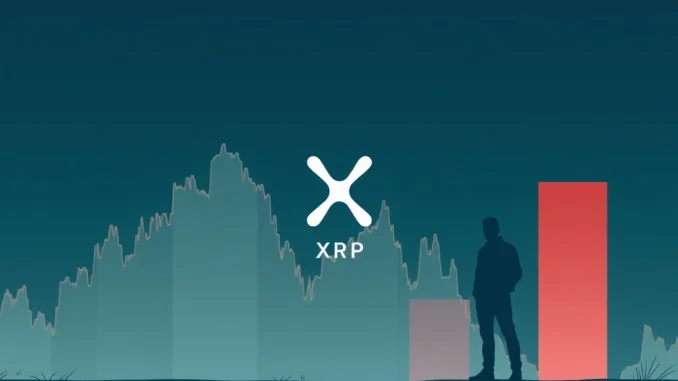
XRP, the digital asset associated with Ripple Labs, has always been subject to intense scrutiny due to its unique position in the financial landscape and ongoing regulatory battles. However, recent movements suggest that internal dynamics might be playing a more immediate role in its short-term volatility. Between July 17 and July 25, 2025, Chris Larsen’s transfers of roughly $140 million in XRP to various exchanges were closely followed by a 10% drop in the token’s value. This isn’t an isolated incident; a similar $140 million transfer in June 2025 also correlated with a 10.33% drop and triggered $86 million in liquidations across the market.
The impact of these large-scale sales is often magnified by automated trading systems and investor sentiment. When a major holder moves such a significant volume, it can signal potential selling pressure, prompting others to offload their holdings, thereby accelerating a downward trend. On July 23, a single-day 10% drop in XRP’s price led to $7.3 million in long positions being wiped out on Binance, highlighting the immediate and severe consequences for leveraged traders.
| Date Range (July 2025) | Chris Larsen XRP Sales (Approx.) | XRP Price Impact | Noteworthy Market Events |
|---|---|---|---|
| July 17-25 | ~$140 million | 10% decline | Intensified scrutiny on large holder influence |
| July 23 (single day) | (Coinciding with transfers) | 10% drop | $7.3 million XRP long liquidations on Binance |
| July 17 | ~$175 million (preceded) | 15% decline (following week) | Reinforced historical patterns of volatility |
Who is the Ripple Co-Founder and Why Do Their Actions Matter?
Chris Larsen is not just any investor; he is one of the original founders of Ripple, the company behind XRP. Along with Jed McCaleb, he was initially allocated a substantial 9 billion XRP tokens from Ripple’s 2012 founder distribution. This massive initial allocation means that even small percentages of their holdings can translate into hundreds of millions, or even billions, of dollars worth of tokens. As of early July, Larsen still held an estimated 2.58 billion XRP, valued at $7.9 billion.
The actions of such a significant Ripple co-founder are closely watched for several reasons:
- Market Signal: Large sales by an insider can be interpreted by the market as a lack of confidence in the asset’s future price or a strategic divestment.
- Liquidity Impact: Selling billions of dollars worth of tokens, even gradually, can absorb market liquidity and put consistent downward pressure on the price.
- Trust and Transparency: While founders have every right to manage their assets, the timing and scale of such sales can raise questions among the community about transparency and fairness, especially during periods of market weakness.
This situation contrasts sharply with fellow Ripple co-founder Jed McCaleb, who completed his extensive XRP divestment strategy in July 2022. McCaleb’s selling was a long-term, pre-announced process, which, while large, eventually ceased, removing a known source of selling pressure from the market. Larsen’s continued sales, however, suggest a different, ongoing strategy.
Chris Larsen‘s Divestment Strategy: A Closer Look
Analysts, including CryptoQuant’s J.A. Maartun, have suggested that Chris Larsen‘s recent activity might be part of a larger, deliberate divestment strategy. Since November 2024, Larsen has reportedly sold 107 million tokens, totaling approximately $3.3 billion at current prices. While he still holds a substantial amount, these ongoing sales indicate a consistent offloading of his founder allocation.
It’s important to distinguish between planned, transparent sales (like McCaleb’s) and less predictable, market-driven ones. Larsen’s sales have often coincided with price declines, leading some traders to directly link these movements to insider activity. This perceived correlation can amplify fear, uncertainty, and doubt (FUD) within the community, making it harder for the asset to recover.
However, it’s also crucial to consider the nuances. Larsen might be diversifying his portfolio, managing personal finances, or even making strategic moves for tax purposes. Without direct statements, market observers are left to interpret the on-chain data and its correlation with price action.
Impact of Large Sales on the Broader Crypto Market
While specific to XRP, the dynamics at play here have broader implications for the entire crypto market. The influence of large holders, or ‘whales,’ is a constant factor in less liquid assets. Their actions can create significant ripple effects:
- Increased Volatility: Large sell-offs can lead to rapid price swings, making the asset more volatile and less predictable for smaller investors.
- Liquidation Cascades: As seen with the Binance long liquidations, price drops triggered by large sales can initiate a chain reaction, forcing leveraged positions to close, further exacerbating the downturn.
- Sentiment Shift: Persistent selling from a prominent figure can erode investor confidence, leading to a bearish sentiment that is hard to shake off, even if fundamental factors remain strong.
- Market Depth: A market needs sufficient depth (buy orders) to absorb large sell orders without significant price impact. If liquidity is thin, even moderate sales can cause sharp drops.
It’s also important to remember that the crypto market is influenced by a multitude of factors beyond individual sales. Macroeconomic trends, such as inflation, interest rate hikes, and global economic stability, play a significant role. Industry-wide corrections, regulatory news (like the ongoing SEC lawsuit against Ripple), and technological advancements also contribute to an asset’s price trajectory. Legal expert Bill Morgan rightly cautioned against oversimplifying XRP’s performance to founder sales alone, emphasizing the multifaceted nature of market movements.
Staying Informed: Essential XRP News and Future Outlook
For investors navigating the current landscape, staying abreast of relevant XRP news is paramount. While founder sales are a critical data point, they should be viewed as one piece of a larger puzzle. A holistic approach involves monitoring:
- Regulatory Developments: Updates on the SEC vs. Ripple lawsuit remain a significant determinant of XRP’s long-term outlook. Positive outcomes could provide substantial upward momentum.
- Ripple’s Partnerships and Adoption: News about new partnerships, use cases, and adoption of Ripple’s On-Demand Liquidity (ODL) service or XRP Ledger advancements can signal underlying growth.
- Broader Crypto Market Trends: XRP often correlates with the broader crypto market. Bitcoin’s performance, for instance, can significantly influence altcoin prices.
- Technical Analysis: Studying chart patterns and indicators can provide insights into potential support and resistance levels.
Despite the recent downturn, some analysts maintain optimistic long-term price predictions for XRP, with forecasts suggesting a rebound to $3.66–$5 by late 2025. However, such projections are contingent on various factors, including a favorable resolution to regulatory challenges and a general bullish trend in the crypto market. The interplay between founder token activity, liquidity events, and external macroeconomic conditions underscores the complexity of predicting short-term price movements.
Conclusion:
The recent sales by Ripple co-founder Chris Larsen have undoubtedly cast a shadow over XRP’s short-term price action, contributing to its July 2025 decline. These events highlight the significant influence that large holders can wield in the cryptocurrency space. However, smart investors understand that no single factor dictates an asset’s entire trajectory. While monitoring insider activity is crucial, it’s equally important to consider the broader market forces, regulatory landscape, and fundamental developments that shape XRP’s future. By adopting a comprehensive view and balancing insights from whale behavior with wider industry trends, investors can better navigate the evolving XRP ecosystem and make informed decisions.
Frequently Asked Questions (FAQs)
Q1: Why did XRP’s price fall by 10% in July 2025?
A1: The 10% price fall in July 2025 coincided with significant XRP token sales by Ripple co-founder Chris Larsen, who transferred approximately $140 million worth of XRP to exchanges. These large movements often create selling pressure and can impact market sentiment.
Q2: How much XRP has Chris Larsen sold recently?
A2: Between July 17 and July 25, 2025, Chris Larsen sold approximately $140 million worth of XRP. This follows a similar $140 million transfer in June 2025. Overall, he has sold 107 million tokens, totaling $3.3 billion at current prices, since November 2024.
Q3: What is the difference between Chris Larsen’s and Jed McCaleb’s XRP sales?
A3: Both were allocated 9 billion XRP initially. Jed McCaleb completed his extensive, largely pre-announced, and consistent selling strategy in July 2022, removing a known source of supply from the market. Chris Larsen’s sales appear to be ongoing and have been noted to coincide more directly with immediate price declines, suggesting a different, possibly less predictable, divestment approach.
Q4: Do founder sales fully explain XRP’s price movements?
A4: No. While founder sales from major holders like Chris Larsen can certainly contribute to short-term volatility and selling pressure, XRP’s price is influenced by a multitude of factors. These include macroeconomic trends, regulatory updates (like the SEC lawsuit), technological advancements, overall crypto market sentiment, and broader industry-wide corrections.
Q5: What should investors do given these large sales?
A5: Investors are advised to adopt a holistic view. While monitoring large holder activity is important, it’s crucial to also consider broader market trends, regulatory news, Ripple’s fundamental developments, and personal risk tolerance. Diversifying portfolios and avoiding panic selling based solely on single events are generally recommended strategies.