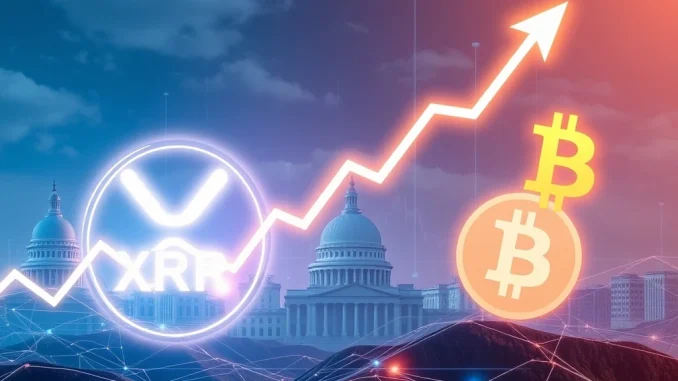
The cryptocurrency world is buzzing with renewed optimism, especially around XRP price prediction. What if a major altcoin like XRP could reach unprecedented heights, propelled by the king of crypto, Bitcoin, and significant breakthroughs in regulatory clarity? Recent projections are painting an incredibly bullish picture for Ripple’s native token, suggesting a future where its value could soar, potentially reaching a staggering $5,000 by 2026 under specific market conditions. This isn’t just wishful thinking; it’s a scenario being discussed by prominent figures in the crypto space, fueled by tangible developments.
XRP Price Prediction: Unpacking the Bold Forecasts
For years, Ripple XRP faced headwinds due to its legal battle with the SEC. However, as regulatory clarity begins to emerge, the narrative is shifting dramatically. Aaron Arnold, co-founder of Altcoin Daily, a prominent voice in the crypto community, has notably transitioned from skepticism to a highly bullish stance on XRP. His revised outlook isn’t without reason; he points to significant regulatory progress and the token’s growing real-world utility as key drivers for its potential parabolic growth.
Arnold’s projections for XRP are ambitious, directly correlating with Bitcoin’s performance:
- If Bitcoin (BTC) hits $150,000: Arnold estimates that 1,000 XRP could be valued at $5,000, implying a significant individual XRP price.
- If Bitcoin (BTC) climbs to $250,000: The projected value for 1,000 XRP could further rise to an impressive $9,000.
These projections, while ambitious, underscore the strong correlation many altcoins have with Bitcoin’s broader market movements. For investors, understanding these intertwined dynamics is crucial.
Ripple XRP’s Strategic Pillars: Regulatory Progress and Utility
Beyond speculative price movements, the fundamental strength of Ripple XRP lies in its evolving utility and the ongoing regulatory developments. The long-standing legal challenges with the SEC have been a cloud over XRP, but recent progress has instilled a renewed sense of confidence among investors and institutions alike.
A major catalyst for Arnold’s bullish shift is the launch and rapid adoption of Ripple’s stablecoin, RLUSD. This stablecoin has quickly surpassed a $500 million market capitalization within just six months, demonstrating strong market demand. A significant portion of RLUSD activity currently resides on the Ethereum blockchain (83%), but Arnold anticipates a substantial migration to the XRP Ledger (XRPL). Why is this important?
- Cost Efficiency: Institutions are constantly seeking more cost-efficient solutions for transactions, and the XRPL offers distinct advantages in this regard.
- Deflationary Mechanism: Increased activity on the XRPL, driven by RLUSD transactions, directly boosts XRP demand through a transaction burn mechanism. This deflationary aspect can naturally increase XRP’s scarcity and, consequently, its value over time.
This strategic move by Ripple to onboard stablecoin activity onto its native ledger is a powerful demonstration of XRP’s real-world utility as a bridge currency, designed for fast, low-cost international payments.
The Power of XRP ETF Filings: A Catalyst for Growth?
One of the most anticipated developments in the crypto space is the potential approval of spot Exchange-Traded Funds (ETFs) for cryptocurrencies beyond Bitcoin. The impact of Bitcoin spot ETF approvals on BTC’s price, which saw it jump from $45,000 to $123,000, has not gone unnoticed. Now, the spotlight is turning to XRP.
The institutional momentum behind XRP ETF approvals is significant. Reports indicate that eleven financial firms, collectively managing a staggering $240 billion in assets, have formally filed for XRP ETF approval with the SEC. A successful approval could trigger a similar, if not more pronounced, price surge for XRP. The recent growth of Teucrium’s XRP Futures ETF (XXRP) to $122 million in assets under management further highlights the heightened institutional interest in XRP as a viable investment vehicle.
The prospect of a regulated and easily accessible investment product like an XRP ETF could unlock massive institutional capital, fundamentally altering XRP’s market dynamics and liquidity.
Bitcoin Price Influence: The Crypto King’s Role in XRP’s Destiny
As highlighted by Aaron Arnold’s projections, the future trajectory of XRP is deeply intertwined with the broader cryptocurrency market, particularly the performance of Bitcoin price. Bitcoin often acts as the market’s bellwether, influencing the sentiment and capital flow across the entire digital asset ecosystem.
The scenarios presented – Bitcoin reaching $150,000 or even $250,000 – are not just arbitrary numbers. They represent a significant bull market, potentially driven by factors such as continued institutional adoption, favorable macroeconomic conditions, and further regulatory clarity across the globe. In such an environment, altcoins like XRP are typically poised for substantial gains, often outperforming Bitcoin on a percentage basis during the peak of a bull cycle.
Understanding this symbiotic relationship is key for any investor looking at XRP’s potential. While XRP has its unique fundamentals, its ability to reach ambitious targets often depends on a strong underlying Bitcoin market.
Navigating the Challenges: What Could Slow XRP’s Ascent?
While the outlook for XRP appears overwhelmingly positive, it’s crucial for investors to maintain a balanced perspective and acknowledge the inherent risks and challenges. The crypto market is known for its volatility, and XRP is no exception.
Key challenges that could impact XRP’s trajectory include:
- Ongoing Regulatory Uncertainty: Despite progress, the regulatory landscape remains fluid. Any new legal challenges or adverse rulings could temper investor enthusiasm.
- Intense Competition: XRP faces stiff competition from other layer-1 solutions and a multitude of altcoins, each vying for market share and developer adoption.
- Market Volatility: The crypto market is susceptible to rapid shifts. A July 2025 market event saw XRP lose $20 billion in market capitalization amid sector-wide volatility, underscoring this risk.
- Delayed ETF Approvals: While filings are in, the SEC’s approval process can be lengthy and unpredictable. Delays could hinder liquidity and dampen investor sentiment.
- Ambitious Valuation Targets: While a $5,000 or even $9,000 XRP is projected, some more conservative estimates range from $4.50 to $7.90 by 2026-2028, contingent on Ripple securing banking partnerships. A speculative $30 target from an AI model highlights the wide divergence in forecasts and the sector’s inherent volatility. Achieving a $10 price target, for instance, would require XRP’s market cap to surpass $500 billion—a significant hurdle given its current valuation.
Investors should always conduct thorough due diligence and consider these factors when making investment decisions.
A Promising Horizon for XRP?
Aaron Arnold’s analysis powerfully underscores XRP’s potential as a utility-driven asset. Achieving the ambitious 2026 forecasts hinges on a confluence of factors: Bitcoin’s continued bullish performance, definitive crypto regulatory progress, and sustained institutional adoption. For existing holders, the token’s deflationary mechanism via RLUSD activity on the XRPL, combined with the potential for XRP ETF approvals, could significantly amplify gains during a broader bull market. However, as with any investment in the volatile cryptocurrency space, caution is warranted. Investors are strongly advised to weigh these exciting prospects against the sector’s inherent risks, including broader macroeconomic trends and evolving regulatory landscapes. The journey for XRP is far from over, and its future looks increasingly intriguing.
Frequently Asked Questions (FAQs)
Q1: What are the main drivers behind the bullish XRP price predictions for 2026?
The primary drivers include anticipated regulatory clarity, particularly regarding Ripple’s legal status, the growing utility and adoption of Ripple’s stablecoin (RLUSD) on the XRP Ledger (XRPL), and the potential approval of spot XRP Exchange-Traded Funds (ETFs) which could unlock significant institutional investment.
Q2: How is Bitcoin’s performance linked to XRP’s price projections?
Many analysts, including Aaron Arnold, correlate XRP’s potential future price with Bitcoin’s performance. If Bitcoin reaches higher price targets (e.g., $150,000 or $250,000), it often signals a broader bull market that tends to lift the prices of altcoins like XRP, sometimes with even greater percentage gains.
Q3: What role does Ripple’s RLUSD stablecoin play in XRP’s potential growth?
RLUSD’s growth and its projected migration from Ethereum to the XRP Ledger are crucial. Increased transaction activity on the XRPL through RLUSD will trigger XRP transaction burns, creating a deflationary mechanism that reduces XRP’s supply and potentially increases its value over time.
Q4: What are the key risks or challenges that could hinder XRP’s price growth?
Major challenges include ongoing regulatory uncertainty, intense competition from other blockchain solutions and altcoins, the inherent volatility of the cryptocurrency market, and potential delays or denials of XRP ETF approvals by regulatory bodies like the SEC.
Q5: Is a $5,000 XRP price target realistic by 2026?
A $5,000 XRP price target is an ambitious projection contingent on specific, highly favorable market conditions, including a significant Bitcoin bull run and major regulatory and institutional breakthroughs. While optimistic, it represents a high-end scenario. Investors should consider a range of projections and the inherent volatility of crypto assets.