The cryptocurrency market, known for its rapid shifts, recently witnessed a significant event that sent ripples through the XRP community. A massive $175 million XRP transfer by Ripple co-founder Chris Larsen sparked immediate concern, leading to a notable 15% XRP price drop and triggering millions in crypto liquidations on major exchanges like Binance. This incident highlights the immense sensitivity of digital asset markets to large movements by prominent holders and raises crucial questions about market dynamics and investor confidence.
XRP News: Unpacking Chris Larsen’s $175M Transfer
Recent XRP news has been dominated by the actions of Ripple co-founder Chris Larsen. Between July 17 and July 24, 2025, Larsen executed transfers totaling 50 million XRP, an amount valued at approximately $175 million. These transactions involved moving funds to a combination of exchange-connected addresses and newly created wallets. Blockchain analytics firm ZachXBT specifically noted that $30 million of this sum was directed to Coinbase, a move widely interpreted as a precursor to potential selling activity. The timing of these substantial transfers was particularly critical, as they coincided with XRP reaching a recent high of $3.65 on July 18.
Such large-scale movements by early stakeholders or project founders often draw scrutiny due to their potential to influence market sentiment and supply dynamics. In the highly interconnected world of cryptocurrencies, even perceived intentions can trigger significant price reactions. Larsen’s team has yet to offer an official comment on these transactions, leaving the community to speculate on the underlying reasons for such a substantial shift of funds.
The Immediate Aftermath: A Sharp XRP Price Drop
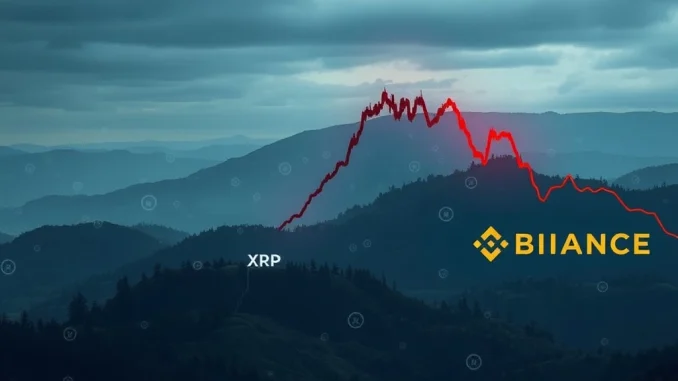
Following these transfers, the market reacted swiftly and decisively, resulting in a pronounced XRP price drop. Over the week subsequent to XRP’s peak, the token experienced a 15% pullback. The most significant decline occurred on July 23, when XRP fell by 10.3% in a single day. This sharp depreciation had immediate and dramatic consequences for traders, particularly those holding leveraged long positions.
The sudden downturn led to substantial liquidations across derivatives markets. Data from CryptoQuant Insights, highlighted by analyst Darkfost, revealed that $7.3 million in long-position liquidations were triggered on Binance alone. This indicates a significant number of traders who had bet on XRP’s continued rise were forced to close their positions at a loss as the price moved against them. CoinGlass data further underscored the market strain, reporting a total of $16.42 million in long liquidations within a 24-hour period across various exchanges. These figures paint a clear picture of the volatility and rapid capital shifts that can occur in response to large institutional movements.
Ripple XRP: Understanding Broader Market Signals
Beyond the immediate price action, other market indicators for Ripple XRP added complexity to the situation. Exchange reserves for XRP, for instance, showed a steady increase from 2.75 billion tokens in May to 2.98 billion tokens by July 24, according to AMBCrypto. Typically, a rise in exchange holdings is interpreted as a bearish signal, suggesting that more tokens are being moved to exchanges, potentially for sale. However, in this instance, the increase in reserves occurred concurrently with XRP reaching its all-time high, adding nuance to the interpretation.
This confluence of events—record highs, increasing exchange reserves, and a subsequent price drop—highlights the intricate nature of crypto market analysis. While increased supply on exchanges can indeed precede distribution, the context of an asset’s price performance is crucial for a complete understanding. The market’s reaction also reflects the ongoing sensitivity surrounding Ripple and its native token, particularly given its historical performance and ongoing legal battles.
The Ripple Effect: Analyzing Crypto Liquidations
The crypto liquidations triggered by XRP’s price decline serve as a stark reminder of the risks associated with leveraged trading. When a trader opens a leveraged position, they borrow funds to amplify their potential gains. However, if the market moves against their prediction, their position can be automatically closed, or ‘liquidated,’ once their margin falls below a certain threshold. The $7.3 million in long liquidations on Binance, alongside the broader $16.42 million across the market, represents significant capital losses for many traders.
These liquidation cascades can further exacerbate price downturns, creating a negative feedback loop where falling prices trigger more liquidations, which in turn push prices even lower. This mechanism underscores the importance of risk management for individual investors, especially when dealing with volatile assets like cryptocurrencies. The incident with XRP serves as a case study in how quickly market sentiment can shift and impact leveraged positions.
Centralization Concerns: The Role of Chris Larsen XRP Holdings
The actions of Chris Larsen XRP holdings have reignited long-standing debates about centralization within the XRP ecosystem. Blockchain forensics firm Lookonchain estimates Larsen’s remaining holdings at a staggering 2.81 billion XRP, valued at over $8.4 billion at current prices. This immense concentration of supply among early stakeholders, including Larsen’s historical allocation of 9 billion XRP from Ripple’s 2012 founding, raises legitimate concerns about the potential for single entities to exert significant influence over the token’s market dynamics.
Critics argue that such concentrated ownership contradicts the decentralized ethos often championed in the cryptocurrency space. While large holders are not inherently problematic, their ability to move vast sums can create market instability and raise questions about fair distribution and market manipulation. It’s important to note that no direct link has been established between these transfers and Ripple’s ongoing SEC litigation concerning XRP’s classification. However, the incident undeniably adds another layer of complexity to the public perception of XRP’s market structure.
Challenges and the Path Forward for XRP
Despite the short-term sell-off and the challenges posed by large whale movements, XRP has shown some resilience. The token found support near the $3.00 level, with analysts suggesting that the $2.9–$3 range could act as a crucial psychological floor. This price consolidation period is vital, allowing both derivatives and spot markets to stabilize after the recent turbulence. At press time, XRP traded at $3.11, demonstrating its ability to rebound somewhat amid broader market corrections.
The incident underscores the inherent sensitivity of crypto markets to significant institutional or individual movements. While Larsen’s recent transfers and potential sales have undoubtedly influenced short-term price action, they have not conclusively altered XRP’s long-term trajectory. The ongoing challenge for XRP, and indeed for many cryptocurrencies with concentrated ownership, lies in balancing market liquidity and investor confidence against the backdrop of regulatory uncertainties and the actions of large holders.
Conclusion: Navigating Volatility in the Crypto Landscape
The recent events surrounding Chris Larsen’s substantial XRP transfer serve as a powerful reminder of the volatility and unique dynamics at play in the cryptocurrency market. A $175 million movement can trigger a 15% XRP price drop and millions in crypto liquidations, underscoring how quickly market sentiment can shift. While the immediate impact was a downturn, XRP’s ability to find support around the $3.00 mark suggests underlying resilience. Investors must remain vigilant, understanding that the actions of large holders and the inherent structure of asset distribution can significantly influence market behavior. As the crypto space matures, navigating these complexities with informed decisions will be paramount for both traders and long-term holders.
Frequently Asked Questions (FAQs)
Q1: What caused the recent XRP price drop?
The recent XRP price drop was primarily triggered by the transfer of 50 million XRP (worth approximately $175 million) by Ripple co-founder Chris Larsen. These large transfers, especially to exchanges like Coinbase, were widely interpreted as a precursor to selling, leading to a significant market reaction and a 15% price decline.
Q2: What are crypto liquidations and how did they affect XRP?
Crypto liquidations occur when a trader’s leveraged position is automatically closed due to the market moving against them, causing their margin to fall below a required threshold. For XRP, the sudden 10.3% price drop on July 23 led to $7.3 million in long-position liquidations on Binance alone, indicating significant losses for traders betting on price increases, and contributing to further downward pressure.
Q3: Does Chris Larsen’s XRP transfer relate to Ripple’s SEC lawsuit?
No direct link has been established between Chris Larsen’s recent XRP transfers and Ripple’s ongoing litigation with the SEC regarding XRP’s classification. While the lawsuit certainly impacts market sentiment, these specific transfers appear to be personal actions by the co-founder.
Q4: What are the concerns about concentrated XRP ownership?
Concerns about concentrated XRP ownership stem from the fact that early stakeholders, including Chris Larsen, hold a significant portion of the total XRP supply (Larsen’s estimated 2.81 billion XRP). Critics argue that such large holdings could allow a few individuals to exert undue influence on the market, potentially leading to volatility and raising questions about decentralization.
Q5: Has XRP found a new support level after the drop?
Yes, after the significant price drop, XRP has found support near the $3.00 level. Analysts suggest that the $2.9–$3 range could act as a psychological floor, allowing the market to stabilize before any potential further upward movement. At press time, XRP traded at $3.11, showing some resilience.