The crypto world is abuzz with the latest XRP news today, as Ripple Labs finds itself embroiled in renewed controversy. A substantial political donation by Ripple’s co-founder, Chris Larsen, has reignited fiery debates, casting a fresh shadow over the already protracted Ripple SEC lawsuit concerning XRP’s elusive classification. This development has not only intensified the legal skirmish but also sparked widespread discussion among XRP token holders and the broader crypto community about corporate alignment, political influence, and the future of digital asset regulation.
Unpacking the Latest XRP News Today: A Political Quake
The core of the recent uproar centers on Chris Larsen’s significant contribution of over $11 million to Kamala Harris’s 2024 presidential campaign. This staggering sum represents the largest crypto industry contribution to date, immediately drawing scrutiny. For many, this donation raises questions about potential conflicts of interest, especially given the U.S. Securities and Exchange Commission’s (SEC) historical opposition to Ripple’s stance that XRP is not a security.
Harris, aligning with President Joe Biden’s regulatory approach, has been a polarizing figure within the crypto community. While some see her as a potential path to clearer regulation, many XRP holders have openly favored Donald Trump’s more overtly pro-crypto rhetoric. This divergence has led to concerns among token holders that Ripple’s leadership might be prioritizing political agendas over the collective interests of its community, fueling skepticism and frustration.
The Enduring Ripple SEC Lawsuit: A Legal Labyrinth
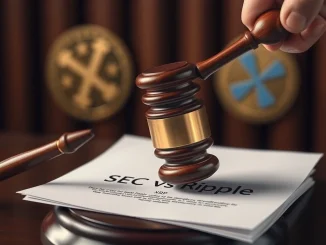
The ongoing legal battle between Ripple Labs and the SEC remains a pivotal point for the crypto industry. Initiated under the Trump administration by then-SEC Chair Jay Clayton, the lawsuit contends that XRP should be classified as a security, a claim Ripple vehemently denies. Marc Fagel, a former SEC attorney, recently clarified the case’s origins, emphasizing that current SEC Chair Gary Gensler inherited the lawsuit and played no role in its initiation. This clarification aims to dispel claims of regulatory partisanship often leveled against the SEC.
Despite these clarifications, Ripple CEO Brad Garlinghouse has often framed the case as a chapter largely closed under the Trump administration, subtly contrasting it with speculative concerns about potential outcomes under a future Harris-era SEC. The prolonged nature of this litigation has created significant regulatory uncertainty, impacting not just Ripple but also the broader market for digital assets. Ripple’s strategy of prolonging the litigation instead of seeking an early settlement has been criticized for extending this period of ambiguity, though the company maintains it is fighting for clarity and innovation.
The Core Debate: Understanding XRP Classification
At the heart of the Ripple SEC lawsuit is the fundamental question of XRP classification: Is XRP a security, a commodity, or a currency? This distinction carries immense implications for how XRP is regulated, traded, and utilized globally. If classified as a security, XRP would fall under stringent SEC regulations, potentially limiting its liquidity and adoption, and imposing significant compliance burdens on exchanges and issuers. Ripple argues that XRP functions as a bridge currency for cross-border payments, distinct from a security.
The SEC’s position, rooted in the Howey Test, asserts that XRP meets the criteria of an investment contract. This test, established in a 1946 Supreme Court case, defines a security as an investment of money in a common enterprise with the expectation of profits to be derived solely from the efforts of others. Ripple contests that XRP does not satisfy all prongs of this test. The outcome of this debate is not just about XRP; it could set a crucial precedent for how other digital assets are viewed and regulated in the United States, shaping the future landscape of the entire crypto market.
Ripple Donation Controversy: Community Backlash and Political Ties
The revelation of Chris Larsen’s substantial political donation has not been met with universal approval within the XRP community. Many token holders express frustration, perceiving a disconnect between Ripple’s corporate actions and their own investment interests. The sentiment among some is that such political maneuvers could complicate the very legal clarity Ripple claims to seek, potentially aligning the company with political figures who are not seen as unequivocally pro-crypto by the community.
Community reactions highlight growing skepticism and a sense of betrayal. One XRP holder’s hypothetical scenario of selling XRP at $3.50 and pivoting to Bitcoin if it hit $125,000 perfectly encapsulates this frustration, reflecting a desire to mitigate risk and seek alignment with assets perceived as more independent of corporate and political entanglements. This underscores the delicate balance Ripple must maintain between its corporate strategy, political engagements, and the expectations of its decentralized token holder base.
Navigating the Crypto Legal Battle: Expert Insights and Future Precedents
The ongoing crypto legal battle involving Ripple and the SEC is more than just a dispute between two entities; it’s a bellwether for the entire digital asset industry. Marc Fagel’s remarks, emphasizing impartial enforcement in high-stakes cases, underscore the need for regulatory clarity that transcends political affiliations. He cautioned against prioritizing corporate interests over legal clarity, a sentiment that resonates with many in the crypto space who seek clear, consistent guidelines for innovation and investment.
The outcome of this case has the potential to influence compliance frameworks for digital assets globally. A definitive ruling on XRP’s classification could provide much-needed guidance for other blockchain projects and cryptocurrency issuers. However, the immediate impact on investor behavior remains speculative, with market reactions fluctuating based on procedural updates and legal analysts’ interpretations. For now, XRP holders grapple with a case that intricately weaves together legal, political, and market dynamics, reflecting the broader challenges of regulating emerging technologies in a politically charged environment.
In conclusion, the intersection of Ripple’s corporate governance, its political advocacy through significant donations, and the relentless pursuit of regulatory oversight by the SEC continues to fuel intense debate. While the legal limbo for XRP holders persists, the broader implications of this landmark case for crypto regulation and investor confidence are undeniable. As the final resolution approaches, the industry watches closely, hoping for clarity that can foster innovation while protecting market integrity.
Frequently Asked Questions (FAQs)
1. What is the latest development in the Ripple SEC lawsuit?
The latest development revolves around the controversy stemming from Ripple co-founder Chris Larsen’s $11 million donation to Kamala Harris’s presidential campaign, which has reignited debates about the lawsuit’s political implications and Ripple’s alignment with its token holders. The core legal battle over XRP’s classification remains ongoing, with procedural updates continuing to emerge.
2. Why is Chris Larsen’s donation to Kamala Harris controversial?
Chris Larsen’s $11 million donation is controversial because it’s the largest crypto industry contribution to a political campaign, and it’s directed towards a figure (Kamala Harris) who, alongside President Biden, represents an administration whose SEC has been in a legal battle with Ripple. Critics argue this creates a perceived conflict of interest, especially as many XRP holders favor more pro-crypto political figures.
3. How does XRP’s classification impact its value and Ripple’s operations?
XRP’s classification as a security, commodity, or currency is crucial. If deemed a security, it would face strict SEC regulations, potentially limiting its liquidity, trading avenues, and adoption. This would significantly impact Ripple’s business model and could negatively affect XRP’s market value, as it would be treated similarly to traditional stocks or bonds.
4. What is the significance of former SEC attorney Marc Fagel’s comments?
Marc Fagel’s comments are significant because he clarified that the Ripple SEC lawsuit was initiated under the Trump administration by Jay Clayton, not by current SEC Chair Gary Gensler. This aims to dispel claims of regulatory bias and partisanship, emphasizing that the enforcement action was an inherited case, promoting the idea of impartial legal enforcement regardless of political changes.
5. How are XRP holders reacting to these developments?
XRP holders are reacting with a mix of frustration and skepticism. Many feel that Ripple’s political engagements might not align with their investment interests, leading to a sense of misalignment. Some express a desire to pivot to other cryptocurrencies like Bitcoin if the uncertainty persists, reflecting a broader sentiment of seeking stability amidst the ongoing legal and political complexities.
6. What could be the long-term impact of this legal battle on crypto regulation?
The long-term impact of the Ripple SEC lawsuit could be profound. Its outcome is expected to set a significant precedent for how other digital assets are classified and regulated in the U.S. A clear ruling could provide much-needed regulatory clarity for the entire crypto industry, influencing future compliance frameworks, innovation, and investor confidence not just domestically but potentially globally.