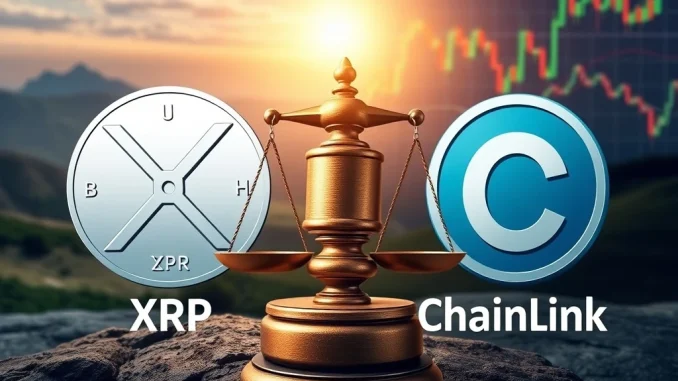
In the fast-paced world of digital assets, simplifying complex realities through comparisons is common. However, recent XRP news highlights a crucial debate, as a prominent legal expert argues against oversimplified comparisons between XRP and Chainlink, urging a deeper look into their distinct legal, technological, and market dynamics. This perspective challenges conventional narratives and encourages a more informed understanding of these leading cryptocurrencies.
XRP News: Unpacking the Oversimplified Comparison
Bill Morgan, a respected legal commentator and advocate for XRP, has voiced strong criticism against recent analyses that draw direct parallels between XRP and Chainlink. His core argument is that such comparisons often oversimplify the intricate legal, technological, and market forces shaping these two distinct cryptocurrencies. Morgan specifically rejected claims positioning Chainlink as a universally superior asset, emphasizing that evaluations of XRP frequently overlook its evolving utility and the broader capabilities of the XRP Ledger (XRPL).
- Narrow Framing: Critics often frame XRP’s value as solely tied to Ripple’s corporate control and its original cross-border payment use cases. Morgan contends this perspective ignores XRP’s decentralized infrastructure and growing utility.
- Distinct Dynamics: The fundamental operational models, regulatory environments, and market trajectories of XRP and Chainlink are vastly different, making direct, simplistic comparisons misleading for investors and enthusiasts alike.
- Overlooked Advancements: The focus on Ripple’s ownership often overshadows the significant technical advancements and community-driven growth within the XRP ecosystem.
XRP Legal Dynamics: Beyond the Headlines
One of the most significant factors distinguishing XRP is its ongoing legal journey, particularly the U.S. Securities and Exchange Commission (SEC) litigation against Ripple. This legal uncertainty has cast a long shadow, yet XRP has demonstrated remarkable resilience, maintaining its position among the top cryptocurrencies by market capitalization for over a decade. Morgan highlights that understanding the unique XRP legal dynamics is essential to any fair assessment.
Unlike Chainlink, which operates with a decentralized oracle network model that largely avoids centralized control issues, XRP has been embroiled in a high-profile legal battle over its classification as a security. This contrast in regulatory exposure creates entirely different risk profiles and operational contexts for the two tokens. Ignoring these divergent legal landscapes leads to flawed conclusions about their respective values and potential.
XRP Ledger Evolution: A New Horizon
Beyond its traditional role in payments, the XRP Ledger evolution showcases a significant expansion of its capabilities. Morgan points to key developments that broaden the XRPL’s appeal and utility:
- Automated Market Makers (AMMs): The integration of AMMs on the XRPL’s native decentralized exchange (DEX) enhances liquidity and offers new DeFi opportunities directly on the ledger. This allows for more efficient and decentralized trading of assets.
- EVM-Compatible Sidechain: The addition of an Ethereum Virtual Machine (EVM)-compatible sidechain significantly expands the XRPL’s accessibility to a vast ecosystem of developers and smart contract functionalities. This move aims to bridge the gap between the XRPL and the broader DeFi landscape dominated by Ethereum.
- Diverse Use Cases: These advancements, coupled with growing interest in XRP for futures and spot exchange-traded funds (ETFs) and institutional treasury management, reflect a broader shift in XRP’s role within the crypto ecosystem, moving beyond just cross-border payments.
These technical strides underscore XRP’s commitment to decentralized innovation and community-driven growth, challenging the outdated narrative that often reduces it to merely a ‘banker’s coin.’
The Crucial Role of Crypto Token Evaluation
The debate sparked by Bill Morgan’s critique reflects broader tensions within the crypto industry regarding how tokens are evaluated. Simplified comparisons often fail to account for varying levels of adoption, technological maturity, and regulatory exposure. A nuanced crypto token evaluation requires considering multiple dimensions:
- Technological Maturity: Assessing the robustness, scalability, and innovation of the underlying blockchain and its features.
- Market Adoption: Beyond price, evaluating actual use cases, developer activity, and user base.
- Regulatory Landscape: Understanding the legal status and potential regulatory hurdles in different jurisdictions.
- Liquidity and Market Cap: While important, these metrics should be contextualized within the token’s utility and long-term vision.
Morgan’s critique aligns with calls for more comprehensive analysis, particularly as investors navigate an evolving compliance landscape. The ongoing SEC litigation against Ripple underscores the importance of contextualizing XRP’s legal challenges alongside its technical and market advancements.
Chainlink’s Context: A Different Trajectory
While Chainlink is technologically robust and plays a vital role in connecting smart contracts with real-world data through its decentralized oracle network, its market trajectory has been different from XRP’s. Despite its utility, Chainlink’s token has faced its own market challenges, struggling to reclaim a top-ten market position. Morgan contrasted this with XRP’s sustained resilience, attributing it to the asset’s dual utility in payments and increasingly in DeFi applications.
The core difference lies in their primary functions and market positioning. Chainlink is an essential middleware for decentralized applications, while XRP aims to be a bridge currency for global value transfer and a versatile asset within the XRPL ecosystem. Conflating their distinct risk profiles and use cases, which are shaped by divergent regulatory and operational contexts, risks misinforming investors.
Conclusion
The discussion surrounding XRP and Chainlink serves as a powerful reminder that the cryptocurrency market is complex and multifaceted. Legal expert Bill Morgan’s critique against oversimplified comparisons is a call for deeper, more informed analysis. Understanding the distinct legal, technological, and market dynamics of each digital asset, including the evolving utility of the XRP Ledger and the unique XRP legal dynamics, is paramount. As the industry matures, a nuanced approach to crypto token evaluation will be crucial for investors and participants to make sound decisions and truly grasp the potential of assets like XRP and Chainlink.
Frequently Asked Questions (FAQs)
Q1: Why are comparisons between XRP and Chainlink considered oversimplified by legal experts?
Legal experts like Bill Morgan argue that such comparisons overlook the distinct legal frameworks, technological architectures, and market dynamics of each cryptocurrency. XRP faces ongoing regulatory challenges, particularly in the U.S., while Chainlink’s decentralized oracle network operates under a different model, leading to vastly different risk profiles and operational contexts.
Q2: What are some key advancements on the XRP Ledger (XRPL) that critics often overlook?
Critics often overlook the integration of Automated Market Makers (AMMs) on the XRPL’s native decentralized exchange and the addition of an Ethereum Virtual Machine (EVM)-compatible sidechain. These developments significantly expand the XRPL’s utility beyond payments, enhancing its accessibility for developers and smart contract functionalities, and fostering a broader DeFi ecosystem.
Q3: How does XRP’s liquidity and market position compare to Chainlink’s?
XRP has consistently maintained its position as one of the top-ten cryptocurrencies by market capitalization for over a decade, demonstrating strong liquidity despite regulatory challenges. Chainlink, while technologically robust, has faced its own market struggles and has not consistently held a top-ten market position.
Q4: What is the significance of XRP’s potential in futures and spot ETFs?
The growing interest in XRP’s potential for futures and spot Exchange-Traded Funds (ETFs) and institutional treasury management signifies a broader shift in its role within the crypto ecosystem. This indicates increasing institutional recognition and potential for wider adoption, moving beyond its initial focus on cross-border payments.
Q5: What should investors consider when evaluating different crypto tokens?
Investors should adopt a nuanced approach to crypto token evaluation, considering factors such as technological maturity, real-world adoption and use cases, the prevailing regulatory landscape, and distinct risk profiles. Relying on simplistic comparisons can lead to incomplete or misleading conclusions.