In the rapidly evolving world of digital finance, the competition among stablecoins and their underlying blockchain infrastructures is intensifying. While USDC has long been a dominant player, a compelling new narrative is emerging, suggesting that Ripple’s XRP Ledger (XRPL) and its native stablecoin, RLUSD, are not just catching up but are actively outpacing competitors like USDC in key areas. Are we witnessing a seismic shift in how institutions view and utilize digital assets for global transactions? Recent analyses point to a resounding ‘yes,’ highlighting the distinct advantages that could redefine the future of Ripple payments and cross-border finance.
XRP Ledger’s Edge: Why is RLUSD’s Integration Superior?
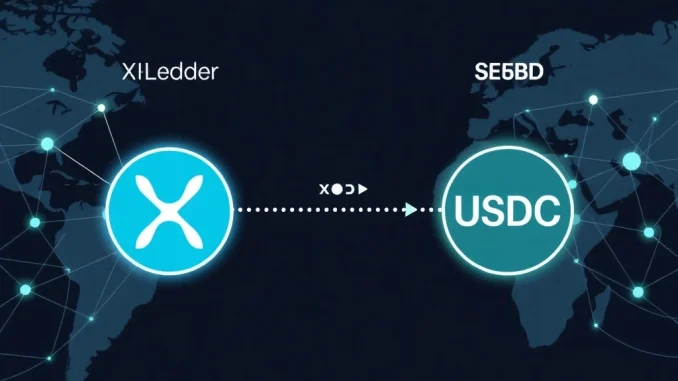
A recent deep dive by crypto researcher SMQKE sheds light on four critical advantages of Ripple’s XRP Ledger and its stablecoin, RLUSD, over Circle’s USDC. The first and perhaps most foundational distinction lies in their integration models. Unlike USDC, which functions as a token on various external blockchains, including Ethereum and recently the XRPL itself, RLUSD is built directly on Ripple’s proprietary ledger. This ‘vertical integration’ is a game-changer.
- End-to-End Control: With RLUSD, Ripple controls both the stablecoin and its underlying ledger. This eliminates reliance on third-party infrastructure, reducing operational complexity and external network dependencies. For institutions, this means a streamlined process with greater control over the entire transaction flow.
- Reduced Intermediaries: While Circle, as USDC’s issuer, does not control the blockchains it operates on, Ripple’s integrated solution enables seamless cross-border settlements without needing additional intermediaries. This design significantly streamlines cost management and aligns perfectly with institutional demands for comprehensive oversight and efficiency.
RLUSD vs. USDC: A Deep Dive into Performance and Trust
Beyond integration, the discussion around RLUSD and USDC extends to critical factors like transaction efficiency and institutional credibility. These aspects are paramount for any stablecoin aiming for widespread adoption in enterprise-level finance.
Unlocking Blockchain Efficiency: Speed and Cost Advantages of XRPL
Transaction efficiency stands as a major differentiator between the XRP Ledger and Ethereum-based operations, where much of USDC’s activity takes place. A comparative study referenced by SMQKE highlights the stark contrast:
- Speed: The XRPL processes transactions in a remarkable three to five seconds.
- Cost: Transactions on the XRPL cost less than a fraction of a cent.
- Contrast with Ethereum: Ethereum-based transactions, while robust, often incur higher and more variable fees, and can take longer to finalize, particularly during network congestion. This difference in blockchain efficiency is crucial for high-volume Ripple payments.
Furthermore, the XRPL’s deflationary tokenomics and inherent interoperability features enhance its utility in multi-chain environments. These capabilities directly address institutional needs for scalable, cost-effective, and adaptable infrastructure, positioning the XRPL as a robust backbone for future financial systems.
Institutional Credibility: Where Does RLUSD Stand?
For institutions, trust and compliance are non-negotiable. Anchorage Digital’s evaluation of stablecoins reinforces RLUSD’s strong institutional credibility. The report places RLUSD alongside compliant assets like PYUSD and USDP, citing its alignment with regulatory standards and robust, high-quality reserve mechanisms. In contrast, the report notes structural risks in USDC due to what it identifies as insufficient buffers against market volatility. This assessment is pivotal, as it positions RLUSD as a more reliable and secure option for institutions that prioritize regulatory compliance and risk mitigation above all else. This focus on compliance and stability makes RLUSD a compelling choice for secure Ripple payments.
Circle’s Strategic Move: A Validation for the XRP Ledger?
The final point of SMQKE’s analysis centers on Circle’s recent decision to launch USDC on the XRP Ledger. While this move undoubtedly demonstrates recognition of the ledger’s technical merits and growing importance, it simultaneously underscores Ripple’s unique strategic position. By operating RLUSD independently on its infrastructure, Ripple avoids reliance on third parties like Circle, which must partner with external networks to enable stablecoin functionality. This self-containment provides Ripple with a distinct advantage, allowing for greater control, faster innovation, and a more integrated ecosystem for Ripple payments.
The Future of Finance: Why These Distinctions Matter
SMQKE’s analysis concludes that the technical, cost, and institutional advantages of the XRP Ledger and RLUSD should significantly inform investor and institutional decision-making. By clarifying the fundamental distinctions between native blockchain solutions and third-party stablecoins, the analysis aims to counter prevailing narratives that might overlook Ripple’s comprehensive and integrated infrastructure. This isn’t just about faster transactions or lower fees; it’s about building a more resilient, efficient, and compliant global financial system. The continuous innovation in blockchain efficiency by the XRP Ledger team promises a future where cross-border transactions are seamless, secure, and accessible to all.
For financial institutions and enterprises seeking to leverage the power of digital assets, understanding these nuances is crucial. The integrated approach of the XRP Ledger, combined with the robust and compliant nature of RLUSD, offers a compelling alternative that promises not just efficiency gains but also enhanced security and regulatory alignment. As the digital economy matures, platforms that offer end-to-end solutions with unparalleled blockchain efficiency will undoubtedly lead the charge.
Frequently Asked Questions (FAQs)
Q1: What is the main difference between RLUSD and USDC?
The primary difference lies in their integration. RLUSD is built natively on Ripple’s XRP Ledger, meaning Ripple controls both the token and the underlying blockchain. USDC, while available on various blockchains including XRPL, is issued by Circle, which does not control the external blockchains it operates on, requiring third-party partnerships for functionality.
Q2: How does the XRP Ledger achieve superior transaction efficiency?
The XRP Ledger processes transactions in 3-5 seconds at a cost of less than a fraction of a cent. This is significantly faster and cheaper than many Ethereum-based transactions, which can incur higher and more variable fees and longer confirmation times, showcasing its superior blockchain efficiency.
Q3: Why is RLUSD considered more institutionally credible than USDC by some analyses?
According to evaluations like Anchorage Digital’s, RLUSD aligns well with regulatory standards and maintains high-quality reserve mechanisms. USDC, while widely used, has been noted to have structural risks due to insufficient buffers against market volatility, making RLUSD a more reliable option for institutions prioritizing compliance and risk mitigation.
Q4: What does Circle’s launch of USDC on the XRP Ledger signify?
Circle’s decision to launch USDC on the XRP Ledger validates the technical merits and growing adoption of the XRPL. However, it also highlights Ripple’s unique position, as RLUSD operates independently on its own infrastructure, demonstrating Ripple’s self-containment compared to Circle’s need to partner with external networks.
Q5: How do these differences impact future Ripple payments and cross-border transactions?
The integrated solution of the XRP Ledger and RLUSD offers enhanced control, reduced complexity, and superior blockchain efficiency for Ripple payments. This makes it a highly attractive option for institutions seeking reliable, cost-effective, and compliant solutions for cross-border transactions, potentially streamlining global finance.