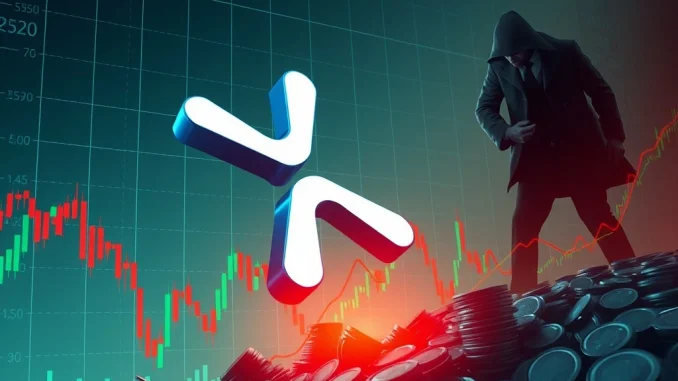
The crypto world was rocked recently when XRP, a major cryptocurrency, experienced a dramatic price plunge. Investors watched in alarm as XRP price dove over 11% in a single day, a sharp correction that immediately sparked intense debate and concern across the market.
XRP News Today: Unpacking the $140 Million Shockwave
Recent XRP news has sent ripples through the crypto community, triggered by a massive transaction that reignited long-standing concerns about centralization. On July 17, 2025, Ripple co-founder Chris Larsen executed a significant transfer of $140 million worth of XRP to various exchanges and off-ramp services. This substantial movement was quickly flagged by blockchain analytics firm CryptoQuant, which confirmed an outflow of 50 million XRP from wallets linked to Larsen. The timing was critical, coinciding with XRP reaching an all-time high of $3.65 earlier that very day. This sudden influx of tokens onto exchanges typically increases selling pressure, and the market reacted almost immediately, leading to the sharp price decline.
Why Did XRP Price React So Sharply? Understanding Centralization Fears
The immediate impact on XRP price wasn’t just about the volume; it was about who was moving the tokens. The transfer by a co-founder like Chris Larsen immediately intensified existing debates about insider influence and the centralized control over XRP’s supply. In a market that often champions decentralization, large-scale movements by a single, influential entity can erode investor confidence. This event isn’t without precedent; analysts point to historical patterns where significant founder wallet outflows have often preceded market corrections, notably during the 2017–2018 bull run. Such transfers suggest a potential for large-scale sales, creating an ‘overhang’ that can suppress future price appreciation.
Chris Larsen’s Holdings: A Lingering Shadow Over XRP?
A key point of concern for investors is the sheer scale of Chris Larsen’s remaining XRP holdings. On-chain data indicates that he still controls an astonishing 2.81 billion XRP, a staggering amount valued at approximately $8.4 billion at current prices. This vast reserve raises legitimate questions about potential future volatility. If even a fraction of these holdings were to be sold, particularly on open exchanges, it could trigger further significant price movements. While large, institutional sales (Over-the-Counter or OTC) might mitigate immediate market shocks, the structural presence of such a large supply in one individual’s control remains a significant factor weighing on investor sentiment and the perception of XRP’s long-term stability.
Unveiling XRP Centralization: The 2012 Agreement Revelation
The recent events have also brought renewed scrutiny to the foundational aspects of XRP centralization. A newly surfaced 2012 agreement between Chris Larsen, Jed McCaleb, and Arthur Britto has shed further light on the token’s early distribution and governance. This document confirms that Britto was allocated 2% of all XRP (then known as ‘Ripple Credits’) and granted independent development rights on the Ripple protocol. This historical context reinforces the notion that XRP’s initial distribution was highly centralized among its founders, rather than being mined or distributed in a more decentralized fashion like Bitcoin. This revelation further fuels the debate around Ripple’s governance model and its long-term supply management policies, adding another layer of complexity to investor perceptions.
Navigating the Volatile Crypto Market: What’s Next for XRP?
For participants in the broader crypto market, understanding XRP’s current technical landscape is crucial. Despite the recent plunge, XRP has managed to maintain technical support near the $3 mark and remains among the top-performing large-cap cryptocurrencies this quarter. However, traders are advised to remain cautious. The token’s price has yet to decisively break above the critical $3.40–$3.50 resistance zone. A sustained breach of this threshold would be essential to confirm a robust rebound and alleviate some of the immediate bearish pressure. Monitoring founder wallet activity remains a key actionable insight, as future large-scale transfers, regardless of the channel, will continue to be a major market driver.
The recent 11% plunge in XRP’s price, triggered by Ripple co-founder Chris Larsen’s $140 million transfer, has starkly highlighted the ongoing concerns about centralization and insider influence within the cryptocurrency market. While XRP maintains key technical support levels, the structural overhang from Larsen’s substantial remaining holdings and the historical context of its centralized distribution continue to weigh on investor sentiment. As the crypto market evolves, transparency and decentralized governance remain paramount for long-term confidence. Investors and traders are advised to stay vigilant, closely monitoring on-chain activity and key technical indicators to navigate XRP’s volatile path forward.
Frequently Asked Questions (FAQs)
- What caused the recent XRP price drop?
The recent XRP price drop was primarily triggered by Ripple co-founder Chris Larsen’s transfer of $140 million worth of XRP to various exchanges, sparking concerns about centralization and potential selling pressure. - What are “centralization fears” in the context of XRP?
Centralization fears stem from the fact that a significant portion of XRP’s supply is controlled by a few key entities, including its founders and Ripple Labs. Large transfers by these insiders can disproportionately impact the market, raising questions about true decentralization and fair distribution. - How much XRP does Chris Larsen still hold?
According to on-chain data, Chris Larsen still controls over 2.81 billion XRP, valued at approximately $8.4 billion at current prices. This substantial holding is a point of ongoing market concern. - Is XRP considered a centralized cryptocurrency?
While Ripple Labs aims for a decentralized network, the initial distribution of XRP and the significant holdings by its founders and the company itself lead many in the crypto community to view XRP as more centralized compared to cryptocurrencies like Bitcoin or Ethereum. The recently surfaced 2012 agreement further highlights this early centralization. - What is the significance of the $3.40-$3.50 resistance zone for XRP?
The $3.40-$3.50 resistance zone is a critical technical threshold for XRP. Breaking above this level would signal a stronger upward momentum and could confirm a sustained rebound, whereas failing to do so could indicate continued price consolidation or further downward pressure. - What should investors monitor regarding XRP?
Investors should closely monitor founder wallet activity, especially large transfers to exchanges. Additionally, keeping an eye on key technical support and resistance levels, and broader crypto market sentiment, is crucial for making informed decisions.