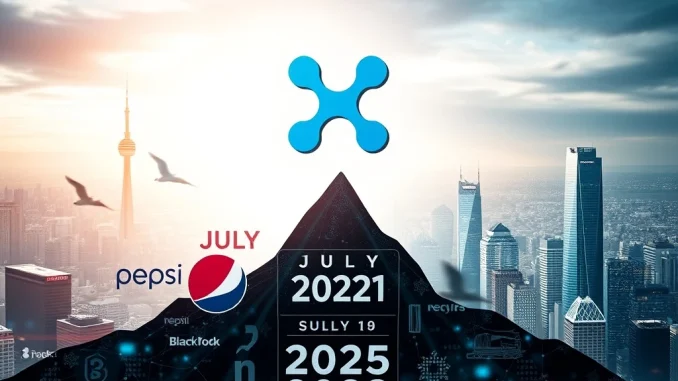
Imagine a future where a digital asset, born from the revolutionary promise of blockchain technology, stands shoulder-to-shoulder with, or even surpasses, titans of industry like Pepsi and BlackRock. This isn’t just a fantasy; it’s a bold projection hinted at for July 23, 2025, suggesting a monumental shift for XRP and the broader cryptocurrency market. What would such an unprecedented achievement truly signify for the world of finance and technology? Let’s delve into the possibilities.
XRP’s Potential Ascent: Redefining the Cryptocurrency Market
The very idea of XRP potentially ‘beating’ established giants like PepsiCo and BlackRock by mid-2025 is a powerful statement about the evolving landscape of global finance. While the exact metric for this ‘win’ remains speculative—whether it’s market capitalization, global adoption, or influence—its mere contemplation underscores the immense growth trajectory of digital assets. If XRP were to achieve such a milestone, it would fundamentally redefine perceptions of value and stability within the cryptocurrency market. This isn’t just about a coin’s price; it’s about a paradigm shift where decentralized technologies challenge centralized powerhouses.
Such an event would highlight several key aspects:
- Mainstream Acceptance: A significant surge for XRP would signal a new level of institutional and retail acceptance for cryptocurrencies as legitimate investment vehicles and functional currencies.
- Scalability and Utility: It would validate XRP’s underlying technology and its utility in cross-border payments, micro-transactions, and potentially new financial instruments.
- Regulatory Clarity: Achieving such stature would likely coincide with, or even necessitate, clearer regulatory frameworks, providing greater confidence for broader adoption.
Ripple’s Strategic Vision: Powering Global Digital Assets
At the heart of XRP’s potential lies Ripple, the company championing its adoption. Ripple’s long-term strategic vision has always been to facilitate fast, low-cost, and reliable global payments, leveraging XRP as a bridge currency. Their partnerships with financial institutions worldwide aim to disrupt traditional remittance and interbank transfer systems. If XRP were to reach the heights implied by ‘beating’ Pepsi and BlackRock, it would be a testament to Ripple’s persistent efforts and their vision for a more efficient global financial system powered by digital assets.
Ripple’s strategy involves:
- On-Demand Liquidity (ODL): Utilizing XRP to enable real-time, cost-effective cross-border payments without pre-funding nostro/vostro accounts.
- Central Bank Digital Currencies (CBDCs): Collaborating with central banks to explore and develop CBDC solutions, further embedding blockchain technology into national financial infrastructures.
- Developer Ecosystem: Fostering a vibrant developer community around the XRP Ledger to build diverse applications beyond payments, enhancing its utility.
This sustained focus on real-world utility positions XRP not just as a speculative asset, but as a foundational element for future financial plumbing.
Beyond Market Cap: The Impact of Blockchain Innovation
While market capitalization is a common metric for comparison, the true significance of XRP’s potential rise extends far beyond mere valuation. It speaks to the transformative power of blockchain innovation. The underlying technology that powers XRP—the XRP Ledger—offers unparalleled speed, efficiency, and low transaction costs, features that traditional financial systems often struggle to match. This innovation isn’t confined to payments; it’s paving the way for tokenized assets, smart contracts, and entirely new decentralized applications that could reshape industries.
Consider the broader implications:
| Aspect | Traditional Finance | Blockchain Innovation (XRP Ledger) |
|---|---|---|
| Cross-Border Payments | Slow, expensive, multiple intermediaries | Near-instant, low-cost, fewer intermediaries |
| Asset Settlement | T+2 or T+3 days | Seconds (atomic settlement) |
| Liquidity | Requires pre-funded accounts | On-demand, global liquidity via XRP |
| Transparency | Opaque, fragmented data | Pseudonymous, immutable ledger |
The ability of blockchain innovation to streamline these processes and reduce friction is a powerful driver for its adoption and a key reason why digital assets like XRP are gaining traction.
Navigating the Future: Challenges and Opportunities for Digital Assets
Achieving such a monumental status by July 2025 won’t be without its challenges for digital assets like XRP. Regulatory uncertainties, particularly in key markets like the United States, remain a significant hurdle. The ongoing legal battles and the lack of clear classification for cryptocurrencies can deter institutional adoption and stifle innovation. Furthermore, competition from other blockchain networks and evolving technological landscapes demand continuous adaptation and development.
However, the opportunities are equally immense:
- Increased Utility: Expanding XRP’s use cases beyond payments into areas like DeFi, NFTs, and supply chain finance.
- Global Partnerships: Forging more alliances with financial institutions, corporations, and governments to integrate XRP and the XRP Ledger into their operations.
- Community Growth: A thriving ecosystem of developers, users, and advocates is crucial for long-term sustainability and widespread adoption.
The journey to potentially surpass traditional giants is complex, requiring robust technology, strategic partnerships, and a favorable regulatory environment.
What’s Next for XRP?
The speculation around XRP’s potential to ‘beat’ Pepsi and BlackRock by July 2025 serves as a compelling narrative for the entire cryptocurrency market. It highlights the disruptive power of blockchain technology and the growing influence of digital assets. While the exact outcome remains to be seen, the trajectory of XRP and Ripple’s ambition suggests a future where decentralized finance plays an increasingly dominant role in the global economy. Investors and enthusiasts alike will be watching closely to see if this bold prediction becomes a reality, signaling a new era for crypto.
Frequently Asked Questions (FAQs)
1. What does it mean for XRP to ‘beat’ Pepsi and BlackRock?
This phrase, particularly given the future date of July 2025, likely refers to XRP potentially surpassing these companies in terms of market capitalization, global influence, or adoption within their respective sectors. It symbolizes a significant shift in financial power from traditional corporations to a decentralized digital asset.
2. How could XRP achieve such a milestone?
XRP’s potential growth is tied to increased adoption of Ripple’s On-Demand Liquidity (ODL) solution for cross-border payments, strategic partnerships with financial institutions, regulatory clarity, and the expansion of the XRP Ledger’s utility into new areas like CBDCs and decentralized applications.
3. What is Ripple’s role in XRP’s success?
Ripple is the company that developed and promotes the XRP Ledger and XRP. They actively work with banks and payment providers to integrate XRP into their operations, aiming to make global payments faster and cheaper. Ripple’s business development and technological advancements are key drivers for XRP’s utility and value.
4. What are the main challenges facing XRP and the cryptocurrency market?
Key challenges include regulatory uncertainty (especially in major markets like the U.S.), intense competition from other blockchain projects, market volatility, and the need for continuous technological innovation and widespread user adoption.
5. How does blockchain innovation contribute to XRP’s potential?
Blockchain innovation, particularly the XRP Ledger’s design, provides the underlying technology for XRP’s efficiency. Its ability to process transactions quickly and at low cost makes it a compelling alternative to traditional financial infrastructure, driving its potential for global adoption and disruption.