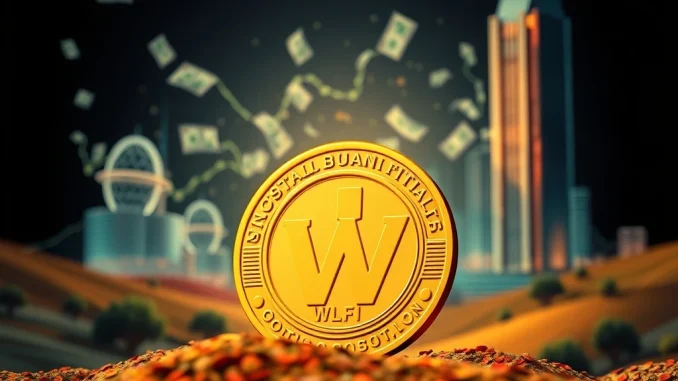
The cryptocurrency world is buzzing with a seismic shift: the WLFI Token, a blockchain initiative linked to Donald Trump’s family, has officially become tradable. This isn’t just another token launch; it’s a move that followed a near-unanimous 99.94% community approval and immediately attracted a staggering $155 million in institutional investment. What does this mean for the future of digital assets, and why is this particular WLFI Token making such waves?
WLFI Token: A New Era of Tradability Unlocked?
The journey of the WLFI Token has reached a pivotal milestone. Following an overwhelming 99.94% approval from over 20,000 community participants, the governance token is now a tradable asset. This significant endorsement allowed for the unlocking of peer-to-peer and secondary market transactions for investor-held WLFI tokens. It marks the first phase of liquidity expansion, empowering holders to transfer and list their digital assets.
The WLFI team emphasized this step as “the next phase of community ownership and engagement,” signaling a commitment to decentralized principles, even as founder and team tokens remain locked, awaiting a future governance vote to prevent immediate supply shocks. This careful approach to market introduction aims to manage supply dynamics and foster a stable environment for the newly tradable WLFI Token.
Who’s Backing WLFI? The Surge of Institutional Crypto Investment
The moment WLFI Token became tradable, it didn’t just attract individual traders; it drew substantial institutional crypto investment. A staggering $155 million commitment poured in, highlighting significant confidence from major players in the crypto space. This includes:
- Aqua1 Foundation: Committed $100 million in WLFI tokens, establishing itself as the largest single holder.
- Justin Sun: The founder of TRON, invested $30 million.
- DWF Labs: Contributed an additional $25 million.
This influx of capital from established entities like Aqua1 Foundation, Justin Sun, and DWF Labs provides a strong validation for the WLFI project’s potential and its underlying vision. Such large-scale backing often signals a project’s credibility and future growth prospects within the broader digital asset ecosystem, potentially setting a precedent for similar politically-linked blockchain initiatives.
The Trump Family Crypto Connection: Centralization Concerns and Solutions?
While the institutional backing is impressive, the project’s reported association with the Trump family crypto initiatives has raised eyebrows. Reports indicate that the Trump family controls a significant 60% of the WLFI token supply. This concentration of ownership has sparked discussions about potential centralization risks, a key concern in the decentralized finance (DeFi) world, which typically champions distributed control and broad participation.
However, the WLFI project is actively addressing these concerns through strategic technological integrations. Its partnership with Vaulta, an EVM-compatible blockchain formerly known as EOS, is designed to mitigate some of these issues. Vaulta’s low-latency infrastructure is intended to support WLFI’s various applications, including its USD1 stablecoin, real-world asset tokenization, and smart contract functionalities. This technical backbone aims to ensure the platform’s robustness and scalability, regardless of ownership structure, attempting to balance centralized control with decentralized technology.
WLFI’s Ambitious Vision: Paving the Way for Web3 Banking?
Beyond just being a tradable token, WLFI harbors ambitious goals, positioning itself at the forefront of the evolving Web3 banking landscape. Its integration with Vaulta is a cornerstone of this vision. Vaulta’s EVM compatibility provides a familiar and developer-friendly environment, crucial for building out a comprehensive suite of Web3 financial services.
Key components of WLFI’s Web3 banking strategy include:
- USD1 Stablecoin: A stablecoin pegged to the US dollar, essential for facilitating stable transactions within the ecosystem.
- Real-World Asset (RWA) Tokenization: The ability to tokenize tangible assets, bridging traditional finance with the blockchain.
- Smart Contract Applications: Enabling automated and trustless agreements for various financial services.
These initiatives align with a broader move towards decentralized financial services that leverage blockchain technology for greater transparency, efficiency, and accessibility, potentially reshaping how we interact with banking in the digital age. This blockchain initiative aims to be a significant player in this transformation.
Navigating the Market: What’s Next for This Ambitious Blockchain Initiative?
The tradability of WLFI Token introduces a new set of market dynamics and challenges. For retail traders, the expansion of liquidity will create new opportunities for engagement and price discovery as unlocked holdings enter circulation. However, volatility is a strong possibility, especially given the project’s high-profile political affiliations.
Regulatory scrutiny is almost a certainty. U.S. authorities, in particular, may review WLFI due to its connections, potentially impacting its trajectory. The project’s roadmap includes several critical steps:
- Further Governance Votes: Future votes will determine the unlocking of remaining team and founder tokens, directly impacting market supply.
- Centralized Exchange (CEX) Listings: Potential listings on major exchanges could significantly boost liquidity and accessibility.
For those considering involvement, monitoring exchange listings, token price movements, and governance progress will be crucial. The interplay between political developments, financial connections, and regulatory oversight will undoubtedly shape WLFI’s path in the Web3 ecosystem. This ambitious blockchain initiative faces both immense opportunity and significant hurdles.
The WLFI Token’s transition to a tradable asset marks a significant moment in the crypto space, underscored by massive institutional investment and a strong community mandate. While its association with the Trump family and the concentration of token supply raise valid decentralization concerns, the project’s strategic integration with Vaulta and its ambitious Web3 banking vision aim to build a robust and scalable ecosystem. The road ahead for this blockchain initiative will be shaped by market dynamics, regulatory developments, and its ability to balance innovation with the core principles of decentralization. As WLFI navigates these complex waters, it offers a compelling case study for the evolving intersection of politics, finance, and blockchain technology.
Frequently Asked Questions (FAQs)
Q1: What is the WLFI Token?
A1: The WLFI Token is the governance token for World Liberty Financial, a blockchain initiative reportedly associated with Donald Trump’s family. It has recently become tradable after overwhelming community approval.
Q2: How much institutional investment has WLFI Token attracted?
A2: The WLFI Token has attracted $155 million in institutional investment, with Aqua1 Foundation committing $100 million, TRON founder Justin Sun investing $30 million, and DWF Labs adding $25 million.
Q3: What are the centralization concerns surrounding WLFI Token?
A3: Concerns about centralization arise from reports that the Trump family controls 60% of the WLFI token supply, which could potentially undermine decentralized finance (DeFi) principles.
Q4: How does WLFI plan to achieve its Web3 banking ambitions?
A4: WLFI plans to achieve its Web3 banking ambitions through integration with Vaulta (formerly EOS), leveraging its EVM compatibility for its USD1 stablecoin, real-world asset tokenization, and various smart contract applications.
Q5: What are the potential regulatory risks for WLFI Token?
A5: Due to its high-profile political affiliations, WLFI Token is likely to face significant regulatory scrutiny, particularly from U.S. authorities, which could influence its market trajectory.