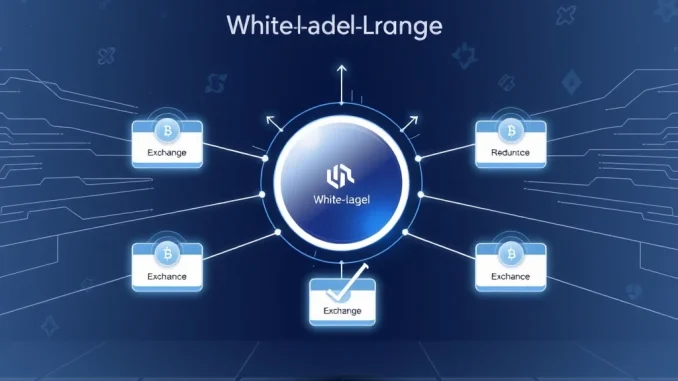
Are you looking to enter the dynamic world of cryptocurrency but daunted by the immense costs and technical hurdles? The landscape is rapidly changing, and a groundbreaking solution is empowering businesses to dive in without the traditional headaches. White-label crypto exchange platforms are not just a trend; they are becoming the standard, significantly lowering barriers to entry and reshaping how new players launch their digital asset ventures. Imagine launching your own fully functional exchange, complete with liquidity and compliance tools, in a fraction of the time and cost it once took. This isn’t a distant dream; it’s the reality for businesses leveraging cutting-edge white-label crypto exchange solutions in 2025.
Unlocking Efficiency: How White-Label Crypto Exchanges Are Redefining the Market
In 2025, the white-label crypto exchange market has solidified its position as a critical component of the digital asset economy. Leading providers like Binance Cloud, HollaEx, and AlphaPoint are at the forefront, offering customizable, enterprise-ready solutions. These platforms enable businesses to launch their own branded exchanges rapidly, bypassing the prohibitive costs and complex technical development traditionally associated with building an exchange from scratch. By leveraging pre-built infrastructure, new entrants gain immediate access to essential features:
- Pre-existing liquidity pools: A crucial advantage in a competitive market, ensuring smooth trading from day one.
- Advanced compliance tools: Essential for navigating complex regulatory environments.
- Multi-lingual support: Catering to a global user base.
- Reduced time-to-market: Accelerating deployment from years to months, or even weeks.
For instance, Binance Cloud integrates with Binance’s robust trading systems, allowing partners to deploy exchanges with battle-tested infrastructure and established liquidity. Similarly, AlphaPoint has carved a niche among institutional clients, focusing on robust compliance frameworks and AI-driven analytics to meet strict regulatory demands. This shift towards white-label platforms has fundamentally reshaped the crypto industry by making market entry more accessible than ever before.
Significant Savings: The Promise to Reduce Operational Costs
One of the most compelling advantages of white-label solutions is their dramatic impact on a business’s bottom line. Industry analyses indicate that these solutions can reduce operational costs by up to 70% compared to traditional in-house exchange builds. This substantial saving stems from several factors:
- Elimination of extensive R&D: No need to build core functionalities from scratch.
- Shared infrastructure: Providers spread the cost of maintaining high-performance servers and security systems across multiple clients.
- Reduced staffing needs: Less demand for specialized blockchain developers and cybersecurity experts for initial setup.
- Scalability on demand: Pay-as-you-grow models avoid large upfront investments for capacity that may not be immediately needed.
For banks and fintech firms, the ability to outsource the technical heavy lifting allows them to concentrate resources on user acquisition, marketing, and developing unique value propositions. This strategic focus has accelerated adoption across various financial sectors, democratizing access to the crypto market.
Streamlining Entry: Launch Crypto Exchange Faster Than Ever
The speed at which businesses can now launch crypto exchange operations is unprecedented. Historical trends from 2020-2022 highlighted the success of modular platforms, demonstrating how operators leveraging partnerships could outperform competitors reliant on proprietary systems. Changpeng Zhao, CEO of Binance, emphasized this ecosystem benefit: “Binance Cloud enables partners to harness secure, battle-tested infrastructure and expand local crypto ecosystems.” This ability to quickly deploy a fully functional and compliant exchange is a game-changer for entrepreneurs and established institutions alike. It means faster revenue generation and the ability to capture market share before competitors.
Beyond the Basics: Advanced Crypto Exchange Solutions
The competitive landscape in 2025 is marked by diversification, with providers offering increasingly sophisticated crypto exchange solutions. Non-custodial models, for instance, are gaining traction, aligning with broader industry preferences for self-custody. Platforms like ChangeNOW, serving millions of users, prioritize decentralized asset control, empowering users with greater autonomy over their funds. Meanwhile, ChainUP and HollaEx distinguish themselves through modular architectures that emphasize rapid deployment alongside robust fraud detection capabilities.
However, the market remains fragmented, with varying levels of technological maturity among providers. Regulatory challenges persist, especially as jurisdictions like the U.S. and EU enforce stricter Anti-Money Laundering (AML) and Know Your Customer (KYC) requirements. White-label providers are actively integrating automated compliance tools to address these demands, though cross-border operability gaps still exist. Strategic collaborations, such as Deepcoin’s partnership with Upbit Singapore for cross-platform transfers, illustrate how these platforms are working to enhance interoperability and global reach.
Navigating the Future of Digital Asset Trading
The sector’s continued growth is underpinned by ongoing innovation in security and scalability. AlphaPoint’s adaptations to evolving compliance standards and ChainUP’s focus on advanced data encryption highlight the industry’s response to institutional-grade needs. The future of digital asset trading hinges on addressing market fragmentation and maintaining compliance in a rapidly evolving regulatory environment. As businesses worldwide seek scalable entry points into the crypto space, white-label providers like Binance Cloud and ChangeNOW are positioning themselves as essential infrastructure players, driving the next wave of crypto adoption.
In conclusion, white-label crypto exchanges are more than just a convenience; they are a strategic imperative for businesses looking to navigate the complexities of the digital asset market. By drastically cutting operational costs and simplifying the launch process, these platforms are empowering a new generation of crypto entrepreneurs and institutions, making the dream of running a successful exchange a tangible reality. The future of crypto is accessible, efficient, and ready for your mark.
Frequently Asked Questions (FAQs)
What is a white-label crypto exchange?
A white-label crypto exchange is a pre-built, customizable software solution that allows businesses to launch their own branded cryptocurrency exchange quickly and cost-effectively. The core technology and infrastructure are provided by a third-party vendor, while the client customizes the branding, user interface, and specific features.
How much can white-label solutions reduce operational costs?
White-label solutions can reduce operational costs by up to 70% compared to building an exchange from scratch. This significant saving comes from leveraging existing infrastructure, reducing development time, and minimizing the need for extensive in-house technical teams.
What are the key benefits of using a white-label platform to launch crypto exchange?
Key benefits include rapid deployment (reduced time-to-market), access to pre-existing liquidity, integrated compliance tools (AML/KYC), enhanced security features, and lower initial investment and ongoing operational costs. It allows businesses to focus on marketing and user acquisition rather than technical development.
Which companies are leading providers of crypto exchange solutions?
Leading providers of white-label crypto exchange solutions include Binance Cloud, AlphaPoint, HollaEx, ChainUP, and ChangeNOW. Each offers distinct features and caters to different client needs, from institutional-grade platforms to non-custodial models.
Are white-label crypto exchanges compliant with regulations?
Reputable white-label providers integrate advanced compliance tools for AML and KYC requirements. However, the ultimate responsibility for regulatory adherence often lies with the business operating the exchange. Providers continuously adapt their solutions to meet evolving global regulatory standards.