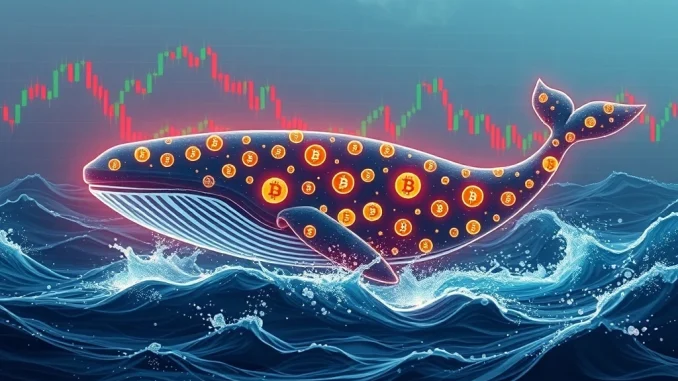
In the unpredictable world of cryptocurrencies, where fortunes can be made or lost in a blink, a recent event has captured the attention of many: a massive whale crypto investment. An address identified as 8RwxXR executed a significant transaction, withdrawing 17,082 SOL, valued at approximately $3.19 million, from Binance. This substantial sum was then used to acquire 22.4 million VINE tokens. What makes this move particularly intriguing, and frankly, audacious, is that it comes shortly after the same whale reportedly incurred a $125,000 loss during a previous PUMP event involving another token. This contrasting behavior highlights the extreme risks and cyclical nature of speculative crypto markets, inviting us to delve deeper into the rationale behind such high-stakes decisions.
Decoding the Audacious Whale Crypto Investment
The recent acquisition of VINE tokens by this prominent Solana whale (given the SOL withdrawal) is a testament to the high-risk, high-reward mentality prevalent in certain corners of the crypto market. Blockchain tracking data from LookIntoChain confirmed the large withdrawal from Binance and the subsequent purchase. For many, investing such a significant amount – $3.19 million – into an asset that has no known intrinsic utility and is primarily associated with speculative trading, especially after a recent substantial loss, seems counterintuitive. Yet, this is precisely the kind of move that defines the frontier of digital asset trading.
This transaction isn’t just about the money; it’s about the psychology of large players. It showcases a willingness to double down on a volatile asset, perhaps in anticipation of a quick rebound or to influence market sentiment. Such actions can temporarily stabilize a token’s price or even attract smaller retail traders, creating a ripple effect. However, historical patterns suggest that such interventions often struggle to sustain long-term momentum, especially for tokens lacking fundamental value.
What Exactly is the VINE Token, and Why the Risk?
The VINE token, like many assets involved in rapid price fluctuations, is characterized by its reliance on speculative demand rather than underlying utility. Unlike established cryptocurrencies with robust ecosystems, development teams, or real-world applications, tokens like VINE often gain traction through social media hype, coordinated buying efforts, and liquidity imbalances. This makes them prime candidates for what are commonly known as crypto pump and dump schemes.
A pump and dump is a form of market manipulation where the price of an asset is artificially inflated (pumped) through misleading positive statements, only to be sold off (dumped) by the manipulators at a higher price, leaving other investors with worthless holdings. While the article doesn’t explicitly state VINE is part of an ongoing pump, its characteristics and the whale’s previous loss in a ‘PUMP event’ strongly suggest its involvement in such high-risk scenarios. The lack of fundamental value means its price is almost entirely dictated by supply and demand dynamics influenced by sentiment and speculation.
To illustrate the difference, consider this:
| Feature | VINE Token (Typical Speculative Token) | Utility Token (e.g., ETH, SOL) |
|---|---|---|
| Intrinsic Utility | None stated; primarily for trading | Powers dApps, network fees, staking, governance |
| Price Drivers | Social media hype, speculation, liquidity imbalances, FOMO | Network adoption, development milestones, technological advancements, demand for services |
| Risk Profile | Extremely High; prone to sudden crashes | High, but often mitigated by fundamental use cases and broader ecosystem growth |
| Long-Term Viability | Low; often fades after hype subsides | Higher; tied to project success and real-world application |
Navigating Extreme Market Volatility: A Whale’s Perspective
The crypto market is infamous for its extreme market volatility. This whale’s actions perfectly encapsulate this characteristic. Despite suffering a significant loss just days prior, the decision to plunge another $3.19 million into a similar high-risk asset suggests a calculated, albeit risky, strategy. Whales, or large investors, often operate with different risk appetites and market insights than retail traders. They might:
- Believe in a short-term recovery: The whale might see a specific technical pattern or a potential catalyst for VINE’s price to bounce back.
- Attempt to influence the market: A large purchase can create buying pressure, potentially attracting smaller traders and initiating a new speculative wave.
- Capitalize on liquidity: Large players can exploit periods of low liquidity to make significant moves that impact price.
However, even seasoned players are not immune to the market’s unpredictability. The $125,000 loss serves as a stark reminder that leverage and rapid sentiment shifts can amplify risks, even for those with deep pockets. The interplay between liquidity provision and high-stakes speculation is a constant battle, where success is contingent on factors often beyond individual control, such as regulatory scrutiny, overall market sentiment, and the emergence of competing tokens.
Lessons from a Crypto Pump and Dump: A Cautionary Tale
The whale’s prior experience with a $125,000 loss during a crypto pump and dump event offers invaluable lessons for all market participants. These schemes thrive on FOMO (Fear Of Missing Out) and often target tokens with low liquidity and market capitalization, making them easier to manipulate. Here’s how they typically unfold:
- Accumulation: Manipulators secretly buy up a large supply of a low-cap token.
- Pumping: They then aggressively promote the token across social media, forums, and messaging apps, often using false or exaggerated claims to generate hype and attract new buyers.
- Dumping: Once the price has significantly inflated due to new money pouring in, the manipulators sell off their holdings, causing the price to crash and leaving late entrants with substantial losses.
The whale’s loss underscores that even large, sophisticated investors can fall prey to market unpredictability or misjudge the timing of such events. For retail investors, the takeaway is clear: be extremely wary of tokens promoted heavily on social media with no discernible use case or technology. The promise of quick riches often masks the reality of significant financial risk.
What This Means for Your Crypto Strategy: Beyond the Hype
The story of this Solana whale and the VINE token saga reinforces a critical message for anyone navigating the crypto landscape: the dominance of short-term volatility over long-term value creation in certain assets. For investors, the key takeaway is the need to critically evaluate whether a token’s price movements stem from genuine utility and adoption or purely from speculative activity.
Here are some actionable insights:
- Do Your Own Research (DYOR): Always investigate a token’s fundamentals. Does it solve a problem? Is there a development team? What’s its roadmap?
- Understand Risk: Recognize that not all cryptocurrencies are created equal. Assets like VINE are inherently high-risk and should only be approached with capital you can afford to lose.
- Beware of FOMO: Avoid making impulsive decisions based on social media hype or rapid price surges. Often, by the time retail investors hear about a “pump,” the smart money is already preparing to exit.
- Diversify: Don’t put all your eggs in one basket, especially when it comes to highly speculative assets.
- Focus on Utility: Prioritize investments in projects with clear use cases, strong communities, and transparent development.
The whale’s actions reflect a broader trend in crypto markets: the interplay between liquidity provision and high-stakes speculation. While large investors can indeed influence price movements, their ultimate success is contingent on unpredictable factors and the collective psychology of the market. The VINE case vividly illustrates the risks of allocating capital to assets where liquidity and sentiment are the primary drivers, rather than solid fundamentals.
In conclusion, this bold whale crypto investment into the VINE token, especially following a prior crypto pump and dump loss, serves as a powerful reminder of the extreme market volatility and speculative nature of certain digital assets. While the motives of the Solana whale remain speculative, the incident provides valuable lessons on risk management, due diligence, and the critical importance of distinguishing between genuine innovation and fleeting hype in the ever-evolving crypto market. Always prioritize knowledge over speculation.
Frequently Asked Questions (FAQs)
What is a “whale” in cryptocurrency?
In cryptocurrency, a “whale” refers to an individual or entity that holds a very large amount of a particular cryptocurrency, enough to potentially influence its price. Their large transactions are closely watched by market analysts.
What is a “PUMP event” in crypto?
A “PUMP event” typically refers to a coordinated effort to artificially inflate the price of a cryptocurrency token. This is often done through social media promotion and rapid buying, with the intention of selling off holdings at the peak, leading to a “dump” and significant losses for late buyers.
Does the VINE token have any real-world utility?
Based on the provided information, the VINE token has no known intrinsic utility and is primarily traded in high-risk, speculative scenarios. Its value appears to be driven by market sentiment and speculation rather than any fundamental use case or technology.
Why would a whale invest heavily after a loss?
Whales might invest heavily after a loss for various reasons, including a belief in short-term recovery, an attempt to influence market sentiment, or to capitalize on specific liquidity conditions. It often indicates a high-risk speculative strategy, hoping to recover previous losses or profit from a new wave of speculation.
How can I protect myself from speculative tokens like VINE?
To protect yourself, always conduct thorough research (DYOR) into a token’s fundamentals, avoid impulsive decisions based on hype (FOMO), diversify your portfolio, and prioritize investments in projects with clear utility and a strong development roadmap. Be wary of tokens with no stated use case and aggressive social media promotion.
What is the significance of the SOL withdrawal in this context?
The withdrawal of 17,082 SOL from Binance by the whale indicates that the whale held a significant amount of Solana (SOL) and chose to convert it into USD (or stablecoin equivalent) to then purchase VINE tokens. This marks the whale as a ‘Solana whale’ by virtue of their large SOL holdings and their subsequent allocation decision, highlighting a shift of capital from a more established asset to a highly speculative one.