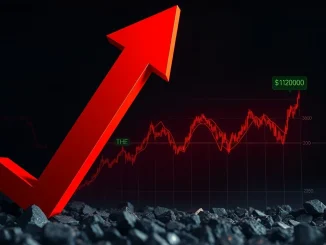
The financial world often feels like a complex web. Yet, certain indicators cut through the noise. For those tracking cryptocurrencies, understanding traditional market signals is crucial. Recently, the **VIX**, often called the **Wall Street fear gauge**, climbed above the 20 mark. This development typically signals increased apprehension among investors. It suggests a period of heightened uncertainty. Furthermore, this shift can profoundly influence the broader financial landscape. Consequently, it may also affect the volatile **crypto market impact**.
VIX Surges Above 20: Decoding Wall Street’s Fear Gauge
The Chicago Board Options Exchange (CBOE) Volatility Index, known as the **VIX**, provides a real-time measure of market expectations. Specifically, it forecasts near-term **market volatility**. This index derives from options prices on the S&P 500. A rising VIX indicates growing investor fear or uncertainty. Conversely, a falling VIX suggests market calm. The 20-level often acts as a critical threshold. A move above 20 signals a shift from a low-volatility environment to one of elevated risk perception. Therefore, its recent surge has caught the attention of analysts worldwide. This index reflects collective **investor sentiment**.
The VIX calculation is complex. However, its interpretation is straightforward. Higher values mean more expected price swings. Lower values mean stability. When the VIX jumps, it means options traders are buying more protection. They anticipate larger price movements. This often happens during periods of economic uncertainty. Geopolitical tensions or significant policy changes can also trigger such spikes. Understanding the **VIX** helps investors gauge the prevailing mood. It offers a snapshot of market anxiety.
Understanding Market Volatility and Investor Sentiment
**Market volatility** refers to the degree of variation of a trading price series over time. High volatility means prices can change dramatically. Low volatility suggests more stable prices. The **VIX** is specifically designed to measure this expected future volatility. Its recent rise indicates that market participants foresee greater price swings ahead. This perception directly impacts **investor sentiment**. Fear can lead to selling pressure. Conversely, excessive greed can inflate asset prices.
Several factors contribute to increased **market volatility**. Economic data, such as inflation reports or employment figures, play a significant role. Central bank policies, including interest rate decisions, also exert influence. Global events, like conflicts or pandemics, can trigger widespread panic. Furthermore, corporate earnings reports often move individual stocks and sectors. When many of these factors align negatively, the **Wall Street fear gauge** tends to climb. Investors become more cautious. They seek safer assets. This shift in sentiment is a powerful force in financial markets.
The Historical Context of VIX Spikes and Market Reactions
Historically, significant VIX spikes have often preceded or accompanied major market downturns. For instance, during the 2008 global financial crisis, the **VIX** soared to unprecedented levels. It reached over 80. This reflected extreme panic. Similarly, in March 2020, at the onset of the COVID-19 pandemic, the index again surged past 80. These instances highlight the VIX’s role as a barometer for systemic risk. After such peaks, markets often experience sharp corrections. Then, a period of recovery typically follows.
However, a high VIX does not always guarantee a crash. Sometimes, it signals a period of heightened uncertainty that eventually resolves. Nevertheless, it always warrants close attention. It provides a warning sign. Traders and analysts use these historical patterns. They try to anticipate future market behavior. A VIX above 20 suggests that markets are no longer complacent. Instead, they are bracing for potential turbulence. This historical perspective is vital for informed decision-making. It informs current **investor sentiment**.
Analyzing the Crypto Market Impact
Traditional financial markets and the crypto world are increasingly intertwined. Therefore, a surge in the **Wall Street fear gauge** often has a tangible **crypto market impact**. When traditional assets face pressure, investors sometimes liquidate riskier holdings. Cryptocurrencies, despite their unique characteristics, are still perceived as high-risk assets by many. Consequently, Bitcoin (BTC) and other major cryptocurrencies can experience sell-offs. This happens even if the underlying crypto fundamentals remain strong.
The correlation between Bitcoin and the S&P 500 has grown over time. During periods of high **market volatility** in traditional finance, Bitcoin often mirrors these movements. For example, if equities drop sharply, Bitcoin might follow suit. Altcoins, which tend to be even more volatile than Bitcoin, often experience larger percentage declines. This phenomenon underscores the importance of monitoring global **investor sentiment**. It shows that crypto is not entirely decoupled from traditional finance. However, crypto markets also have their own unique drivers. These include regulatory news and technological developments.
Navigating Current Market Volatility: Strategies for Investors
For investors, a rising **VIX** and increased **market volatility** demand careful consideration. During such times, risk management becomes paramount. Diversification across different asset classes can help mitigate potential losses. This includes traditional assets and digital assets. Furthermore, dollar-cost averaging, which involves investing a fixed amount regularly, can be an effective strategy. It helps smooth out purchase prices over time. This approach reduces the impact of short-term price swings. It is especially useful in volatile periods.
Investors should also reassess their risk tolerance. High volatility might not suit everyone. Maintaining a long-term perspective is often beneficial. Short-term market fluctuations can be unsettling. However, focusing on long-term goals helps to avoid panic selling. Staying informed about economic indicators and global events is also crucial. This knowledge empowers investors. It allows them to make more informed decisions. Finally, avoiding emotional trading is key. Decisions should be based on analysis, not fear or greed. This disciplined approach is vital during periods of heightened **investor sentiment**.
What Lies Ahead for Investor Sentiment?
The current rise in the **VIX** signals ongoing uncertainty. The future direction of **market volatility** depends on several evolving factors. Inflation trends, central bank actions, and geopolitical stability will all play a role. Furthermore, corporate earnings and consumer spending data will offer insights into economic health. Any positive developments in these areas could help calm markets. This would likely lead to a decline in the **Wall Street fear gauge**. Conversely, negative news could sustain or even increase volatility.
For the crypto market, this means continued vigilance. Bitcoin and altcoins will likely remain sensitive to broader market movements. However, the crypto ecosystem continues to mature. Innovations and increased institutional adoption could eventually help to stabilize these markets. Investors should monitor both traditional financial news and crypto-specific developments. Understanding the interplay between these forces is essential. It helps anticipate future trends. Ultimately, navigating this environment requires patience and a strategic approach. The **crypto market impact** will continue to evolve with global financial shifts.
Frequently Asked Questions (FAQs)
What is the VIX, and why is it called the Wall Street fear gauge?
The VIX is the CBOE Volatility Index. It measures expected short-term **market volatility** based on S&P 500 options prices. It’s called the **Wall Street fear gauge** because higher values indicate greater investor anxiety and expectation of larger price swings in the stock market.
What does it mean when the VIX rises above 20?
A VIX reading above 20 generally signifies a shift from a low-volatility environment to one of elevated risk perception. It suggests that market participants expect increased price fluctuations and greater uncertainty in the near future.
How does a high VIX impact traditional financial markets?
A high VIX typically indicates a period of heightened **investor sentiment** and potential market turbulence. It often precedes or accompanies stock market corrections, as investors become more cautious and may sell off riskier assets.
Is there a direct crypto market impact from the VIX?
While not always direct, a rising **Wall Street fear gauge** can have a significant **crypto market impact**. Cryptocurrencies are often considered high-risk assets. During periods of traditional market fear, investors may sell crypto holdings, leading to price declines, especially in Bitcoin and altcoins, due to increased correlation with broader markets.
What strategies can investors use during periods of high market volatility?
During high **market volatility**, investors can consider strategies like diversification, dollar-cost averaging, and maintaining a long-term perspective. Reassessing risk tolerance, staying informed, and avoiding emotional trading are also crucial for navigating uncertain times.
Does a high VIX always lead to a market crash?
No, a high **VIX** does not always guarantee a market crash. It signals an expectation of increased volatility and uncertainty. While it often accompanies market downturns, it can also reflect temporary apprehension that eventually subsides without a severe crash. However, it always serves as a warning sign for potential turbulence.