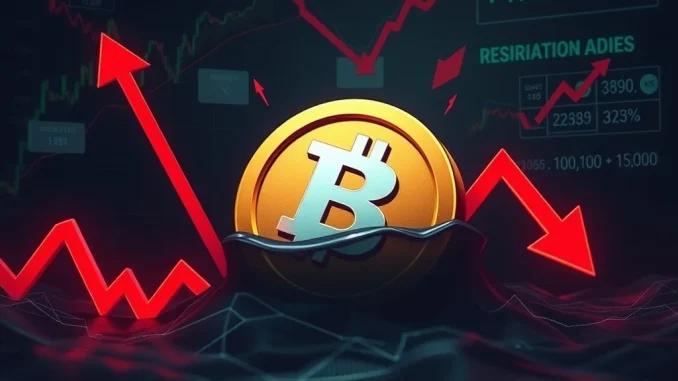
The cryptocurrency market is no stranger to volatility, but the recent dramatic decline of the VIRTUAL token has sent ripples through the digital asset space. Investors are grappling with a sharp 20% weekly plummet, questioning the token’s resilience and its path to recovery. This significant downturn is not isolated, but rather a complex interplay of bearish market dynamics, particularly intensified by pressures from the derivatives market and substantial DeFi outflows.
Understanding the Derivatives Market Pressure
The derivatives market often acts as an early indicator of shifting sentiment, and for the VIRTUAL token, its signals have been overwhelmingly bearish. A critical factor in the recent decline has been the sustained selling pressure originating from these complex financial instruments. In a single day, liquidity withdrawals from futures contracts tied to VIRTUAL totaled a staggering $9.48 million. This rapid exodus of capital pushed the open interest – the total number of outstanding derivatives contracts – down to $172.21 million, marking a 5.51% drop. Traders, sensing impending volatility or simply opting to de-risk, voluntarily exited positions worth $8.9 million, clearly underscoring a growing uncertainty about the token’s short-term trajectory.
Further amplifying concerns, the open interest weighted funding rate, a key metric indicating the cost of holding long or short positions, has plummeted to a near-zero 0.0001%. A funding rate nearing zero suggests a significant weakening of long-term bullish sentiment. Analysts are now closely watching for a potential negative shift in this metric, which could further tilt market positioning toward sellers, thereby amplifying bearish momentum and accelerating the crypto sell-off.
The Impact of Intensifying DeFi Outflows
Beyond the derivatives landscape, the VIRTUAL token has also been significantly impacted by intensifying DeFi outflows. Decentralized finance platforms are typically seen as hubs for liquidity and yield generation. However, a widespread withdrawal of assets from these platforms can severely impact token prices, especially for those deeply integrated into the DeFi ecosystem. For VIRTUAL, the data paints a grim picture: spot DEX volume for VIRTUAL-related assets collapsed from $6.5 million to a mere $650,000 in just seven days. This drastic 90% reduction reflects a sharp decrease in market participation and liquidity, making the token more susceptible to price swings and harder for buyers to enter without moving the market significantly.
When liquidity drains from DeFi protocols, it often signals a broader risk-off sentiment among investors, who might be pulling funds to secure profits, cut losses, or reallocate to less volatile assets. This trend not only removes buying pressure but can also trigger cascading liquidations, further exacerbating the downturn for tokens like VIRTUAL.
Why is the Memecoin Sector Underperforming?
VIRTUAL’s market context is also deeply intertwined with the broader memecoin sector. While the memecoin category has seen remarkable gains throughout the month, up 33% overall, VIRTUAL has notably underperformed its peers, registering a 3.45% decline in the past week, according to Artemis data which showed the sector slipping 2.8%. This underperformance highlights VIRTUAL’s susceptibility to broader macro trends affecting speculative assets, including waning speculative demand and reduced trading activity on decentralized exchanges (DEXs).
Memecoins, by their nature, are highly volatile and often driven by community sentiment and social media trends rather than fundamental utility. When the speculative fervor cools, or when broader market conditions become unfavorable, these tokens are often the first to experience sharp corrections. VIRTUAL’s inability to keep pace with the overall memecoin rally suggests specific weaknesses or a loss of investor confidence compared to its counterparts.
Are Large Entities Accumulating or Liquidating VIRTUAL?
Amidst this widespread crypto sell-off, an intriguing development introduces a layer of ambiguity: large entities have reportedly continued to accumulate VIRTUAL token holdings. Arkham Intelligence reported that top exchanges, including Binance and Bybit, have added a substantial $67 million in VIRTUAL holdings. The intent behind these significant moves, however, remains unclear and has sparked debate among market observers.
- Strategic Rebalancing? If this accumulation reflects strategic portfolio rebalancing by institutional players or whales, it could signal underlying confidence in the token’s long-term potential, perhaps viewing the current dip as a buying opportunity.
- Increased Exchange Reserves? Conversely, if these inflows stem from increased exchange reserves, it might presage further selling pressure. Exchanges often increase their reserves to manage risk during periods of high volatility, potentially preparing to liquidate assets or meet withdrawal demands, which could flood the market with more VIRTUAL tokens.
This dichotomy leaves market observers divided on the path forward. The actions of these large entities will be a crucial determinant of VIRTUAL’s near-term stability.
What’s Next for VIRTUAL?
The outlook for the VIRTUAL token is complex and fraught with uncertainty. While some technical indicators suggest a prolonged correction is possible, the lack of fundamental upgrades or significant developments within the Virtual Protocol’s ecosystem limits optimism for a swift recovery. Without a compelling catalyst for renewed demand or structural improvements to the protocol, VIRTUAL’s recovery remains highly contingent on volatile market sentiment and broader external macroeconomic conditions.
Investors should closely monitor several key factors:
- Derivatives Market Trends: A reversal in funding rates or a decrease in selling pressure from futures markets could signal a shift.
- DeFi Liquidity: Any signs of renewed liquidity inflows into VIRTUAL-related DeFi pools would be a positive indicator.
- Memecoin Sector Performance: VIRTUAL’s ability to keep pace or outperform its peers in the memecoin sector will be telling.
- Large Entity Movements: Continued monitoring of whale and exchange activity for clearer signals on their intentions.
In conclusion, the VIRTUAL token faces significant headwinds. Its recovery hinges not just on market sentiment, but on a stabilization of the derivatives market, a reversal of DeFi outflows, and potentially, a clearer signal from large entities regarding their long-term conviction. Until then, caution remains the watchword for investors in this volatile asset.
Frequently Asked Questions (FAQs)
Q1: What caused the recent 20% plummet in the VIRTUAL token’s price?
The VIRTUAL token‘s 20% plummet was primarily driven by sustained selling pressure in the derivatives market, significant liquidity withdrawals from futures contracts, and substantial DeFi outflows, leading to a sharp reduction in market participation and liquidity.
Q2: What do derivatives market indicators like open interest and funding rate tell us about VIRTUAL?
A drop in open interest and a near-zero open interest weighted funding rate for VIRTUAL token indicate weakening long-term bullish sentiment and increased uncertainty among traders. It suggests a tilt towards bearish positioning and potential for further selling pressure.
Q3: How have DeFi outflows impacted VIRTUAL?
Intensifying DeFi outflows have severely impacted VIRTUAL by causing a drastic collapse in spot DEX volume for VIRTUAL-related assets (from $6.5 million to $650,000). This indicates a significant reduction in liquidity and trading activity, making the token more vulnerable to price declines.
Q4: Why is VIRTUAL underperforming the broader memecoin sector?
Despite the overall memecoin sector being up for the month, VIRTUAL has declined, indicating its susceptibility to waning speculative demand and reduced trading activity compared to its peers. This suggests a loss of specific investor confidence or less robust community support relative to other memecoins.
Q5: What is the significance of large entities accumulating VIRTUAL during the sell-off?
The accumulation of VIRTUAL token by large entities introduces ambiguity. It could signal strategic portfolio rebalancing and long-term confidence, or it might indicate increased exchange reserves in preparation for further liquidation, potentially adding more selling pressure to the market.
Q6: What factors are crucial for VIRTUAL’s recovery?
VIRTUAL’s recovery is contingent on a stabilization of the derivatives market, a reversal of DeFi outflows, renewed demand catalysts, and potential structural improvements to the Virtual Protocol. Without these, its recovery remains dependent on volatile market sentiment and external macroeconomic conditions.