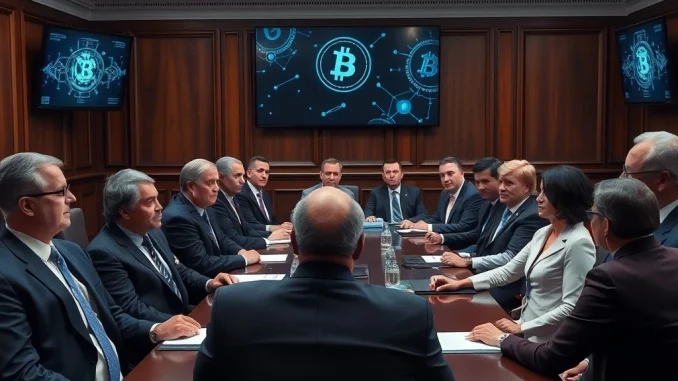
A pivotal moment approaches for the cryptocurrency industry. Representatives from leading global cryptocurrency firms are scheduled to meet with the leadership of the US Senate Banking Committee tomorrow morning. This crucial gathering aims to address the evolving landscape of crypto regulation in the United States. Eleanor Terrett, host of Crypto in America, reported this significant development, citing multiple reliable sources. The discussions will cover critical areas, including the approach to classifying digital assets and the treatment of decentralized finance (DeFi).
US Senate Banking Committee to Tackle Digital Asset Classification
The upcoming meeting holds immense importance. One primary topic on the agenda is the committee’s stance on digital asset classification. Currently, a lack of clear guidelines creates significant uncertainty for crypto firms. Regulators often debate whether specific cryptocurrencies qualify as securities or commodities. This distinction carries profound implications for oversight bodies. The Securities and Exchange Commission (SEC) typically oversees securities, while the Commodity Futures Trading Commission (CFTC) handles commodities. Furthermore, differing interpretations create a complex regulatory environment. This meeting seeks to provide clarity on these vital definitions.
The Significance of Classification for Crypto Regulation
Proper classification is not merely a technicality. It dictates which regulatory body has jurisdiction. Moreover, it impacts how crypto projects operate within the US legal framework. For instance, if a digital asset is deemed a security, it falls under strict SEC registration and disclosure requirements. Conversely, if it is a commodity, it faces different rules. The current ambiguity often hinders innovation and deters investment. Therefore, the US Senate Banking Committee hopes to establish a more consistent framework. Industry leaders eagerly await clearer guidance on this front.
Addressing the Complexities of DeFi
Another key discussion point involves the treatment of DeFi. Decentralized finance represents a rapidly growing sector within the crypto ecosystem. DeFi platforms offer financial services without traditional intermediaries. These services include lending, borrowing, and trading. However, their decentralized nature presents unique challenges for regulators. Identifying responsible parties and enforcing compliance becomes difficult. The committee will explore potential regulatory approaches for this innovative space. They must balance fostering innovation with protecting consumers.
Navigating Regulatory Paths for Decentralized Finance
Regulating DeFi requires careful consideration. Traditional financial regulations may not directly apply to these new models. Lawmakers must understand the technology’s nuances. They aim to prevent illicit activities without stifling legitimate development. The discussion will likely explore various strategies. These could include licensing requirements for certain DeFi protocols or enhanced transparency measures. Ultimately, the goal is to integrate DeFi safely into the broader financial system. The outcome of these discussions will shape the future of decentralized applications.
Crypto Executives Advocate for Clearer Crypto Regulation
Leading crypto executives will represent the industry’s perspective. They advocate for clear, consistent, and innovation-friendly crypto regulation. These firms operate globally and seek a level playing field. They understand the need for investor protection. However, they also emphasize the importance of technological advancement. Their input is crucial for developing practical policies. These executives will share insights on how current regulations impact their operations. They will also propose solutions that support both growth and compliance. Their collective voice aims to influence future legislative efforts positively.
Key Issues Beyond Classification and DeFi
The meeting will likely extend beyond just classification and DeFi. Other critical issues will probably emerge. These may include stablecoin regulation, consumer protection, and market integrity. The committee will also discuss anti-money laundering (AML) and know-your-customer (KYC) compliance. Tax implications of digital assets are another ongoing concern. Furthermore, discussions could touch upon the role of central bank digital currencies (CBDCs). All these elements contribute to the broader landscape of crypto regulation. The comprehensive dialogue seeks to establish a robust framework.
The Role of the US Senate Banking Committee
The US Senate Banking Committee plays a vital role in shaping financial policy. This committee oversees banking, housing, and urban affairs. Its jurisdiction includes securities, commodities, and insurance. Therefore, its engagement with the crypto industry is highly significant. The committee’s leadership seeks to understand the technology better. They also want to identify potential risks and opportunities. Their objective is to craft legislation that safeguards investors and promotes responsible innovation. This meeting represents a proactive step towards achieving regulatory clarity. It signals a serious commitment to addressing these complex issues.
This high-level dialogue signifies a critical juncture for the digital asset space. The discussions between crypto executives and the US Senate Banking Committee leadership could lay the groundwork for future legislation. Industry participants hope for a path towards greater certainty. This will undoubtedly foster innovation and ensure robust consumer protection. The outcome of tomorrow’s meeting will provide valuable insights into the direction of US crypto regulation.
Frequently Asked Questions (FAQs)
Q1: Who is meeting with the US Senate Banking Committee leadership?
Representatives from various global cryptocurrency firms are scheduled to meet with the leadership of the U.S. Senate Banking Committee. These include prominent crypto executives.
Q2: What are the main topics of discussion?
The primary topics include the committee’s approach to digital asset classification (i.e., whether they are securities or commodities), the regulatory treatment of decentralized finance (DeFi), and other key issues related to crypto regulation.
Q3: Why is digital asset classification important?
Digital asset classification determines which regulatory body (e.g., SEC or CFTC) has jurisdiction over a particular cryptocurrency. This distinction impacts how crypto projects must comply with legal and financial regulations, affecting their operations and market access.
Q4: What is DeFi, and why is it a concern for regulators?
DeFi, or decentralized finance, refers to financial applications built on blockchain technology without traditional intermediaries. Regulators are concerned about DeFi due to its decentralized nature, potential for illicit activities, consumer protection issues, and the challenge of applying existing financial regulations to new, permissionless systems.
Q5: What could be the potential outcomes of this meeting?
This meeting could lead to clearer guidelines for the crypto industry, inform future legislative proposals, and foster ongoing dialogue between lawmakers and industry leaders. It aims to create a more predictable and stable regulatory environment for digital assets in the US.